
Forget luck. Learning how to make a YouTube video go viral isn't about catching lightning in a bottle—it's about mastering a repeatable formula. The whole game boils down to creating content that hits people right in the feels, optimizing every last detail for clicks and watch time, and knowing how to play the Shorts game to tap into a massive new audience.
Cracking the YouTube Virality Code

That dream of "going viral" feels like a lottery ticket, right? The truth is, it’s far less about random chance and much more about understanding what makes both humans and the YouTube algorithm tick. Virality isn't just about a big view count; it's about view velocity. It’s about how many views you can stack up in a ridiculously short amount of time.
Think about it: a video that pulls in 100,000 views in the first 24 hours sends a massive signal to the algorithm. It's a much louder signal than a video that slowly trickles its way to a million views over a year. That initial explosion tells YouTube, "Hey, people are loving this right now," which makes the platform want to show it to even more people. Getting a handle on the key YouTube statistics is the first real step to cracking this code.
The Metrics That Matter to the Algorithm
When deciding if a video is worth pushing, the algorithm is obsessed with two main signals above all else:
- Click-Through Rate (CTR): This is simple. Of all the people who see your thumbnail and title, what percentage actually clicks to watch? A high CTR is proof that your packaging is irresistible.
- Audience Retention: Once they click, how long do they stick around? High retention tells YouTube that your video delivers on the promise of its title and thumbnail, which means you're helping keep users on the platform longer. And YouTube loves that.
"The more clicks you get, the better YouTube's algorithm will love you for it. Once they've clicked on your video, you need to make sure they're staying around for as long as possible… That's called your retention and YouTube's algorithm loves a video with high retention."
This is the feedback loop that powers a viral hit. A killer CTR brings waves of people in, and great retention keeps them glued to the screen. That tells the algorithm to show it to even more people, which drives the CTR up again. It's a self-feeding engine.
The Emotional Triggers That Get People Sharing
But metrics are only half the story. The content that truly goes viral almost always plugs directly into powerful human emotions. Research consistently shows that content sparking high-arousal emotions gets shared the most. We're not just talking about simple happiness or sadness, but more intense feelings like:
- Awe and Wonder: Content that's so breathtaking it expands how someone sees the world.
- Laughter and Joy: Genuinely funny or heartwarming videos are universally shareable.
- Surprise and Curiosity: Videos that have an unexpected twist or finally answer a question everyone's been asking.
Your job is to make a video so compelling that viewers feel a genuine urge to hit the share button and show it to someone. That’s how you get organic reach that snowballs. If you want to get better at spotting these opportunities, check out our guide on https://shortsninja.com/blog/how-to-find-viral-trends-from-competitor-videos/.
When you start focusing on these core principles, you stop hoping for a lucky break and start engineering your own success.
Mastering the First Five Seconds

The battle for a viewer's attention isn't won in minutes. It's won or lost in the blink of an eye. You don't have thirty seconds to prove your video is worth watching; you have about five.
If you can't immediately convince someone they’ve landed in the right place, they’ll swipe away without a second thought. And just like that, another potential viral hit vanishes into the algorithm's abyss.
That initial moment is everything. It's your handshake with the viewer, a direct promise that sticking around will be worth their time. Your hook isn't just a flashy intro—it's a contract that sets the expectation for the entire video.
Proven Hook Formulas That Work
Forget the long, branded intros or a slow, meandering build-up. Viral videos dive straight into the action. Your only goal is to spark an immediate sense of urgency or curiosity that makes leaving feel impossible.
Here are a few battle-tested hook formulas I've seen work time and time again:
- Start with the Climax (In Medias Res): Drop the viewer right into the most exciting part of your video. Show the finished product, the final result, or the peak of the action, then spend the rest of the video explaining how you got there. A video titled "I Built a Secret Room in My House" should open with the hidden door swinging open, not with a trip to the hardware store.
- Pose an Unignorable Question: Frame your video around a question that taps into a common pain point or a deep-seated curiosity. A question like, "Are you making these three mistakes that are killing your channel?" instantly forces a creator to self-reflect and stick around for the answer.
- Present a Shocking Statistic or Bold Claim: Hit them with a number or a statement so surprising they have to see the proof. Starting with, "This one simple tweak boosted my views by 500% in just one week," is way more compelling than a generic, "Hey guys, welcome back to my channel."
The secret sauce here is creating what’s known as an open loop. By showing a result without the process, or asking a question without the answer, you create a psychological itch that viewers feel compelled to scratch by watching through to the end.
Virality on YouTube is less about luck and more about math. The algorithm relentlessly promotes videos with high watch time. With over 500 hours of video being uploaded every minute, grabbing attention immediately is not just an option; it's a survival tactic.
Aligning Your Hook With Your Title and Thumbnail
Your hook doesn't exist in a vacuum. It's the final piece of a three-part puzzle that starts with your title and thumbnail. This trio has to tell a single, cohesive story.
If your thumbnail shows a massive explosion, your title teases a "failed experiment," and your first five seconds show you calmly mixing ingredients, you've created a massive disconnect.
This is a surefire way to lose viewer trust and absolutely tank your audience retention. The viewer clicked because of a specific promise, and your hook has to start delivering on that promise immediately. This alignment is what sends all the right signals to the YouTube algorithm, telling it that your video is satisfying the audience's intent.
The numbers don't lie. Virality is math, and the algorithm is obsessed with watch time. Videos that manage to hold viewers for 50 seconds or more pull in an average of 4.1 million views, while those with shorter watch times fade away. With a billion hours of content consumed daily and 70% of that coming from recommendations, holding attention is your superpower. You can learn more about the powerful video marketing statistics that drive YouTube's engine, but it all starts here. Nailing that initial hook is your first real step toward earning the watch time that fuels a viral hit.
Using YouTube Shorts as a Virality Shortcut

If your long-form videos are a slow-burning campfire, then Shorts are the wildfire that can spread your channel across the entire platform. One of the biggest mistakes I see creators make is treating Shorts as an afterthought. They aren't just chopped-up long-form content; they are arguably the single most powerful growth engine YouTube has right now for getting in front of millions of people who've never heard of you.
Shorts tap into a totally different viewer mindset. The feed is a rapid-fire, endless scroll where attention is measured in split seconds. People are there for a quick hit of entertainment or a fast solution, and if your content doesn't deliver instantly, they've already swiped past.
Understanding this is everything. You're not just competing against other videos; you're competing against the viewer's thumb. This means slick production value often takes a backseat to raw, immediate engagement and a relentless posting schedule.
Mastering the Shorts Feed Psychology
The beauty of the Shorts algorithm is that it's built for discovery. Unlike the main YouTube feed, which is heavily influenced by who you're subscribed to, Shorts are served up based on viewing habits. This is your golden ticket to break out of your subscriber bubble and reach a massive new audience.
To win here, you have to think differently:
- Jump on Trending Audio: Sound is the lifeblood of the Shorts feed. Using a trending song or audio clip gives your video an immediate algorithmic boost because YouTube wants to show it to everyone else who's engaging with that sound.
- Tell a Story Visually: A huge chunk of viewers watch with the sound off. Can your video still land its punchline or deliver its core message with just visuals and text? This isn't a "nice-to-have"; it's a must.
- Use Bold Text Overlays: Bright, easy-to-read text hooks are non-negotiable. They act as your title and hook all in one, stopping the scroll and explaining the video's premise before the viewer's brain has even processed the visuals.
A perfect example is a cooking Short. It doesn't start with a long intro. It starts with a close-up of sizzling food and bold text saying, "3-Ingredient Dinner in 5 Minutes." It's immediate, it solves a problem, and it's visually satisfying even on mute.
The scale here is just staggering. YouTube Shorts now pull in over 70 billion daily views. That's not a typo. Since their launch, they've racked up over 5 trillion total views with an engagement rate of 5.91%, which is actually higher than both TikTok and Instagram Reels. If you're not taking this format seriously, you're leaving massive growth on the table.
Building a Scalable Shorts Workflow
The brutal reality of the Shorts feed is that it demands volume. Posting once a week just isn't going to cut it. The algorithm rewards consistency, and the most successful channels are often posting multiple times per day. For most creators, that sounds like an impossible grind.
This is where you have to get smart with your workflow. You can't spend hours editing every 30-second clip. You need a repeatable system.
This is especially true for the faceless channels that are absolutely exploding on Shorts. You can build an entire viral brand around content that never shows your face. If you want to get into the nuts and bolts, our guide on the best practices for uploading YouTube Shorts is a great place to start. This is how you go viral without burning out.
The Power of AI in Shorts Creation
The need for high-frequency posting has created a perfect opening for AI tools to completely change the game. Platforms like ShortsNinja were built to solve this exact problem, turning a soul-crushing task into a streamlined, automated operation.
Picture this workflow:
- Idea to Script: You come up with one solid topic. An AI tool can instantly spit out multiple script variations, each with a different hook to test.
- Automated Visuals: Instead of spending hours hunting for B-roll, the AI generates unique video clips and visuals that perfectly match the script's pacing.
- Realistic Voiceovers: Professional-sounding AI voices in any language can be applied in seconds, opening you up to a global audience.
- Effortless Publishing: The finished Shorts are automatically scheduled and published to your channel, keeping your posting cadence locked in without you even touching it.
This approach transforms your strategy from a manual slog into an automated growth machine. You can take one successful long-form video concept and use AI to generate dozens of high-quality, faceless Shorts from it. Each one is a new lottery ticket for hitting that viral jackpot. This isn't just about saving time; it's about exponentially multiplying your chances for discovery.
Optimizing Your Videos for Maximum Discovery
You can pour your heart and soul into making the perfect video, but if nobody sees it, it’s like it never existed. Once you’ve nailed the hook and structured your content to keep people watching, the next battle is getting them to click in the first place. This is where you graduate from basic SEO to the art of packaging your video to be absolutely irresistible.
Think of your video's title and thumbnail as its movie poster. This one-two punch is the single biggest factor driving your Click-Through Rate (CTR), a metric YouTube's algorithm obsesses over. A high CTR tells YouTube your content is magnetic, and it'll start showing it to more and more people.
Crafting Titles That Blend Search and Intrigue
A killer YouTube title has to do two jobs at once: satisfy the search algorithm and spark human curiosity. Just cramming keywords into your title is an old-school tactic that screams "I'm trying too hard," and viewers see it from a mile away. The real goal is to write something that feels natural, promises a solution or a compelling story, and makes someone feel like they have to know more.
Just look at the difference:
- Keyword-Stuffed: How to Go Viral on YouTube SEO Tips 2024
- Intrigue-Focused: The SEO Mistake That's Killing Your YouTube Views
The second one still hits relevant keywords ("YouTube Views," "SEO"), but it wraps them in a mystery. It creates what’s called an "open loop," making the viewer wonder, "Wait, am I making that mistake?" That little bit of psychological tension is infinitely more powerful than a dry list of terms.
A study of viral content found that headlines triggering strong emotions—both positive (like awe) and negative (like anxiety)—get shared and clicked far more often. If your title pushes an emotional button, you're on the right track.
The Anatomy of a High-CTR Thumbnail
On the crowded highway of the YouTube homepage, your thumbnail is your billboard. It has less than a second to grab someone's attention and scream what your video is all about. While your title can afford some nuance, your thumbnail needs to be loud, clear, and emotional.
Here are the non-negotiable parts of a thumbnail that actually works:
-
Emotional Faces: We're hardwired to connect with other human faces. A thumbnail showing a clear, expressive emotion—shock, joy, confusion—creates an immediate connection and makes the video feel more human.
-
Vibrant, Contrasting Colors: Your thumbnail can't blend in with YouTube’s red, white, and black interface. Use bright, saturated colors that pop off the screen. Think about using complementary colors, like a pop of orange on a blue background, to create visual friction that draws the eye.
-
Minimalist, Bold Text: If you use text, keep it to three or four powerful words, max. Use a thick, easy-to-read font that has a strong contrast with whatever is behind it. The text should add to the title, not just repeat it—often by highlighting the most shocking or interesting part of the video's promise.
This is a prime area where AI automation tools can be a secret weapon, helping you brainstorm and generate visuals that are already proven to perform.
As you can see, tools like ShortsNinja let you drop in an idea and let the AI do the heavy lifting—from scripting to generating visuals and even adding voiceovers.
This screenshot shows just how simple it can be. A text prompt becomes the seed for an entire video, radically simplifying the whole optimization process.
Using Descriptions and Tags for Context
While your title and thumbnail are for your viewers, the description and tags are mainly for the algorithm. This is your chance to give YouTube the extra context it needs to figure out what your video is about and who the right audience is.
The first two or three sentences of your description are the most valuable because they show up in search results. Make sure they include your main keyword and give a clear, compelling summary of what the viewer will get. Below that, feel free to add more details, timestamps, and links to other resources or videos.
Tags aren't as powerful as they used to be, but they still help. Use them to list different versions of your main keyword, related topics, and other phrases people might search for to find your content. Think of them as little signposts guiding the algorithm in the right direction.
When you master this trifecta—title, thumbnail, and metadata—you give your video its best shot at getting discovered, clicked, and ultimately, going viral.
Scaling Your Success with AI and Automation
Going viral is a rush. But keeping that momentum going? That’s a whole different ballgame. The hard truth is, the YouTube algorithm doesn't care about one-hit wonders; it rewards consistency. To build a real, growing channel, you need a system for churning out high-quality content without burning yourself out.
This is where you bring in the machines.
It’s not about letting AI take over your creativity. Think of it as augmenting your best ideas. By handing off all the repetitive, soul-crushing tasks to automation, you free up precious time to focus on strategy, engaging with your community, and dreaming up the next big idea.
Building an Automated Content Engine
What if you could schedule a month's worth of YouTube Shorts in a single afternoon? That’s not a pipe dream anymore. Creators who build smart, automated workflows are already doing it. The goal is to set up a production line that hums along in the background, freeing you up completely.
Here’s what that looks like in practice:
- AI-Powered Brainstorming: Stuck staring at a blank screen? Feed a single topic to an AI and get back dozens of video ideas, hooks, and script outlines. It’s the ultimate cure for creator's block and lets you test more concepts, faster.
- Automated Scriptwriting: Once you’ve picked a winning idea, AI can flesh it out into a full script, perfectly formatted for a Short or long-form video. You just swoop in at the end to add your personal flair.
- AI Visual and Voice Generation: This part is a complete game-changer, especially for faceless channels. Tools can now whip up entire videos with slick AI visuals and surprisingly realistic voiceovers in minutes. This used to take hours of digging through stock footage and recording audio.
"Take time to understand how YouTube’s algorithm works so you can leverage it to get your content in front of the right people at the right time. You should also make your video engaging enough for people to hang around to the end."
That quote hits the nail on the head. The core challenge is making great content, consistently. Automation is what makes the kind of frequency the algorithm loves possible, without watering down the engagement that keeps people watching.
Ultimately, this is all about feeding the algorithm the signals it craves. Your title, thumbnail, and tags are the gatekeepers that get you discovered in the first place.
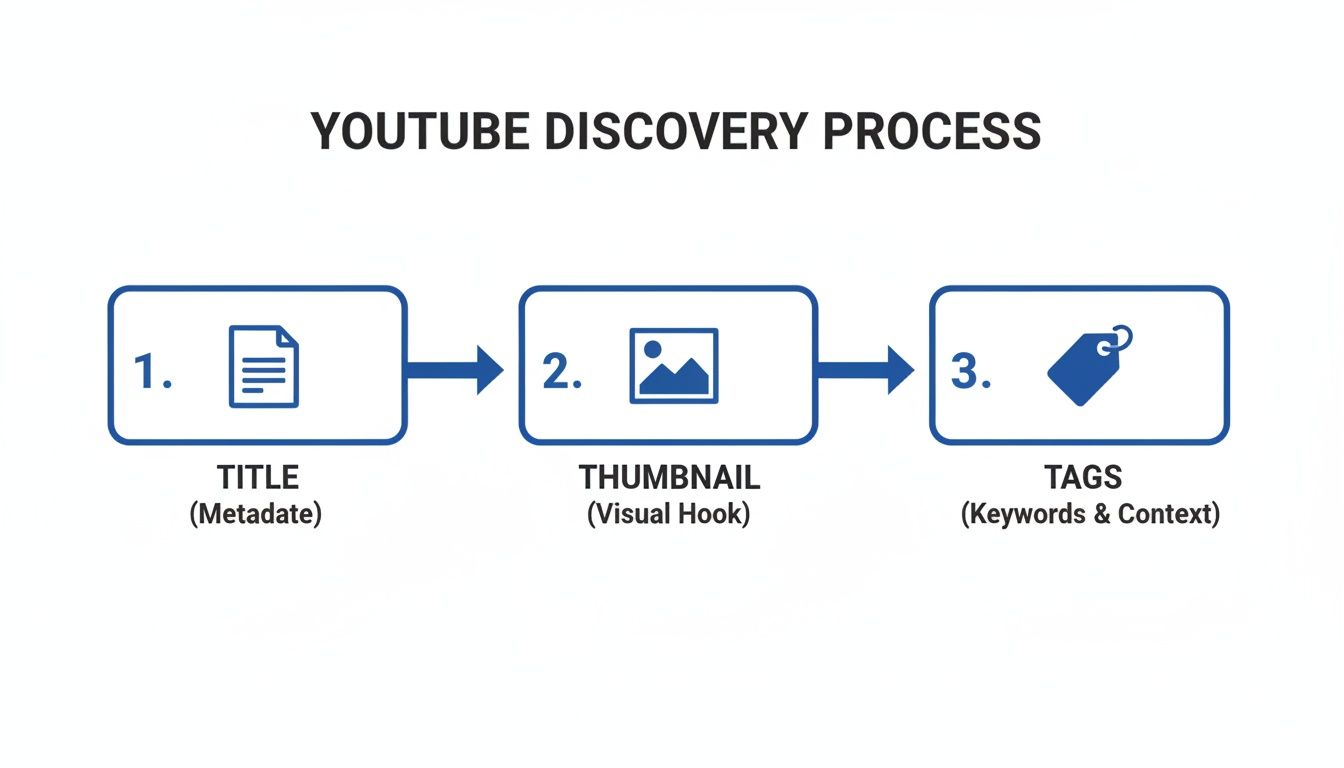
As you can see, these three elements are your first impression. The right AI tools can help you nail all of them, every single time.
Why Platforms Like ShortsNinja Are Essential
Sure, you could try to manually stitch together different AI tools for scripting, visuals, and voiceovers, but that’s clunky and slow. That’s why integrated platforms are becoming non-negotiable for serious creators. A tool like ShortsNinja brings the entire workflow under one roof. You can literally go from a simple text prompt to a fully produced, scheduled video in minutes.
This kind of efficiency changes the entire game.
Instead of grinding all day on one video, you can create ten. This lets you A/B test different hooks, styles, and topics at lightning speed, see what works, and immediately double down on your winners. To see this workflow in action, you can learn more about building a fully https://shortsninja.com/blog/automated-youtube-channel/.
As you scale, it’s also smart to look at how AI in sales and marketing can open up new efficiencies beyond just production. By adopting an automation-first mindset, you graduate from being just a content creator to a content strategist, steering a powerful system that works for you 24/7.
Your Questions on Going Viral Answered
Diving into YouTube with dreams of going viral can feel like trying to solve a puzzle in the dark. You've probably absorbed a ton of strategies, but those nagging, specific questions always seem to pop up right when you're about to hit "publish."
Let's clear the air. Think of this as your personal FAQ for sparking that explosive channel growth. We'll tackle the real-world questions about timelines, content styles, and posting frequency that trip up so many creators.
How Long Does It Take for a Video to Go Viral?
There's no magic stopwatch for virality, but the first 24 to 48 hours after you publish are everything. This is when the YouTube algorithm is intensely watching for what I call "viral velocity"—a sudden, rapid spike in views that tells it your content is hitting a nerve right now.
A YouTube Short can take off like a rocket, sometimes catching fire within just a few hours because of the feed's rapid-fire nature. On the other hand, a longer video might be more of a slow burn, gradually building momentum over several days as the algorithm tests it out with different pockets of viewers.
But here’s the bottom line: it all comes down to the strength of your early engagement. A huge surge in likes, comments, shares, and—most critically—high audience retention sends a blaring signal to YouTube that your video is a winner and deserves a massive promotional push.
This initial burst is what separates a dud from a viral explosion. If your new video is massively outperforming your channel's average in its first few hours, you're on the right track.
Can I Go Viral on YouTube Without Showing My Face?
Absolutely. Not only is it possible, but "faceless" channels are one of the fastest-growing and most successful categories on the platform. Your success has everything to do with the value and engagement you provide, not whether you're on camera.
You can create incredibly captivating viral content without ever pointing a camera at yourself. The options are wide open.
-
Stock Footage and B-Roll: You can weave together powerful visual stories using high-quality stock video.
-
Screen Recordings: This is the gold standard for tutorials, gaming walkthroughs, and any software-focused content.
-
Animations and Motion Graphics: Tools like After Effects or even simpler animation apps can bring any topic to life in a dynamic way.
-
AI-Generated Visuals: This is a game-changer. Modern AI tools can create stunning, unique visuals from just a few words, making faceless content more accessible than ever.
The secret to making faceless content pop is to double down on the things that matter most in these formats: sharp storytelling, crystal-clear audio, and visuals that are so dynamic the viewer can't look away. Niches like history, meditation, finance, and coding tutorials are tailor-made for this approach.
Does Posting Daily Actually Help You Go Viral?
Posting daily, especially with YouTube Shorts, is like buying more lottery tickets—it dramatically increases your odds of hitting the jackpot. Every single video you upload is a fresh chance for the algorithm to grab hold of it and show it to the world. It’s a game of volume.
But it’s also a game of data. A high-frequency posting schedule does more than just signal to YouTube that you're a serious creator. It gives you an incredibly fast feedback loop. By publishing daily, you get to rapidly test:
- Different hooks to see what stops the scroll.
- Various topics and sub-niches to find what resonates.
- New editing styles or visual effects.
- Trending sounds and popular formats.
This firehose of data lets you zero in on what your audience loves and ditch what they don't, way faster than someone who only posts once a week. You can pivot on a dime, double down on the videos showing early signs of life, and seriously accelerate your path to that viral hit.
Ready to stop grinding and start scaling? ShortsNinja uses AI to turn your ideas into dozens of high-quality, faceless videos for YouTube, TikTok, and Instagram in minutes. Automate your content creation and watch your channel grow hands-free. Start creating with ShortsNinja today.