
Making a video go viral on YouTube isn't about luck. It's about engineering. The magic formula is creating highly shareable content that triggers a strong emotional response and then packaging it perfectly for the algorithm.
It all starts with a killer idea, followed by an irresistible hook that grabs viewers in the first three seconds. From there, you need a smart promotion strategy to light the initial fire. Success is never random; it's a repeatable process.
Deconstructing Viral YouTube Videos
So, what really makes a video blow up? It’s way more than just a lucky break. Virality is a calculated game of understanding both human psychology and the YouTube algorithm. The videos that truly take off aren't just watched—they're felt. They get discussed, debated, and shared like crazy, creating a ripple effect that turns into a cultural moment.
The goal isn't just to make "good content." It's to engineer an experience so compelling that viewers feel an almost primal urge to share it.
This guide is your playbook for doing just that. We're breaking down the entire process, covering everything you need to know to make a video go viral on YouTube. We'll get into:
- Viral Idea Generation: How to find topics with built-in, massive appeal.
- Retention-Focused Scripting: The art of structuring your story to keep people glued to their screens.
- Algorithmic Optimization: Mastering the trifecta of titles, thumbnails, and SEO.
- Strategic Distribution: Creating that initial spark that the algorithm loves.
The Core Elements of Virality
At its heart, a viral hit connects with a huge audience on an emotional level. It might be humor that makes them laugh out loud, awe that leaves them speechless, or something so relatable it makes them scream, "That is SO me!" A video that makes you feel something is a video that gets shared.
The competition is insane. As of 2025, YouTube has roughly 2.85 billion monthly active users. And get this—a mind-boggling 500 hours of video are uploaded every single minute. According to data from awisee.com, that's an 8,233% explosion in content since 2007. Standing out is tougher than ever, which means your strategy has to be sharper than ever.
The secret to virality isn't just making a video people want to watch. It's making a video people need to share. That impulse to show it to someone else is the engine of exponential growth.
A Repeatable Process for Success
Creativity is non-negotiable, but a structured process is what dramatically stacks the odds in your favor. Think of it as a roadmap that takes you from a raw concept to a full-blown promotional blitz.
This simple infographic breaks down the core workflow into three critical stages: ideation, creation, and promotion.
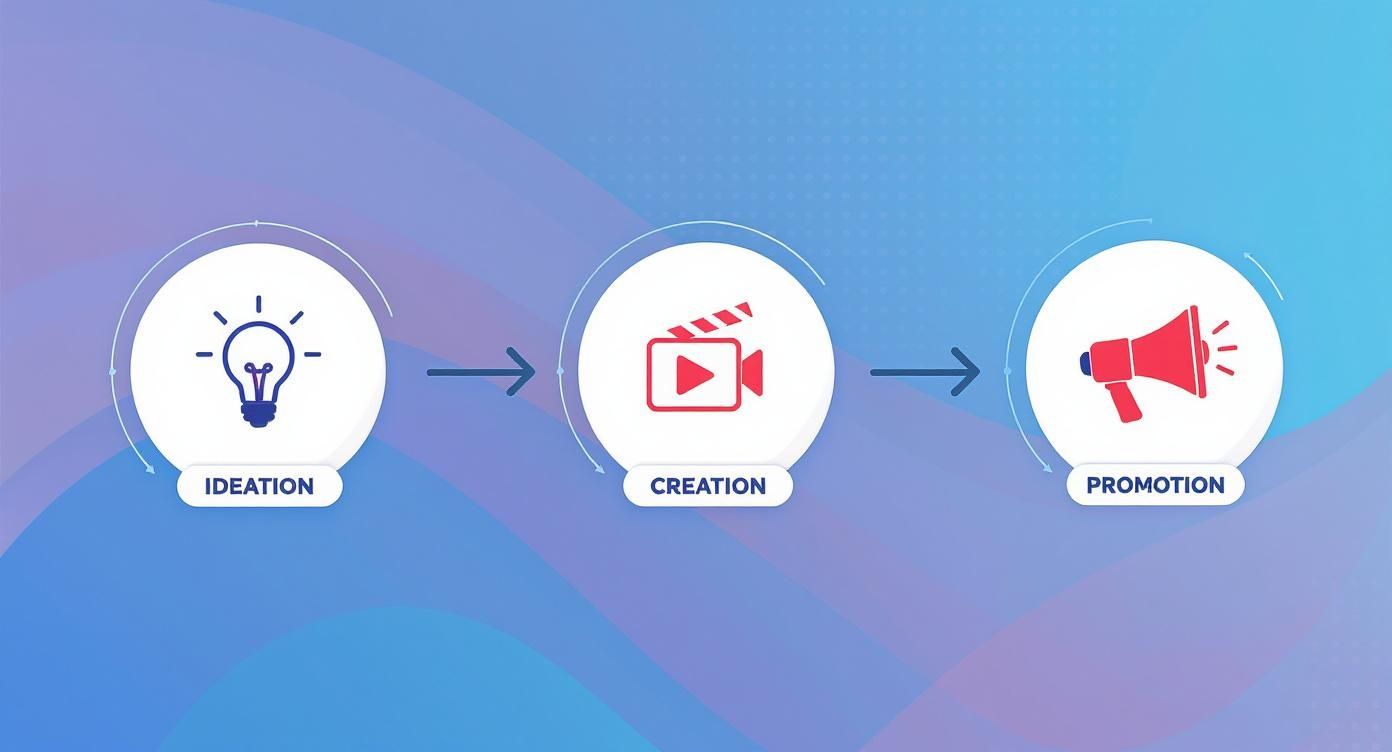
Each stage is built on the one before it. A strong idea makes for an engaging video, and an engaging video is way easier to promote effectively. For example, solid ideation involves seeing what's already crushing it. If you want to dive deeper, our guide on how to find viral trends from competitor videos is a great place to start.
Mastering this workflow turns the chaotic, unpredictable nature of "going viral" into a much more manageable and repeatable strategy. To make this even clearer, here's a quick roadmap summarizing the entire process.
The Viral Video Creation Roadmap
This table outlines the essential stages and focus areas for engineering a viral video, moving from the initial spark of an idea all the way to amplifying its reach across the web.
| Stage | Primary Goal | Key Focus Areas |
|---|---|---|
| Ideation | Discover a high-potential concept | Trend analysis, competitor research, emotional triggers, audience appeal |
| Creation | Produce an engaging, high-retention video | Scripting hooks, visual storytelling, pacing, clear audio, powerful editing |
| Optimization | Package the video for the algorithm | Compelling thumbnail design, SEO-friendly title, strategic description & tags |
| Promotion | Ignite initial momentum and viewership | Cross-platform sharing, community engagement, leveraging existing audiences |
Think of this as your checklist. By nailing each of these stages, you're not just hoping for virality—you're systematically building the foundation for it.
Finding Your Next Viral Video Idea
The entire journey to a viral video hinges on a single, powerful, shareable idea. This isn’t about waiting for a lightning strike of inspiration. It’s a systematic process—a hunt for concepts practically engineered for massive reach from the moment you hit record.
Forget generic brainstorming. The real goal is to find that sweet spot where current trends, timeless human appeal, and your own unique spin all collide. That intersection is exactly where viral potential is born.
Tapping into Current Trends and Conversations
The easiest way to get views is to jump into a conversation that’s already happening. Riding a trend wave gives you an instant audience of curious viewers actively searching for that exact topic. Tools like Google Trends and YouTube’s own trending tab are your best friends here.
But don’t just skim the surface. You have to dig a little deeper:
- What's the real emotion driving this? Is a trend fueled by humor, outrage, curiosity, or nostalgia? Figuring this out helps you craft an angle that truly connects.
- Can I bring a new perspective? Instead of just copying a trend, could you debunk it? Test it to its limits? Or maybe show a behind-the-scenes look nobody else has? A unique take is what makes you stand out.
- Does this trend actually fit my channel? Jumping on a random trend might get you a temporary spike, but it's often empty views from people who will never watch your content again. Stick to trends that make sense for your niche.
For example, when a new smartphone drops, the internet is flooded with basic reviews. Instead of adding to the noise, you could do an extreme durability test or a "10 Hidden Features You Definitely Missed" video. This takes a popular subject and gives it a fresh, irresistible angle.
The Universal Appeal Framework
Trends come and go, but certain human emotions are forever. The most-viewed videos of all time tap into these core feelings, making them relatable to a global audience. I call this the "Universal Appeal Framework."
Your idea should connect with at least one of these powerful emotional triggers:
- Awe and Wonder: Content that shows off something incredible, beautiful, or just plain mind-boggling. Think stunning drone footage, unbelievable science experiments, or people with extraordinary talents.
- Humor and Relatability: Videos that make people laugh and think, "That is so me!" This can be anything from comedy sketches and funny animal clips to sharing everyday frustrations everyone understands.
- Inspiration and Positivity: Stories of someone overcoming the odds, heartwarming moments, or simple acts of kindness. This stuff creates a powerful feel-good response that people love to share.
- Curiosity and Surprise: Ideas that present a mystery, challenge a common belief, or have an unexpected twist that keeps viewers hooked right to the very end.
An idea doesn't need to be complex to be powerful. Often, the simplest concepts that evoke a strong, universal emotion are the ones that travel the furthest.
Music videos are a perfect example of this framework in action. They absolutely dominate YouTube's most-viewed list by tapping into universal themes like love, celebration, and rhythm. The kids' song "Baby Shark Dance" holds the all-time record with over 16.3 billion views as of 2025. In the same way, massive hits like "Despacito" (8.8 billion views) and "Gangnam Style" (5.7 billion views) prove how catchy, culturally transcendent content can become a global phenomenon. You can dig deeper into why these types of videos get so many eyeballs over at creamyanimation.com.
Validating Your Idea Before You Record
Before you sink hours into filming and editing, you need to validate your idea. This one step is what separates the hopeful creators from the strategic ones. Your goal is to find cold, hard evidence that people are actually interested in your concept.
Start by searching for your video idea on YouTube. Look at the top-ranking videos. Are they pulling in millions of views? That's a fantastic sign. Pay close attention to the titles, thumbnails, and especially the comment sections of these successful videos to see what viewers are buzzing about.
| Validation Method | What to Look For | Actionable Insight |
|---|---|---|
| YouTube Search | High view counts on similar topics, strong like-to-dislike ratios. | Confirms there's an existing audience and gives you a benchmark for success. |
| Competitor Analysis | A creator in your niche had a breakout video on this exact topic. | Shows the topic resonates specifically with the audience you're trying to reach. |
| Community Feedback | Ask your existing audience on the Community Tab or other social media. | Gauges direct interest and can even help you fine-tune the video's angle based on their input. |
If you find a topic with proven interest but notice a gap in how it’s being covered—maybe everyone’s making long, boring videos and you can make a short, punchy one—that’s your sweet spot. That’s your opening to step in, offer a better or different take, and capture a massive audience that's hungry for more. This process turns brainstorming from a guessing game into a data-backed strategy for your next viral hit.
Scripting for Maximum Watch Time and Shares

A viral idea is just the spark. Your script is the blueprint that turns that spark into a wildfire, creating an experience that glues viewers to their screens. Without a tight, strategic script, even the most brilliant concepts fall flat. Viewers drop off, signaling to the YouTube algorithm that your video isn't worth anyone's time.
The battle for attention is won or lost in the blink of an eye. You have maybe three seconds to convince someone your video is worth watching. A weak opening is a death sentence for your watch time, one of the most critical metrics for going viral.
The First Three Seconds: Your Most Important Real Estate
Think of your hook as a powerful promise. It has to immediately deliver what the viewer came for or present a mystery so compelling they have to see it solved. Never waste this precious time with long, branded intros or the classic "Hey guys, welcome back to the channel."
Jump straight into the action or lead with a bold statement. MrBeast is a master of this. He’ll often start his videos with the most dramatic clip or just flat-out state the video's premise. For a video titled "I Survived 50 Hours in Antarctica," the first shot is him in the snow, saying, "I'm spending the next 50 hours in Antarctica." It's direct, it confirms the viewer made the right click, and it hooks them instantly.
Here are a few hook formulas I've seen work time and time again:
- The Transformation Teaser: Show the jaw-dropping "after" before you even hint at the "before." If it's a DIY video, lead with the stunning final product.
- The Controversial Statement: Open with a claim that challenges a common belief. It forces the viewer to stick around to see how you back it up.
- The Unanswered Question: Pose a direct question that your video promises to answer. This creates an open loop in the viewer's mind they'll feel a need to close.
Structuring Your Script for Engagement
Once they're hooked, your script's job is to keep the momentum going. A framework that works like a charm for this is the Problem-Agitation-Solution (PAS) model. It's wildly effective because it taps directly into your viewer's pain points and desires.
- Problem: Kick things off by clearly identifying a problem your audience actually has. This creates immediate relatability.
- Agitation: Don't just state the problem—poke the bruise. Dig into the frustrations and negative feelings that come with it, making the viewer feel completely understood.
- Solution: Finally, position your video as the clear, actionable solution they've been looking for. This makes the payoff at the end feel earned and incredibly valuable.
This structure is flexible enough for almost any content, from tutorials to vlogs. For a travel vlog, the "problem" could be the overwhelming stress of planning a trip. The "agitation" is the fear of missing out on hidden gems. The "solution" is your perfectly curated itinerary. For those just starting out, we have an in-depth guide covering the fundamentals of script writing for beginners that can help you nail these frameworks.
The best scripts don't just present information; they craft a narrative journey. Even a simple "how-to" video should have a beginning (the problem), a middle (the process), and a satisfying end (the result).
Engineering Shareability into Your Content
Making a video people finish is one challenge. Making one they feel compelled to share is how you actually go viral on YouTube. Shareability isn't an accident—it's designed. People share content that reinforces their own identity, makes them look smart, or triggers a powerful emotion.
Your script needs a powerful Call-to-Share (CTS), and I'm not talking about a lame "please share this video." A great CTS is woven directly into the fabric of the content.
| CTS Tactic | How It Works | Example |
|---|---|---|
| The "Send This To" Prompt | Directly tell the viewer who in their life needs to see this video. | "If you know someone who is always complaining about their messy desk, send this video to them right now." |
| The Identity Trigger | Frame the video as a badge of honor for a specific group of people. | "Only true coffee lovers will understand the struggle. Share this if you're one of them." |
| The Emotional Spark | Connect the act of sharing to a positive feeling, like helping someone or making them laugh. | "If this video made you smile, share it to brighten someone else's day." |
The goal is to make sharing feel like a natural extension of watching the video. By scripting these moments in, you turn your audience from passive viewers into active promoters. This is the kind of strategic scripting that transforms a good video into a viral one, driving both the watch time and the shares that fuel explosive growth.
Modern Production with AI-Powered Workflows
The old barriers to creating high-quality video have completely disappeared. You no longer need a fancy camera, an expensive lighting rig, or years of editing experience to produce content that looks and sounds incredible. Modern tools, especially AI-powered platforms, are making it possible to create killer videos faster and more efficiently than ever.
This shift is huge. It means you can test ideas rapidly without sinking a ton of time or money into them. The key is building a smart workflow that lets you focus on what really matters—the idea, the script, the story—while automation handles the heavy lifting. This is especially true if you're creating faceless content or YouTube Shorts at scale, where speed is everything.
The Rise of AI-Assisted Creation
AI video creation isn’t about replacing creativity; it’s about amplifying it. Think of these tools as a production assistant that works for you 24/7. They can take a simple text prompt and spit out a script, find the perfect background clips, generate a realistic human-sounding voiceover, and even add captions and music.
For creators wanting to experiment with different niches, this is a total game-changer. Instead of spending a full day shooting and editing a single video, you can now generate several different versions in under an hour. This lets you A/B test topics, hooks, and styles to see what actually connects with your audience before you go all-in on a big production.
Platforms like ShortsNinja are built around this exact principle. You start with a basic idea, and the AI helps you flesh out a script, generate the visuals, and produce a video that’s ready to publish in minutes. That kind of speed is a massive advantage when you’re trying to go viral, as it lets you jump on trends while they’re still red hot.
Key Use Cases for AI in Your Workflow
Bringing AI into your production process opens up a world of possibilities. It’s not just about moving faster; it's about unlocking entirely new content styles that might have been too expensive or time-consuming before.
Here are a few powerful ways to put AI to work:
- Faceless Content Channels: You can build entire channels around topics like history, finance, or meditation without ever showing your face. AI can generate all the visuals and voiceovers, leaving you to focus on the research and scripting.
- Rapid Short-Form Video Production: Turn a single long-form video into dozens of YouTube Shorts or TikToks. AI tools can pinpoint the most engaging moments, reformat them for vertical viewing, and add trendy captions and music automatically.
- Idea Validation: Got a dozen video ideas? Quickly turn them into simple, short videos. Post them and let the audience data tell you which concepts are actually worth developing into longer, more polished content.
The biggest advantage of an AI workflow is the ability to decouple your time from your output. Your capacity to create is no longer limited by the hours in a day, but by the strength of your ideas.
To really speed up your video creation and generate visually stunning content, it's worth exploring advanced AI video generators like Wan2.2 GGUF. These tools are getting incredibly sophisticated and offer more and more control over the final look and feel of your videos.
Traditional vs AI-Assisted YouTube Production
The difference between the old way of making videos and the new AI-assisted approach is pretty stark. One requires specialized skills and expensive gear, while the other prioritizes creativity and speed. To see what I mean, let's break it down.
Traditional vs AI-Assisted YouTube Production
| Aspect | Traditional Production | AI-Assisted Production |
|---|---|---|
| Time Investment | Hours or days per video | Minutes per video |
| Required Skills | Filming, lighting, audio engineering, video editing | Scriptwriting, creative direction, prompt engineering |
| Equipment Cost | High (camera, microphone, lights, software) | Low (primarily subscription-based software) |
| Output Volume | Low to moderate | High |
| Ideal For | High-production vlogs, documentaries, cinematic content | Faceless content, Shorts, news updates, listicles, educational clips |
This isn't about one being "better" than the other. In fact, many of the most successful creators use a hybrid approach. They might film their main talking-head shots the old-fashioned way but then use AI to quickly generate engaging B-roll, create animated explainer segments, or produce promotional clips for social media.
Ultimately, the goal is the same: produce high-quality, engaging content that grabs and holds your viewer's attention. By embracing modern, AI-powered workflows, you give yourself the ability to do that more consistently and with fewer resources, which dramatically increases your chances of creating a video that really takes off.
Mastering YouTube SEO for Discoverability
Let’s be real: you can create the most incredible video in the world, but if no one finds it, it might as well not exist. YouTube is the planet's second-biggest search engine, so learning to play by its rules isn't just a good idea—it's non-negotiable if you want to go viral.
Think of it this way: without a solid SEO strategy, you’re just throwing content into the void and hoping for the best. A smart approach to keywords, titles, and descriptions turns that hope into a repeatable system for getting discovered.
Uncovering High-Traffic Keywords
First things first. Before you even dream up a title, you need to get inside the head of your audience. What are they actually typing into the YouTube search bar? This is keyword research, and it’s the bedrock of your entire SEO game.
This is where tools like TubeBuddy and VidIQ become your best friends. They plug right into YouTube and give you the inside scoop on search volume versus competition. The goal is to find that sweet spot: search terms with a ton of interest but not a ton of creators fighting over them. That's your opening.
For instance, trying to rank for "how to invest" is like trying to win a shouting match in a stadium. You’ll get drowned out. A much smarter move is targeting a long-tail keyword like "how to start investing with little money in your 20s." The audience is smaller, but they’re highly specific, and your chances of hitting that #1 spot skyrocket.
Crafting Titles That Demand a Click
Your title and thumbnail are a tag team. They're the first—and often only—chance you get to convince someone to watch your video instead of the ten others in their feed. And it's no joke: research shows that a whopping 90% of top-performing videos use a custom thumbnail.
A killer title has to do two jobs at once: satisfy the search algorithm and pique human curiosity. It needs to include your main keyword, but it can't be boring. It has to spark an emotion or a question.
| Title Type | Example | Why It Works |
|---|---|---|
| Generic | My Trip to Japan | Vague, forgettable. Offers zero value. |
| Optimized | I Tried the 7 Craziest Vending Machines in Tokyo | Specific, uses a number (people love lists!), and creates instant intrigue. |
The key is to make a promise your video can keep. Don't fall into the trap of misleading clickbait; it’ll tank your watch time when viewers leave in frustration, and that kills your channel’s reputation.
Your title and thumbnail are your video's billboard. If they don't grab attention in a crowded feed, the quality of the video itself becomes irrelevant. They are arguably the most critical elements of your entire YouTube SEO strategy.
Writing Descriptions and Tags That Work
The description and tags are the behind-the-scenes heroes of your SEO strategy. While they aren't as flashy as the title and thumbnail, they give YouTube’s algorithm the context it needs to understand and recommend your video.
Don't just write a single sentence in your description. The first two or three lines are prime real estate because they show up in search results, so make them count. Include your primary keyword and a compelling hook. Below that, write a few paragraphs that expand on what the video is about, weaving in your main keyword and a few related ones naturally.
As for tags, they might not have the power they once did, but they still help. Use a mix of broad and specific tags to cover your bases.
- Specific Tags: "how to install laminate flooring"
- Broad Tags: "home improvement," "DIY," "flooring"
This strategy helps YouTube properly categorize your video and, more importantly, suggest it alongside similar content. Nail these fundamentals, and you're giving the algorithm every possible signal that your video is worth watching and sharing.
Igniting Virality with Strategic Distribution
Hitting "publish" isn't the finish line—it's the starting gun. You can have the most amazing, perfectly optimized video in the world, but if nobody sees it right away, it can still fall completely flat. The first 24 hours are absolutely critical. This is your window to signal to the YouTube algorithm that your content is a hit and deserves to be pushed out to a much wider audience.
That initial burst of momentum is what kicks off a viral chain reaction. Your job is to feed the algorithm a stream of positive signals—clicks, watch time, shares, and comments—from a targeted group as quickly as possible. This is where a smart distribution plan makes all the difference.
Your Post-Publication Checklist for the First 24 Hours
The second your video goes live, the clock is ticking. The immediate goal is to get your core community fired up and generate a concentrated wave of activity. This early engagement from your most loyal fans sends a powerful message to YouTube: "Hey, this video is good, show it to more people!"
Here’s a simple checklist I run through to maximize those crucial first few hours:
- Rally Your Core Community First: Before you blast your link everywhere, share it with your most dedicated fans. Post it on your YouTube Community Tab, drop it in your private Discord server, or send it out to your email list. These are the people most likely to watch the whole thing, like, and leave a meaningful comment right away.
- Treat the Comments Like a Live Chat: For the first hour or two, be glued to your comments section. Reply to every single person who takes the time to leave feedback. It not only makes your viewers feel seen and appreciated but also tells the algorithm your video is sparking a conversation.
- Pin a High-Value Comment: Scan the comments for one that adds real value, asks a brilliant question, or nails the video's main point. Pin it to the top. This encourages more thoughtful discussion and shows new viewers that you've got an active, engaged community.
A video's initial velocity is a massive factor in its long-term success. Think about it: a video that gets 1,000 views in the first hour is way more likely to get picked up by the algorithm than one that trickles to that same number over a week.
Smart Cross-Promotion for External Views
Once you've got your core audience buzzing, it's time to bring in traffic from outside YouTube. The key here is to be smart about it. Don't just spam your link everywhere and hope for the best. You need to repackage your content to feel native to each platform you're sharing on.
The point of cross-promotion isn't just to get a click; it's to prime the viewer so that when they land on YouTube, they're already excited to watch. A well-played cross-platform strategy can be a huge source of new subscribers who would have never found you otherwise. For a deeper dive, our guide on effective content distribution strategies breaks down how to tailor your message for different platforms.
- TikTok and Instagram Reels: Don't just upload a random horizontal clip. Create a dedicated, vertical video that teases the juiciest part of your main content. Use a killer hook and a clear call-to-action, like "Full breakdown is on my YouTube channel now—link in bio!"
- Reddit: Find relevant subreddits where your video would be genuinely useful or entertaining. But don't just drop a link and run. That's a great way to get downvoted into oblivion. Become part of the community, and share your video when it actually adds value to the conversation.
- Facebook and X (formerly Twitter): Share a short, punchy clip or a GIF from your video and pose a question to get people talking. Turn it into a conversation starter, not just a broadcast announcement.
Turning Viewers into Your Advocates
At the end of the day, making a video go viral is about creating a genuine groundswell of support. It’s about building a community that doesn't just watch your stuff but actively champions it. True virality happens when your viewers become your volunteer marketing team. Many of the same principles found in potent word of mouth marketing strategies are at play here—it's all about inspiring people to share and advocate on their own.
This is the magic that happens when you consistently reply to comments, feature viewer feedback in your videos, and make your audience feel like they're a real part of your channel's journey. When people feel seen and heard, they're infinitely more likely to share your content with their friends, creating that organic, word-of-mouth snowball that is the true essence of going viral.
Ready to create viral-worthy content without spending hours on production? ShortsNinja uses AI to help you generate engaging faceless videos for TikTok, YouTube, and Instagram in just minutes. Input your idea, and let our platform script, create visuals, and schedule your content, so you can focus on growing your channel hands-free. Start your journey to virality and get your first video free at https://shortsninja.com.