
Going viral on YouTube isn't about catching lightning in a bottle. It's a calculated mix of creating something that hits people right in the feels, understanding what makes them tick, and playing nice with the YouTube algorithm.
The real trick is crafting a shareable idea, packaging it perfectly, and giving it that initial push to get the ball rolling. Most of the time, breakout success comes down to a video’s uncanny ability to forge a strong emotional connection or plug directly into a cultural moment.
What Going Viral on YouTube Actually Means

Before you start chasing a viral hit, we need to get clear on what that term even means today. It’s not just about racking up a massive view count anymore. A video with millions of views that everyone forgets by next Tuesday isn't the real goal.
True virality is all about share velocity—how fast viewers feel compelled to pass your video along to their friends, family, and followers on other platforms.
This creates an incredible feedback loop, organically pushing your content into new communities and audiences you’d never reach otherwise. To really get a handle on the mechanics, it’s worth understanding the core principles of viral marketing. This knowledge helps you move from just hoping for luck to building a repeatable game plan.
The Anatomy of a Modern Viral Video
Today’s viral hits have a few things in common that set them apart from your standard high-performing videos. It’s usually less about slick production and more about a raw, authentic connection.
Here are the key ingredients I see time and time again:
- A Powerful Emotional Trigger: Videos that make you feel something strong—whether it's gut-busting laughter, awe, inspiration, or even a bit of outrage—get shared. People share content that moves them.
- Cultural Relevance: The content taps into a conversation, meme, or trend that’s happening right now. It feels timely and is instantly relatable to a huge audience.
- High Shareability: The concept is simple, easy to explain, and makes the person sharing it look good. We share things that reflect our identity or that we know will make our friends laugh.
The core of virality isn’t just making a great video. It’s making a video that people feel an urgent need to talk about, turning passive viewers into your most active promoters.
A History of Record-Breaking Virality
The sheer scale of "going viral" has exploded since YouTube's early days. Music videos, in particular, have a knack for shattering records because they can leap over language and cultural barriers.
Remember Psy’s "Gangnam Style"? It was the first video to smash two billion views way back in 2014. Then came Luis Fonsi's "Despacito," which sailed past seven billion views by the end of 2020. And the phenomenon just keeps growing—"Baby Shark Dance" rocketed past 15 billion views, proving that content with universal appeal can achieve a global reach we once thought was impossible.
Crafting Content With Viral Potential

Let’s be real: a viral video doesn’t just happen. It’s engineered. The process kicks off way before you ever press record, starting with an idea that feels electric and shareable. The trick is to tap into what people are already buzzing about and then add your own unique flavor.
Tools like Google Trends are your best friend here. Just pop in a few keywords from your niche, and you can see what’s heating up and what’s cooling down. This is how you catch a trend on its way up, not after it’s already peaked.
Take a look at the screenshot above. It’s comparing search interest for “AI video” and “VR headset,” and it's no contest—AI content is on a serious upward climb. Hopping on a rising trend like this gives your video a built-in tailwind because you’re creating something people are already looking for.
Identify and Twist Emerging Trends
Okay, so you've found a hot trend. The goal isn't just to make another cookie-cutter video. Virality is born from originality. You’ve got to put a spin on it that makes people stop scrolling.
Here are a few ways I’ve seen this work brilliantly:
- The Contrarian Take: If everyone’s raving about a new gadget, what if you offered a smart, well-reasoned critique? A compelling counter-argument gets people talking.
- The Niche Crossover: Blend the trend with your own expertise. A professional chef could make a video about how AI is changing the kitchen, for example.
- The Extreme Execution: See a popular challenge? Do it bigger and better. Take the core idea and push it to its absolute limit.
The videos that truly take off don't just follow a trend; they redefine it. Your unique voice is the secret sauce that turns a popular topic into something unforgettable.
Scripting for Maximum Shareability
A solid script is the skeleton of any great video. This isn’t about writing an Oscar-worthy screenplay—it’s about structuring your message to grab and hold attention from the very first frame. If you want a deeper look at the fundamentals, check out these 10 best practices for YouTube videos.
One of the most powerful scripting frameworks I know is the Problem-Agitate-Solve (PAS) model. It just works.
- Problem: Kick things off by hitting a pain point your audience knows all too well. Show them you get it.
- Agitate: Don’t just name the problem—pour a little salt in the wound. Describe the frustration it causes, making the viewer really feel it.
- Solve: This is your big reveal. Present your solution as the answer they’ve been waiting for. It’s a satisfying payoff that makes the video feel incredibly valuable and worth sharing.
This structure is effective because it plays on basic human psychology. You build tension, then provide a welcome release. It creates a viewing experience that sticks with people. If you're looking to bring your scripts to life faster, you might want to look into some of the best AI video generators out there. They can handle the heavy lifting on production, freeing you up to focus on the creative side.
Cracking the Code of the YouTube Algorithm
You can't force a video to go viral on YouTube. It just doesn't work that way. Instead, you have to get the platform's insanely powerful recommendation engine to work for you.
Think of the algorithm less like a gatekeeper and more like an audience satisfaction machine. Its one and only job is to put the perfect video in front of the perfect viewer at the perfect time—and keep them glued to the screen for as long as possible.
To pull this off, it zeroes in on two signals above all others: Click-Through Rate (CTR) and Audience View Duration (AVD). A sky-high CTR tells YouTube, "Hey, people are seeing this title and thumbnail, and they desperately want to know what's inside." A long AVD follows up with, "And once they click, they're sticking around because the video is actually good."
Nail these two metrics, and you’ve laid the foundation for the algorithm to take notice.
Winning the Click-Through Rate Game
Your thumbnail and title are your video’s first—and often only—impression. You have less than a second to convince someone to click. This isn't the time to be subtle or clever. Your only goal is to create a combination so irresistible that users have no choice but to click your video over the dozens of others begging for their attention.
A classic mistake is designing a thumbnail that looks nice but doesn't spark any real curiosity or scream value. The thumbnails that win almost always use high-contrast colors, expressive human faces making eye contact, and a tiny bit of large, easy-to-read text that hints at the video's core promise.
Here's the ultimate test for any thumbnail: If you saw it on your own homepage, sandwiched between videos from your favorite creators, would you honestly click on it? If the answer is anything but a gut-level "hell yes," it's time to head back to the drawing board.
Keeping Viewers Glued to the Screen
Getting the click is only half the battle. Now you have to deliver. The first 30 seconds of your video are non-negotiable; this is where the biggest viewer drop-off happens, every single time. You have to immediately prove to the viewer that their click was a brilliant decision.
To hook them right from the jump, try one of these approaches:
- Show the Payoff First: Give them a quick flash of the most exciting, valuable, or dramatic moment that’s coming later in the video.
- State the Promise: Tell them, point-blank, what they will learn or experience by the end of the video. No fluff.
- Ask a Killer Question: Pose a problem or a mystery that you promise to solve by the time the video is over. This creates an open loop in their brain they'll want to see closed.
But it doesn't stop after the intro. You have to maintain that energy. Use quick cuts, pop-up graphics, different camera angles, and a conversational tone to keep things moving. A high AVD is a massive signal to the algorithm that your content is making people happy, which is its cue to push your video out to even more people.
The YouTube algorithm is constantly learning from viewer behavior. Understanding the metrics it cares about most is the first step toward creating content that it wants to promote.
Below is a breakdown of the key metrics that fuel the algorithm and what you can do to improve each one.
Key YouTube Algorithm Metrics and How to Improve Them
| Metric | What It Measures | Why It's Important for Virality | How to Improve It |
|---|---|---|---|
| Click-Through Rate (CTR) | The percentage of people who click on your video after seeing its thumbnail and title. | A high CTR signals that your video's packaging is compelling and relevant to a specific audience, encouraging YouTube to show it to more people. | Design high-contrast, emotionally resonant thumbnails. Write curiosity-driven titles that create a question or promise a clear benefit. A/B test different combinations. |
| Audience View Duration (AVD) | The average amount of time viewers spend watching a single video. | A long AVD tells the algorithm that your content delivers on its promise and keeps viewers engaged, which is a strong indicator of quality. | Hook viewers in the first 30 seconds. Use pattern interrupts (B-roll, graphics, camera angle changes) to maintain momentum. Tell a clear, compelling story. |
| Session Watch Time | The total time a viewer spends on YouTube after starting with your video. | This is the ultimate goal. If your video leads to a longer viewing session, you're helping YouTube keep users on the platform—its primary objective. | Use end screens and cards to recommend your own relevant videos. Mention other videos in your script. Create playlists to encourage binge-watching. |
| Engagement Signals | Likes, dislikes, comments, and shares on your video. | While not as critical as CTR or AVD, strong engagement indicates an active and passionate audience, which the algorithm views as a positive signal. | Ask questions in your video to prompt comments. Pin a top comment to start a conversation. Encourage viewers to share the video if they found it valuable. |
By focusing on improving these core metrics, you align your content strategy directly with the algorithm's goals, dramatically increasing your chances of getting recommended.
Going for the Holy Grail: Session Watch Time
Beyond just getting people to watch one video for a long time, the algorithm's ultimate prize is session watch time. This is the total time a viewer spends on YouTube after they started watching your content.
If your video makes someone immediately click over to watch another one of your videos, you've just handed the algorithm exactly what it wants: a binge-watching session. This is a massive win.
You can engineer this by strategically using end screens to suggest a perfectly relevant next video. Or, you can just mention a related video during your script and drop a link in the description and a pinned comment. When you turn a single view into a multi-video session, you're signaling to YouTube that your channel is a valuable destination, making it far more likely to get promoted across the entire platform.
Launching Your Video for Maximum Momentum
Even the most brilliant video can get completely lost in the noise without a strong initial push. The first 48 hours after you hit publish are everything. This is your small window to send powerful signals to the YouTube algorithm that people are actually excited about your new content.
Your main goal here is to drive a concentrated burst of views right out of the gate. That initial momentum is what catches the algorithm's attention, convincing it to start showing your video to a much wider audience. Think of it like starting a ripple that grows into a massive wave.
It all comes down to mastering YouTube’s key signals—Click-Through Rate (CTR), Audience View Duration (AVD), and Session Time—which creates a positive feedback loop for virality.
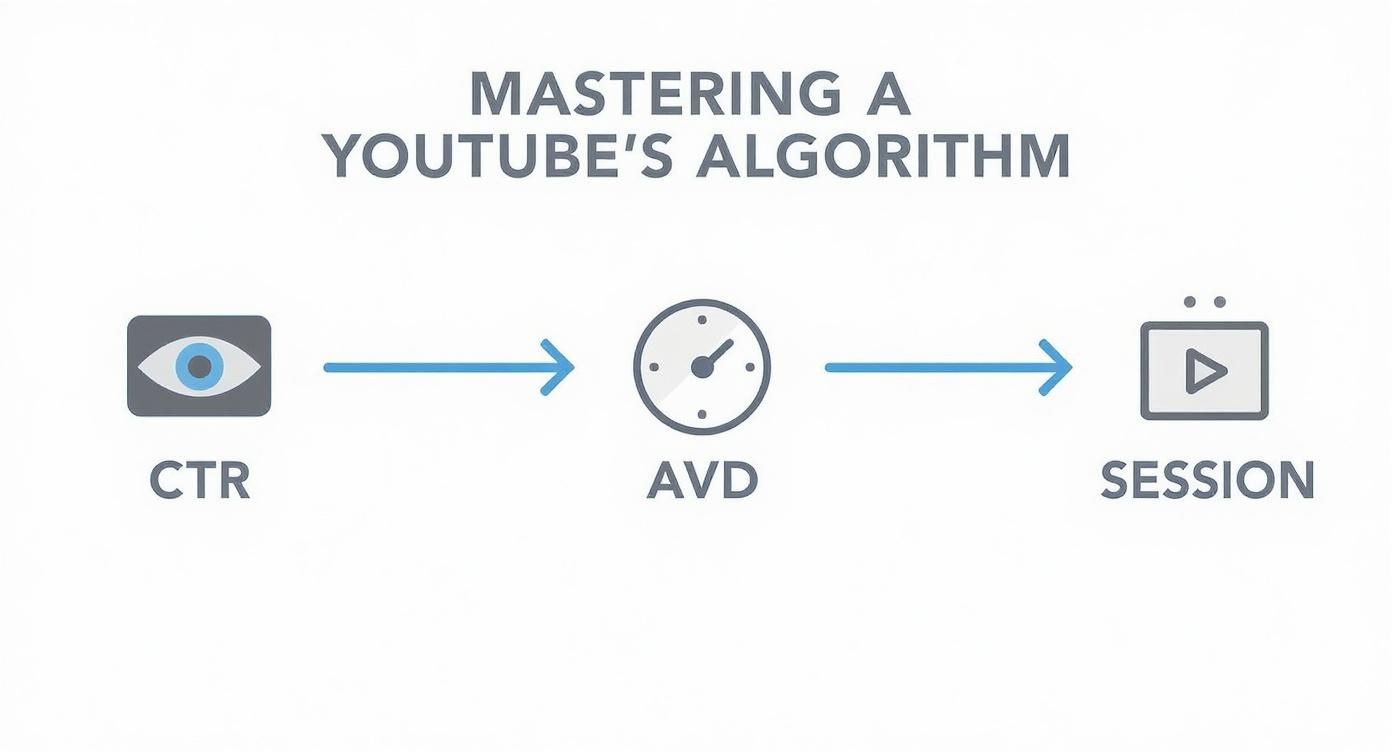
As you can see, a high CTR gets people in the door. A strong AVD keeps them watching. And a long session time—turning one view into a binge-watching session—is the ultimate signal of quality for the YouTube algorithm.
Target Niche Communities Strategically
Instead of just spamming your link everywhere, find specific communities where your video provides real value. Think about relevant subreddits, Facebook groups, or Discord servers where people are already talking about your topic.
The trick is to lead with value, not just a link. Become part of the conversation first. Then, you can craft a post that shares a cool insight or a compelling clip from your video, naturally introducing the full piece.
Don't just drop a link and run. Frame your video as the solution to a problem or an interesting take on a popular subject. The goal is to be a helpful contributor, not a self-promoter.
Leverage Your Owned Channels
Your existing audience is your most powerful asset at launch. If you have an email list, send a dedicated broadcast the second your video is live. These are your most loyal supporters, and their early views and engagement are gold.
At the same time, you should be using short-form content as a promotion machine. Create a killer teaser or a highlight clip for YouTube Shorts, TikTok, or Instagram Reels.
These short clips do two things for you:
- They act as a low-commitment preview, grabbing attention on platforms built for quick scrolling.
- They create a direct funnel, pushing interested viewers from the short clip over to your full-length video.
This cross-platform approach builds a powerful, multi-channel launch. A compelling teaser can seriously boost your initial traffic. For a deeper dive into the mechanics of this, check out our guide on uploading YouTube Shorts for maximum impact. When you combine these methods, you create a strategic launch that gives your video the best possible chance to catch fire.
How to Ride the Viral Wave
When one of your videos finally starts taking off, the real work has just begun. That first big surge is an amazing feeling, but your job is to turn that lightning in a bottle into real, sustainable channel growth. It's time to ride the wave, not just watch it from the shore.
The second you spot an unusual spike in your Realtime analytics, put on your detective hat. Your first move should be to dive straight into the Traffic Sources report in YouTube Analytics. This report tells you exactly why your video is blowing up. Is a specific subreddit sharing it? Did a big-name influencer just drop a link on Twitter? Pinpointing the source is everything.
Capitalize on the Surge
Once you know where the traffic is coming from, you need to get involved. If a Reddit thread is sending thousands of new viewers your way, jump into the conversation. Answer questions, thank people for the share, and just be present. This is how you start building a real connection with a brand-new audience.
Your comment section is probably going nuts, too. Don't let it become a ghost town.
- Engage Like Crazy: Heart comments and reply to as many as you can, especially in the first 24-48 hours. This sends a powerful signal to YouTube that your video is building a community.
- Pin a Strategic Comment: Use that pinned comment spot to your advantage. You can link to another relevant video on your channel, ask a question to get more discussion going, or add some extra context to the video.
A viral video isn't just a broadcast; it's the start of a massive conversation. Your job is to step in and become the host, guiding the discussion and making every new viewer feel seen.
Adapt and Optimize in Real Time
Going viral means you're reaching people far beyond your usual subscribers. This new, much broader audience might react differently to your video's packaging—the thumbnail and title. Don't be afraid to make adjustments mid-flight to squeeze every last drop of potential out of this moment.
Here's a pro-level tactic: update your thumbnail or title after the initial launch. If you see your Click-Through Rate (CTR) is dipping for traffic coming from "Browse Features" or "Suggested Videos," test a new thumbnail. A simple change can re-ignite the momentum and pull in viewers who might have scrolled right past the original.
Finally, start thinking about your next video immediately. The absolute best way to turn viral viewers into loyal subscribers is to give them another great video to watch. Scan the top comments for recurring questions or hot topics, then create a follow-up video that answers them directly.
This shows new viewers you’re listening and provides immediate value, turning a one-hit wonder into the start of a real following. Stay agile, stay engaged, and you can turn a lucky break into a massive strategic win for your channel. As you track this growth, it's also smart to monitor the top 5 metrics for YouTube Shorts growth, as they can offer some powerful clues.
Common Questions About Going Viral on YouTube
Once you start chasing virality, a million questions pop up. It's a confusing space, so let's clear the air on some of the most common ones I hear from creators.
How Long Should a Viral Video Be?
This is probably the number one question, and the honest answer is: there's no magic number.
Virality is all about engagement, not a specific runtime. A lot of long-form videos that catch fire tend to land somewhere in the 8-15 minute range—long enough to deliver real value but short enough to hold attention. For Shorts, the sweet spot is almost always just under that 60-second mark.
The real goal isn't to hit a certain time, but to make every single second of your video count.
Is Going Viral Just Luck or Is It All Strategy?
It's tempting to chalk up a viral hit to a lucky break, but that's only a tiny piece of the puzzle. The truth is, it's a mix of both, but a solid strategy puts the odds overwhelmingly in your favor.
Luck is the spark, but strategy is the fuel you've been piling up. You can't control a lightning strike, but you can definitely control how you build your bonfire.
A strategic creator is already doing the work: making great content for a specific audience, mastering storytelling to keep people watching, and promoting their videos intelligently. Luck might decide which of your well-made videos takes off, but strategy is what gives you a shot in the first place.
Without a plan, you're just sitting in an open field hoping to get lucky. A good strategy means you're building a lightning rod.
Okay, My Video Went Viral… Now What?
That moment is exhilarating, but what you do next is what separates a one-hit-wonder from a long-term creator. Turning that surge of views into actual channel growth is critical.
Here’s your game plan for when you catch that wave:
-
Be Present and Engage: Don't just watch the numbers climb. Jump into your comment section immediately. Reply to people, heart their comments, and pin the best ones. This shows new viewers you're active and builds an instant community vibe.
-
Become an Analyst: Get straight into your YouTube Analytics and figure out why it blew up. Was it the topic? A specific traffic source like the Shorts feed or Suggested Videos? The format? You need to understand the "how" so you can try to repeat it.
-
Create the Follow-Up: This is your best chance to turn all those new viewers into subscribers. Your next video should be a direct follow-up. Either expand on the viral topic or create a video that answers the most common questions you're seeing in the comments. Give them a reason to stick around.
Ready to create high-quality, engaging content consistently? ShortsNinja uses AI to help you produce amazing faceless videos for YouTube, TikTok, and Instagram in just minutes. Start creating with your free trial video today.