
Sick of the content hamster wheel? If you're constantly feeling the pressure to post, you're not alone. Automatic content creation is your ticket off that endless treadmill. It’s like having an AI-powered scriptwriter, video editor, and voice artist on call 24/7, ready to turn your simple ideas into a steady flow of great videos. The whole point is to get your time back while scaling your social media presence.
Welcome to the New Content Revolution

The demand for fresh, engaging content has never been higher. For creators, marketers, and brands, that means a constant, nagging pressure to produce. Doing it all manually is slow, expensive, and a fast track to burnout and missed deadlines. This is where automation completely changes the game.
Instead of burning hours brainstorming, scripting, and editing, you can now use smart tools to do the heavy lifting. This shift isn't about replacing human creativity; it's about amplifying it. When you hand off the repetitive grunt work to AI, you free yourself up to focus on what really matters—strategy, big-picture ideas, and actually connecting with your audience.
The Core Idea Behind Automation
At its heart, automatic content creation is all about doing more with less effort. It uses AI software to help generate everything from the words on the screen to the visuals themselves. Think of it as a system that can:
- Generate Scripts: Turn a simple prompt or topic into a structured, compelling story.
- Create Visuals: Produce unique video clips and images from just a few words of description.
- Produce Voiceovers: Generate realistic, human-sounding narration in dozens of languages.
This integrated approach means a process that once took days of work can now be knocked out in minutes. Platforms like ShortsNinja are built to manage this entire workflow, turning a single idea into dozens of ready-to-publish short videos. To really get a handle on this new world, it helps to Master AI Social Media Content Creation and make your workflow truly efficient.
This guide will pull back the curtain on the tech and give you a practical roadmap for using automation the right way. You'll learn how to build a sustainable content engine that works for you, not the other way around.
Moving Beyond Burnout
The ultimate goal here is simple: achieve consistency without sacrificing quality or your sanity. For so many creators, the struggle to keep up with demanding platform algorithms is all too real. Automating your workflow allows you to maintain a regular posting schedule, which is absolutely critical for growth on platforms like TikTok and YouTube.
Consider this guide your starting point for building a smarter content strategy. For a deeper dive into how these tools are specifically shaping social media, check out our guide on AI social media content creation for more insights.
How Automatic Content Creation Actually Works
Think of automatic content creation as a high-tech assembly line for your ideas. You come up with the initial concept—the creative spark—and a series of specialized AI tools kick into gear, working together seamlessly to build the final video.
Instead of one person juggling the roles of writer, editor, and designer, this system gives each job to a purpose-built AI. It’s a workflow that turns a process that once took days of grinding into a matter of minutes. This kind of speed makes consistent, high-volume video production a real possibility for any creator, no matter their team size or budget.
The Three Pillars of Automated Video
At its heart, the automated video process is built on three core pillars. Each one is a distinct stage where an AI takes a simple input and spits out something much more sophisticated, building on the previous step to create a complete, ready-to-publish video.
These pillars are:
- AI Scripting: This is where the story gets its bones. The AI acts like a master storyteller, turning your topic or prompt into a structured, engaging script that hooks viewers from the start.
- Visual Generation: Once the script is locked in, this stage brings the story to life. Here, the AI works like a director and animator, creating custom video clips and images that perfectly match the script's vibe.
- Voice Synthesis: Finally, this pillar gives your video its voice. The AI steps in as a voice actor, converting the script into a natural, human-like narration that adds a professional finish.
This integrated system is exactly how platforms like ShortsNinja operate, orchestrating all these AI components behind the scenes. You just provide the initial direction, and the platform handles the entire production line for you.
Stage One: AI Script Generation
Everything starts with the written word. You kick things off by feeding the system a prompt, which can be as simple as a topic like "three productivity hacks for entrepreneurs" or even just a link to an article you like.
From there, a Large Language Model (LLM)—the same kind of tech that powers tools like ChatGPT—gets to work. It analyzes your input, figures out what you're trying to say, and starts crafting a narrative. The model structures the content logically with a clear beginning, middle, and end, making sure to include an engaging hook to grab attention in those critical first few seconds.
The output isn't just a boring block of text. The AI is trained to write specifically for short-form video, using short sentences, punchy language, and a conversational tone that feels right at home on platforms like TikTok and YouTube.
Stage Two: AI Visual and Audio Creation
With a script ready to go, the system shifts into production mode. The AI breaks the script down sentence by sentence and feeds each piece into different generative models.
A text-to-video AI interprets the meaning of each line to generate a matching video clip. For instance, if the script says "a bustling city," the AI creates a dynamic shot of urban life. At the exact same time, a text-to-speech engine takes that text and produces a high-quality voiceover.
Key Insight: This parallel processing is the secret sauce. Instead of a human editor digging through stock footage and then recording audio separately, the AI generates and syncs both at once, slashing production time.
This rapid development has fueled some incredible market growth. The AI content creation market was valued at USD 2.10 billion in 2023 and is projected to hit USD 6.54 billion by 2030. This explosion was kickstarted by tools like ChatGPT, which became the fastest-growing app ever by hitting 100 million users in just two months. It really set the stage for this new era of content production. You can explore more about the AI-powered content creation market projections and see the data for yourself.
Understanding The AI Engine Driving Your Content
When you hit ‘generate’ on an automatic content platform, what’s actually happening under the hood? It’s not just one magic button. Think of it as a sophisticated assembly line, where a team of specialized AI models work together to build your video from the ground up.
The core technology here is generative AI. This isn't your standard number-crunching AI that just analyzes data. This kind is a creator. It’s been trained on a massive library of human-made content—videos, images, scripts, you name it—so it understands what makes a piece of content actually work.
Instead of just finding existing information, it generates something entirely new, whether that’s a script, a visual, or a voiceover.
The AI Filmmaker For Your Script
First up in our AI production crew is the text-to-video model. This is your director, cinematographer, and editor all rolled into one. Give it a line from a script—say, "a lone astronaut gazes at a distant nebula"—and it gets to work.
But here’s the key difference: it doesn't just pull a generic stock clip of an astronaut. It creates a completely new, original visual that matches that exact description. This is how platforms like ShortsNinja can churn out a constant stream of unique visuals for every video, making sure your content never feels stale or repetitive.
The AI Voice Actor On Demand
Next, the script goes to the voice synthesis model. This is your on-demand voice actor, ready to perform anytime. And we’re not talking about the clunky, robotic voices from a decade ago.
Modern text-to-speech (TTS) systems can deliver narration that’s packed with realistic emotion, pacing, and inflection—often so good you can’t tell it’s not human. They can perform in dozens of languages and accents, giving you the power to reach a global audience without hiring an entire team of voiceover artists. In short-form video, where audio is half the battle, this is a massive advantage.
The Big Picture: Generative AI is more than just automation; it's about creation at scale. It hands individual creators the kind of production power that used to be locked away in big studios, making high-quality video creation accessible to everyone.
How These Models Work Together
The real power kicks in when these specialized AI models are woven into a single, seamless workflow. It’s a coordinated dance:
- First, a Large Language Model (LLM) takes your initial idea and generates a script.
- That script is then handed off to the text-to-video model, which starts creating visuals to match each line or scene.
- At the same time, the script goes to the voice synthesis model to generate the narration.
- Finally, an automation layer puts it all together, syncing the visuals and audio, adding background music, and rendering the final video.
This collaborative AI process is what makes everything so fast and effective. You can explore some of the best AI content creation tools to see how different platforms package these features.
For a broader look at the mechanics, digging into AI powered content creation can give you a better sense of the technology. Understanding what’s happening behind the scenes helps you move from just using the tool to truly directing it.
Navigating The Benefits And Potential Pitfalls
Jumping into automatic content creation is like trading in your trusty bicycle for a high-speed train. You're still headed to the same destination—engaging your audience—but the speed, efficiency, and scale are in a completely different league. But just like any powerful tool, it needs a smart operator who knows its strengths and its limits.
This shift is a game-changer, especially if you're struggling to keep up with the relentless pace of social media. The most obvious win is a massive boost in productivity. Tasks that used to eat up hours, or even days, can now get done in a fraction of the time. This frees you up to focus on the big picture—strategy, growth, and community—instead of getting buried in the production weeds.
The Upside: A New Era of Efficiency
Weaving AI into your content process brings benefits you can see and measure almost immediately. It’s not just about moving faster; automation brings a level of consistency and scale that’s nearly impossible to hit on your own, especially for solo creators or small teams.
Here’s where you’ll really feel the difference:
- Massive Productivity Gains: Slash the time it takes to get from a rough idea to a finished video. A week's worth of content can now be knocked out and scheduled in a single afternoon.
- Unwavering Consistency: Stick to a regular posting schedule without missing a beat. AI tools don’t get tired or hit a creative wall, so your content pipeline always stays full.
- Effortless Scalability: Ramp up your content output without having to hire a huge production team. This makes it easy to experiment with new topics, styles, and formats on platforms like ShortsNinja.
Key Takeaway: The goal isn’t just to make more content. It's about making a bigger impact with less grunt work. Automation gives you back your time while helping you maintain a powerful online presence.
The market is already voting with its dollars. The global AI content creation market, currently valued at USD 2.15 billion, is expected to skyrocket to USD 10.59 billion by 2033. Some experts even predict that by 2026, a mind-boggling 90% of all online content will be AI-assisted in some way. If you want to dig deeper, you can discover more insights about the AI content market's growth and see where things are headed.
To put it all in perspective, here's a quick look at how the old way stacks up against the new.
Automatic vs Manual Content Creation: A Quick Comparison
This table breaks down the core differences in resources, speed, and scale between traditional manual methods and today's automated workflows.
| Aspect | Manual Content Creation | Automatic Content Creation |
|---|---|---|
| Time Investment | Hours or days per video | Minutes or hours per batch |
| Cost | High (labor, software, equipment) | Low (affordable subscriptions) |
| Output Volume | Limited by creator's time | Virtually unlimited |
| Consistency | Can be difficult to maintain | Easily maintained with scheduling |
| Scalability | Requires hiring more people | Scales with software plans |
| Skill Requirement | High (editing, design, scripting) | Low (focus on ideas and strategy) |
As you can see, automation fundamentally changes the economics of content creation, making it possible for anyone to compete at a much larger scale.
The Risks: Navigating with Awareness
While the upside is huge, diving into automatic content creation without a plan can cause some predictable headaches. The biggest risk? Losing the human touch that makes your brand relatable and trustworthy in the first place.
If you lean too heavily on AI without giving it proper direction, you can end up with content that feels generic, repetitive, or just slightly off-brand. Remember, the tool is only as good as the instructions you give it. Vague prompts lead to bland videos that just won't connect with your audience.
Authenticity is your most valuable currency online. That’s why you have to ditch the "set it and forget it" mindset. An AI-generated script might be grammatically flawless, but it could easily miss the subtle humor in your brand’s voice or fail to hit on the specific pain points your audience cares about.
This is where the "human-in-the-loop" approach is so critical. Your role evolves from being the sole creator to being the creative director. You guide the AI, you review its work, and you inject your unique personality and strategic insights into the final product. This blend of AI efficiency and human creativity is what separates the most successful automated channels from the rest. You’re still the pilot, making sure every piece of content lands exactly where you want it to.
Your Step-By-Step Video Creation Playbook
Ready to go from theory to practice? Let's walk through how you can build a repeatable, automated workflow for creating killer videos. Think of this as your personal playbook, with you as the director and AI as your ultra-efficient production crew.
The real magic here is understanding that automatic content creation isn't about hitting a button and walking away. It's a partnership. You bring the vision, and the AI handles the heavy lifting. We’ll break this down into three simple phases: sparking the idea, guiding the production, and adding that final human polish.
Phase 1: Define Your Creative Spark
Every great video starts with a great idea. In this workflow, your first job is to give the AI a powerful prompt that sets the stage for everything else. A solid prompt is specific, clear, and gives the AI all the context it needs to nail your vision.
It’s like giving directions to a creative partner. A vague idea like "health tips" won't get you far. But a prompt like this will: "Create a 60-second video on three surprising morning habits to boost metabolism for busy professionals, using a positive and energetic tone." See the difference?
An effective prompt has a few key ingredients:
- Specificity: Nail down the topic, target audience, and ideal length.
- Tone of Voice: Tell the AI if you want the vibe to be inspirational, funny, educational, or something else entirely.
- Key Information: Include any must-have points, stats, or calls to action you want in the final video.
The more detail you feed the AI upfront, the less you'll have to tweak later. This initial input is the single most important step in steering the AI toward a video that feels like yours.
Phase 2: Guide the AI Production
Once your prompt is locked in, the AI gets to work, generating the script, visuals, and voiceover. Your role now shifts from creator to creative director. It's time to review each piece and make sure it’s hitting all the right notes.
This is where you truly generate videos with AI that capture your unique style. For instance, if the script comes out sounding a little too buttoned-up, you can jump in and edit the text to make it more conversational. Or if a generated image doesn't quite fit the mood, you can ask the AI to try again with a different instruction.
Key Insight: Don't get married to the first draft. The real power of this process is how fast you can iterate. You can make adjustments, regenerate assets, and fine-tune the video until it’s perfect, all in a matter of minutes.
This workflow is tapping into a massive and fast-growing market. The global AI content creation market was valued at around USD 2.2 billion in 2023 and is on track to hit an incredible USD 7.9 billion by 2033. This isn't just hype; 47% of marketers are already using AI for content generation. So far, AI has created over 15 billion images, with another 34 million being made daily.
Phase 3: Perform the Final Human Review
This last step is easily the most important one. It's where you add the final layer of human intuition that automation just can't replicate. This is your quality control check, ensuring the video is authentic and perfectly aligned with your brand.
Look at the big picture. Check the pacing, the emotional tone, and the overall story. Does the music actually enhance the message, or is it distracting? Is the call to action clear and convincing? This is your last chance to polish the video and make sure it truly connects with people. The flowchart below shows exactly where this human-centric step fits into a responsible AI workflow.
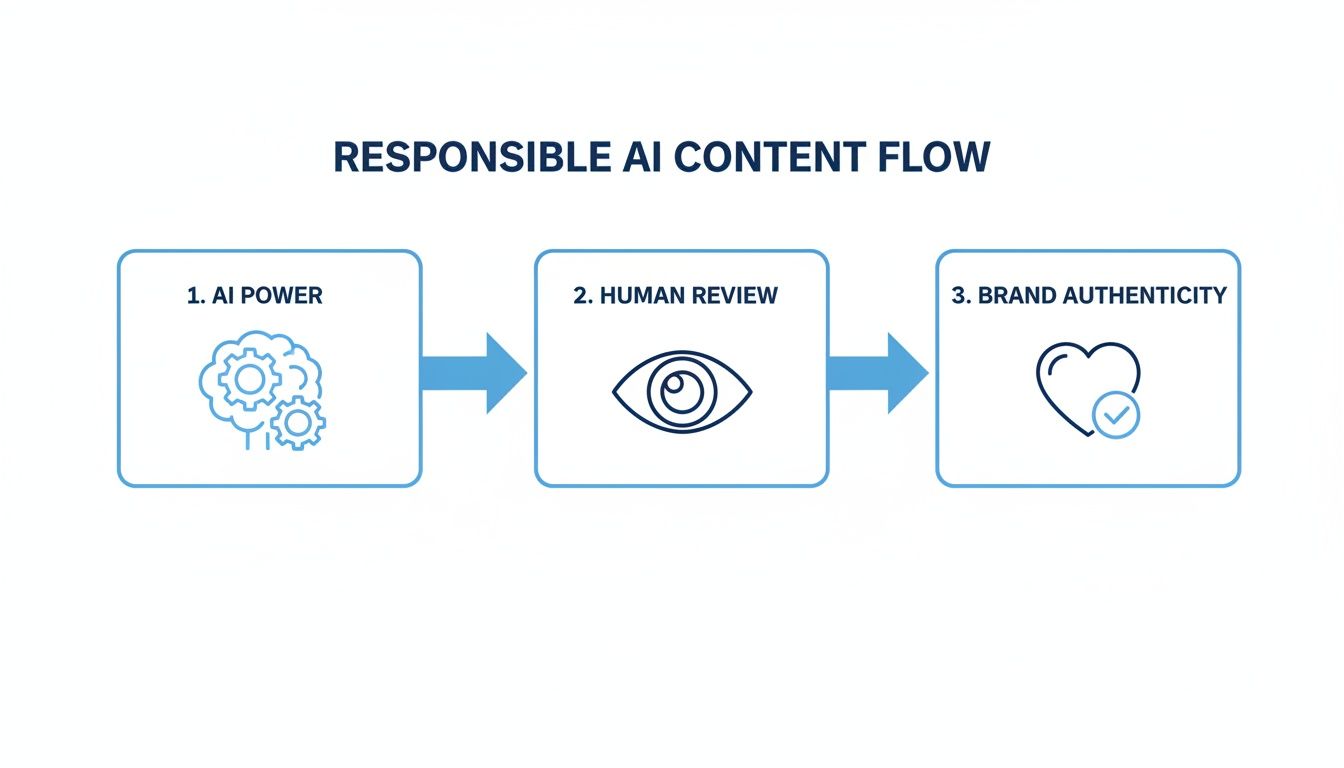
As you can see, human oversight isn't just a quick once-over at the end. It's a core part of the process that guarantees your content feels genuine and high-quality.
Once you’re happy with the final product, it’s time to schedule it to go live. Platforms like ShortsNinja bundle this entire playbook into one smooth interface, letting you go from idea to a scheduled post without any friction. By following these steps, you’re not just making a video; you’re building a reliable system to produce a steady stream of great content and scale your presence on any platform.
Best Practices For Long-Term Success
Making a video is one thing. Building a loyal audience that actually sticks around is a whole different ballgame. If you’re jumping into automatic content creation, you need more than just good tools—you need a smart strategy to make sure you’re building something that lasts. Otherwise, you’re just creating a ton of content that nobody sees.
The best automated channels don't just churn out random videos. They follow a clear playbook, one that starts with knowing their audience inside and out and delivering real value, every single time. It's about thinking in terms of series and themes, not just one-off videos, and building a brand that feels cohesive across every piece of AI-generated media.
Define Your Niche And Audience First
Before you hit "generate" on a single video, you have to know who you're talking to and what makes them tick. A fuzzy goal like "making finance videos" won't cut it. A winning strategy is sharp and specific: "creating 60-second videos that break down complex stock market concepts for beginner investors in their 20s."
See the difference? That level of clarity is your North Star. It shapes your prompts, dictates your tone, and makes sure every video you create connects with a specific group. When your content consistently solves a real problem for a defined audience, you stop being just another channel and start building an actual community.
Inject Your Unique Brand Voice
The biggest trap with automation is ending up with generic, robotic content that feels totally impersonal. Your brand's unique voice is your secret weapon, and it's your job to bake it into everything the AI produces. This is where the human-in-the-loop workflow isn't just a suggestion—it's essential.
Key Insight: Never just accept the AI's first draft. Get in there and edit the scripts. Add your specific humor, your lingo, your unique perspective. That final review is where you turn an AI-generated script into content that is unmistakably yours.
This is the step that keeps your brand feeling authentic and relatable, saving your channel from getting lost in a sea of lookalike automated accounts.
Analyze Data To Refine Your Strategy
Your audience will tell you what's working—if you're willing to listen. Dive into your analytics and see which videos are getting the views, shares, and comments. That data is pure gold.
Use those insights to double down on what people love and tweak your future prompts. If videos on a particular topic are crushing it, build a whole series around it. This data-driven feedback loop is how you continuously sharpen your automatic content creation strategy, making sure your efforts get smarter and more effective over time.
Answering Your Top Questions
Jumping into automatic content creation always sparks a few questions. It's a powerful new way of working, so it’s smart to understand the rules of the road before you hit the gas. Let's dig into some of the most common concerns creators have.
The big one is always about sustainability. The good news? Social media platforms care about one thing above all else: the viewer's experience. They don't care what tools you used. As long as you’re making valuable, original content that people actually want to watch, your work will be judged on its own merit.
Can I Really Make Money With Automated AI Videos?
Absolutely. Plenty of creators are already monetizing channels built entirely on automated or "faceless" content. The formula is simple: produce high-quality, engaging videos consistently. Do that, and you'll build an audience and open up multiple ways to earn.
Think about it this way:
- The YouTube Partner Program: Once you hit the subscriber and watch-time numbers, you can start earning from ads.
- Affiliate Marketing: You can promote products that fit your niche and earn a commission whenever someone buys.
- Selling Your Own Products: Use your channel to drive traffic to your own courses, digital downloads, or merchandise.
Consistency and value are the keys to the kingdom, and that's exactly what tools like ShortsNinja are built to help you deliver. Build a loyal community, and you can create a seriously profitable brand without ever stepping in front of a camera.
Key Takeaway: Monetization is tied to the value you create, not how you create it. Use AI to deliver that value at scale, and the money will follow.
Will Social Media Platforms Penalize AI-Generated Content?
This is a big, important question. The short answer is no—platforms like YouTube and TikTok don't penalize content just because AI was involved. Their algorithms are built to reward one thing: audience engagement.
If your video is interesting, keeps people watching, and follows the community guidelines, it gets promoted. It doesn't matter if it was edited by a human or an AI. The focus should always be on using AI to bring your unique ideas to life, making sure the final video is original and genuinely useful to your audience.
How Much Creative Control Do I Have With Automation?
You have all of it. Seriously. It helps to think of yourself as the creative director and the AI as your super-efficient production crew. You're the one calling all the shots.
You come up with the initial idea, you tweak the AI-generated script so it sounds like you, you pick the visual style, and you make the final edits. These tools are designed to be a collaboration. You guide the AI to do the heavy lifting, but you always have the final say to make sure the video is a perfect reflection of your vision.
Ready to get your time back and start scaling your content? With ShortsNinja, you can turn a single idea into a month's worth of scheduled videos in just a few minutes. Get started with ShortsNinja today and see how easy it is to build your own automated content engine.