
Yes, YouTube Shorts are absolutely monetized. The days of the old, unpredictable Shorts Fund are gone. Now, Shorts are a core part of the YouTube Partner Program, giving creators a stable way to earn from ads shown in the Shorts Feed.
How YouTube Shorts Monetization Actually Works
If you’ve been asking whether YouTube Shorts are monetized, the answer is a firm yes. We've moved past the experimental phase of random bonuses from a limited creator fund. Today, Shorts monetization is woven directly into the YouTube Partner Program (YPP), creating a much more predictable and sustainable income stream for creators.
It all revolves around a shared pot of money called the Creator Pool. Think of it as a monthly potluck where all monetizing Shorts creators get a share.
- Step 1: The Money is Collected: YouTube gathers all the revenue from ads that run between videos in the Shorts Feed. This forms the total pot for the month.
- Step 2: Music Licensing is Paid: Before anyone gets a slice, YouTube uses a portion of this money to cover music licensing costs. This is crucial for making sure artists are paid when you use their tracks.
- Step 3: The Creator Pool is Finalized: Whatever is left after paying for music licenses becomes the Creator Pool. This is the total amount available to be split among eligible creators that month.
The system is pretty straightforward: your earnings depend on your performance. The more views your Shorts rack up compared to the total views of all monetizing creators, the bigger your piece of the pie.
This model shows how much YouTube has invested in Shorts. It started with the Shorts Fund in 2021, which was more like a monthly bonus program. But by February 2023, it was replaced with the current, more permanent ad revenue sharing system.
From Creator Fund To Direct Revenue Sharing
The shift from the temporary Shorts Fund to the current ad revenue sharing model was a big deal. It signaled that Shorts were no longer an experiment but a core part of the YouTube ecosystem. This table breaks down the key differences.
| Feature | Old Shorts Fund (2021-2023) | Current Revenue Sharing (2023-Present) |
|---|---|---|
| Model Type | A fixed, temporary fund for bonuses | A permanent, direct revenue sharing system |
| Payment Basis | Bonuses based on monthly performance | Creators get 45% of the Creator Pool based on their view share |
| Predictability | Very low; payments were inconsistent | High; earnings are directly tied to views and ad revenue |
| Eligibility | Open to creators, even those not in the YPP | Must be an accepted member of the YouTube Partner Program |
| Transparency | Limited; creators didn't know how bonuses were calculated | Clear; based on ad revenue, music costs, and view count |
Ultimately, the new model provides a much clearer and more reliable path to earning money. It makes Shorts a truly viable income stream for creators who are willing to put in the work. You can discover more insights about this revenue model and its history to see how far it has come.
Understanding The Shorts Revenue Sharing Model
So, how does the money actually get from advertisers into your bank account? It’s not as complicated as you might think. YouTube has laid out a pretty transparent, four-step process built around a shared "Creator Pool," making sure everyone gets a fair shake based on performance.
First, all the revenue from ads that run between Shorts in the feed gets collected into one giant monthly pot. Think of it as YouTube gathering all the cash from every single advertiser who wants to be seen on Shorts.
Next, YouTube pays the bills for music licensing. This is a crucial step. It ensures artists get paid when you use their latest hit track in your Short, but it does mean the pot for creators gets a little smaller. What's left over is officially called the Creator Pool.
How The Creator Pool Is Divided
Once the Creator Pool is set for the month, the real magic begins. YouTube tallies up the total number of views across all eligible monetized Shorts from every creator in the program. Your channel then gets a slice of that pool based on your percentage of those total views.
Let's say your Shorts brought in 0.1% of all monetized views for the month. Simple enough—you get allocated 0.1% of the Creator Pool.
This visual breaks down how the ad revenue is collected, pooled, and then shared.
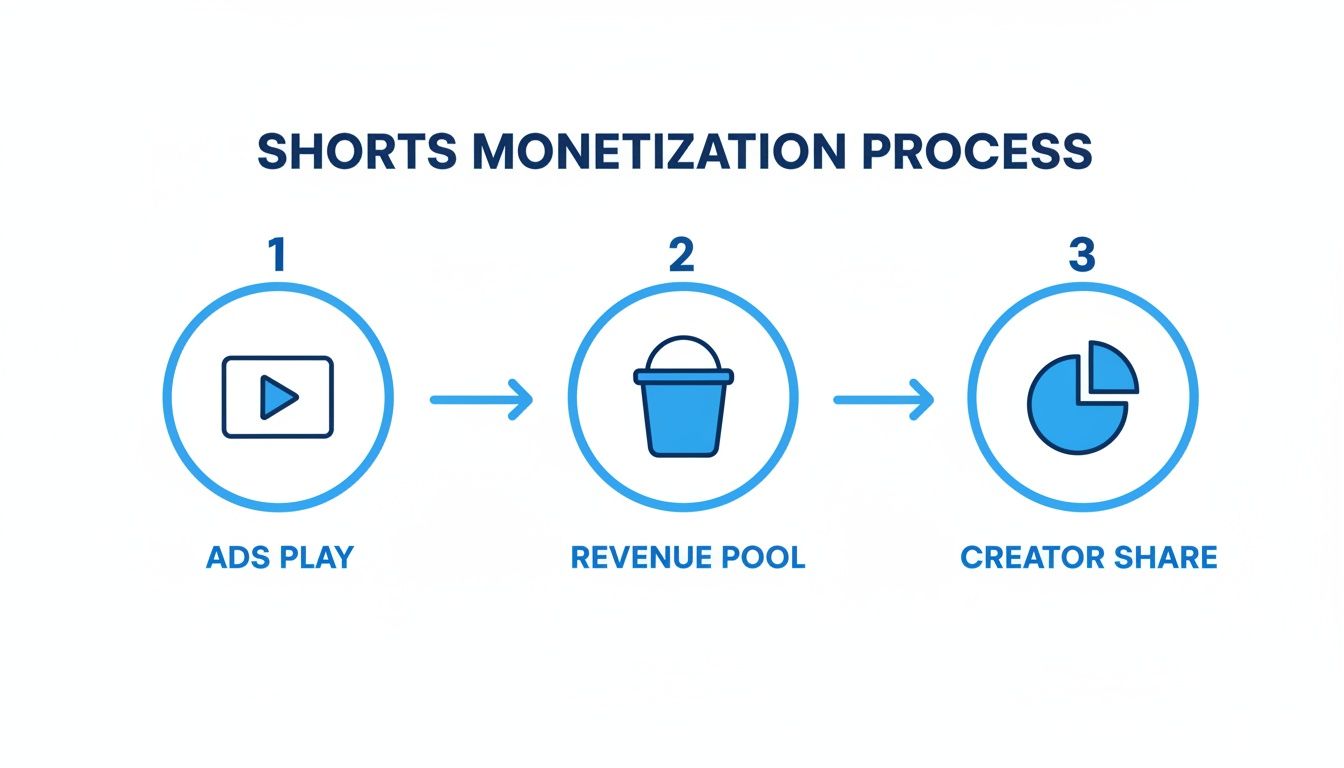
As the diagram shows, it’s basically a funnel. Your performance determines how much of that initial ad revenue makes its way to you.
Finally, you get your cut.
The creator's final share is 45% of their allocated portion from the Creator Pool. YouTube keeps the other 55%.
This fixed percentage creates a predictable and consistent model. Since this system was fully rolled out in 2023, it's become a reliable income stream for tons of creators.
Realistically, earnings often land somewhere between $0.01 to $0.03 per 1,000 views, though this can definitely climb higher depending on your audience's location and how engaged they are. If you want a deeper dive into how those numbers can shift, you can read the full breakdown of Shorts earning potential. The bottom line is, as the Shorts platform grows, so do the opportunities for you.
How To Qualify For YouTube Shorts Monetization
So, you want to get paid for your Shorts? The first step is getting into the YouTube Partner Program (YPP), and YouTube gives you a couple of different ways to get there. This is great because it lets you lean into whatever’s working best for your channel—whether that’s long-form videos, Shorts, or a mix.
Think of it like choosing your lane on the highway to monetization. You only need to hit the mark in one of them to get to your destination.
Choose Your Monetization Path
Your main goal is to meet one of two key eligibility thresholds. You don’t need to hit both.
- The Traditional Route: Get 1,000 subscribers and rack up 4,000 public watch hours on your regular, long-form videos within the last 12 months.
- The Shorts Express Lane: Get 1,000 subscribers and hit 10 million valid public Shorts views in the last 90 days.
This dual-path system is YouTube’s nod to the massive growth Shorts have driven. In 2025, creators need that magic 1,000 subscriber number plus either the 10 million Shorts views or the 4,000 long-form watch hours. It’s a strategy that’s clearly working—over 25% of all channels in the YPP are now earning from Shorts. Even better, 80% of creators who joined through the Shorts threshold have started using other monetization features like Super Thanks. If you want to dive deeper into the numbers, Awisee.com has some detailed Shorts statistics worth checking out.
Heads up: Hitting the numbers is only half the battle. Your channel also has to play by all of YouTube's rules. This part is non-negotiable. You’ll need to be in good standing with the Community Guidelines, follow all monetization policies, and have two-step verification turned on for your account.
Lastly, you’ll need to link an active Google AdSense account to actually get paid. If you need a complete checklist, our guide on YouTube Shorts monetization requirements walks you through every single step.
How Much You Can Realistically Earn From Shorts
So, you know Shorts can be monetized, but let's talk about what that actually looks like in your bank account. It's crucial to set the right expectations from the get-go, because Shorts earnings work very differently than your standard long-form videos.
The key metric here is RPM, which stands for Revenue Per Mille (or revenue per 1,000 views). For Shorts, this number is a lot lower than what you might be used to. Most creators report an RPM somewhere in the ballpark of $0.01 to $0.06. That’s not a typo. It means you need a massive number of views to see significant direct ad revenue. Shorts are truly a volume game.

To make this crystal clear, here’s a breakdown of what those RPMs translate to at different view counts.
Estimated Earnings From Shorts Based On Views
This table gives you a realistic look at what you might earn from ad revenue alone, based on typical RPMs.
| Total Views | Estimated Earnings Range (Low RPM) | Estimated Earnings Range (High RPM) |
|---|---|---|
| 100,000 | $1 – $2 | $5 – $6 |
| 1,000,000 | $10 – $20 | $50 – $60 |
| 10,000,000 | $100 – $200 | $500 – $600 |
As you can see, even a million views might only net you the cost of a couple of coffees. This is why it’s so important to see Shorts as part of a bigger strategy.
What Influences Your Shorts RPM
You're probably wondering why there's such a spread in potential earnings. It's not random—several factors directly influence your RPM.
- Audience Geography: Where your viewers are watching from is a huge deal. Advertisers pay a premium for audiences in countries like the United States, so views from those regions will always earn more.
- Time of Year: Advertising budgets ebb and flow. Expect a nice bump in the fourth quarter (October-December) when holiday spending ramps up, which often gives everyone’s RPM a temporary lift.
- Content Niche: What your Shorts are about really matters. A Short on personal finance or a new tech gadget will almost always attract higher-paying advertisers than a general comedy or dance video.
But here’s the real secret: the direct ad payout is only a small part of the Shorts monetization picture. Think of Shorts as the ultimate channel growth engine. They drive subscribers who then watch your more profitable long-form videos, buy your merch, or sign up for channel memberships. Shorts are the top of your funnel, not the final paycheck.
How To Enable And Track Your Earnings
So, you've made it into the YouTube Partner Program (YPP)—congratulations! The next step is to actually switch on monetization for your Shorts. This part isn't automatic, so you’ll need to flip a few switches yourself to make sure you start earning from all that hard work.
First things first, head over to your YouTube Studio and accept the updated YPP terms. You'll find these in the "Earn" tab. YouTube breaks down the different ways you can make money into agreements called "modules." The one you're looking for is the Shorts Feed Ads module. Accepting this is the final green light for your Shorts revenue.
Finding Your Shorts Analytics
Once monetization is enabled, you'll want to see how your Shorts are actually doing. This is where your YouTube Analytics dashboard comes in. It's the command center for tracking all your performance data and seeing exactly where the money is coming from.
- Go to YouTube Studio.
- Select Analytics from the menu on the left.
- Click the Revenue tab up top.
Here, you’ll get a clean breakdown of how your different content formats are stacking up against each other.
This view separates your earnings into dedicated sections for long-form videos, Shorts, and Live streams. It makes it super easy to see what’s driving your income. You can track your estimated revenue, RPM (revenue per mille), and playback-based CPM specifically for Shorts, giving you the hard data you need to fine-tune your content strategy.
Just a heads-up: revenue only starts to pile up from the moment you accept the Shorts Monetization Module. Any views your Shorts got before you opted in won't be paid out retroactively.
Getting comfortable with these metrics is a huge part of growing your channel. For creators who really want to get into the weeds, exploring AI-powered revenue analytics can unlock deeper insights, helping you pinpoint what content truly moves the needle for your channel’s bottom line.
Strategies To Maximize Your YouTube Shorts Earnings
Getting accepted into the YouTube Partner Program is the starting line, not the finish. Now the real fun begins—turning those views into a reliable income stream. While direct ad revenue is a pure numbers game that requires massive volume, the smartest creators know Shorts are a powerful gateway to building a sustainable business.
First things first: shift your mindset. Stop chasing fleeting viral trends and start creating high-quality, original content that serves a specific audience. Advertiser-friendly videos in niches like finance or tech often pull a higher RPM than general entertainment. More importantly, consistent quality builds a loyal community that actually trusts you.
It’s this loyal audience where the real earning potential is hiding. You just need to use your Shorts strategically to guide viewers toward more profitable parts of your brand.
Create A Monetization Funnel
Think of each Short as a bite-sized ad for your larger channel ecosystem. The goal isn't just to get a view; it's to convert a casual viewer into a long-term fan who supports you in multiple ways.
Here's how that looks in practice:
- Drive Traffic to Long-Form Videos: Use pinned comments and clear calls-to-action in your Shorts to point people to your full-length videos. Long-form content has a significantly higher RPM and gives you more room to build a connection.
- Promote Channel Memberships: Once you have a core group of fans, offer them exclusive content and perks through channel memberships. This creates a recurring, predictable monthly income stream.
- Sell Merchandise or Products: If you have a brand, Shorts are the perfect commercial. They're quick, engaging, and a fantastic way to showcase products and drive traffic directly to your online store.
The most successful Shorts creators understand that views are just the beginning. The real money is made when a viewer becomes a subscriber, then a member, and finally, a customer.
Ultimately, maximizing what you earn from Shorts comes down to building a multifaceted brand. It’s not about the views you get, but what you do with them. By creating top-notch content and guiding your audience deeper into your world, you can transform a low RPM into a high-value community.
And don't forget, great visuals are non-negotiable. Learning how to edit YouTube Shorts properly can make a massive difference in keeping viewers hooked and engaged.
Got Questions About Shorts Monetization?
Let’s wrap things up by tackling some of the most common questions creators have about making money with YouTube Shorts. This should clear up any final confusion.
Do My Old Shorts Views Count?
Yes, they do—sort of. Any valid, public views your Shorts have gotten in the last 90 days will count toward the 10 million view requirement to get into the YPP.
However, and this is the important part, you only start earning ad revenue on views that happen after you’ve been accepted into the program and switched on Shorts monetization. Those past views get you in the door, but they aren't retroactively paid out.
How Does Popular Music Affect My Earnings?
Using commercial music has a direct impact on your paycheck. Before you see a dime, YouTube dips into the Creator Pool to pay for music licenses.
If you use one licensed song, the revenue from that Short gets split between you and the music publisher. If you use two licensed tracks, the music rights holders get paid first, and there might not be anything left for you. For the highest possible earnings, your best bet is to stick with original audio or dive into YouTube's royalty-free Audio Library.
Heads up: To get monetized, your content has to be yours. Re-uploading TikToks with watermarks, using unedited clips from movies, or posting compilations of other people's videos without adding your own significant creative touch is a fast track to getting demonetized.
Ready to create high-quality, monetizable Shorts without all the hassle? ShortsNinja uses AI to help you generate engaging videos in minutes, from scripting to visuals. Streamline your content creation and start building your monetized channel today.