
Ever heard of a YouTube channel that pulls in revenue without the creator ever showing their face? That’s a YouTube automation channel. It's less about being a personality and more about building a media business—a content machine that runs on smart systems, AI tools, and a bit of outsourcing.
Why YouTube Automation Is a Game Changer
Imagine building a profitable media asset that pretty much runs itself. That's the real promise of a YouTube automation channel. This isn't some shady tactic using bots for fake views or trying to game the system. It’s about building a ridiculously efficient and scalable content engine.
Think of your channel less like a personal vlog and more like a digital factory. You're the producer, not the talent. Your job shifts from being in front of the camera to behind the scenes, focusing on strategy, management, and optimization. The actual heavy lifting? That’s handled by the systems you put in place, whether it’s AI, freelance help, or a mix of both.

Building an Efficient Content Engine
The true magic of this approach is how well it scales. A traditional creator is always the bottleneck—limited by their own time and energy. With a dialed-in workflow, you can smash through those limitations.
Let's say you start a history channel. You could use AI to draft scripts on ancient Rome, send them to a freelance voice actor for narration, and have a video editor source clips from stock footage libraries. Once that process is systemized, you can crank out high-quality videos week after week without getting bogged down in the day-to-day grind.
This efficiency brings some serious perks:
- Rapid Scaling: You can publish content way more often than a solo creator, putting your channel’s growth on the fast track.
- Diversification: Perfect your workflow on one channel, then replicate it. You can launch channels in totally different niches and build multiple, independent income streams.
- Time Freedom: By delegating the daily tasks, you free yourself up to focus on the big picture—or just kick back and enjoy the passive income.
- No Personal Branding: You can build a valuable asset without tying it to your name or face, giving you a level of privacy and flexibility most creators don't have.
The term "automation" can be a bit misleading. This isn’t a set-it-and-forget-it deal. A successful channel still needs you to be the manager of the operation—overseeing quality, setting the strategy, and managing your team or tools.
The Modern Toolkit for Automation
Lately, platforms like ShortsNinja have popped up to bring all the moving parts together. Instead of juggling separate subscriptions for scriptwriting, voiceovers, and video creation, these tools offer an all-in-one workflow. You can literally go from a simple idea to a fully produced, scheduled video in minutes.
This approach massively lowers the barrier to entry. You no longer need to be an expert video editor or a world-class scriptwriter to get in the game. The real value is in building a sustainable system that delivers predictable results, turning your creative concepts into a consistent and profitable business.
How to Find a Profitable Niche for Faceless Content
Picking your niche is hands-down the most important decision you'll make for your faceless channel. Get this wrong, and you're stuck pushing a boulder uphill from day one. Let's set passion projects aside for a minute—the real goal here is to find a sweet spot with high viewer demand, beatable competition, and solid ways to make money.
The best niches for this automated, faceless style all have a few things in common. They’re built on information and storytelling, not a magnetic personality. Think about finance explainers, deep dives into history, or even guided meditations. These topics are not only a breeze to illustrate with stock footage and animations but also pull in an audience that’s actively looking for answers or knowledge.
Identifying High Demand and Low Competition
This all starts with good old-fashioned market research. Don't just throw a dart at the board and hope it sticks. Use data to back up your ideas.
A deceptively simple trick is to use YouTube's search bar as your guide. Start typing a broad topic like "personal finance" and pay close attention to what YouTube suggests. These aren't random guesses; they're the exact phrases real people are searching for right now.
Next, actually look at the search results for those terms. Are the top spots dominated by monster channels with millions of subscribers? That’s a red flag for brutal competition. But if you spot smaller channels—say, under 100k subs—ranking on the first page, you might have just stumbled upon a gap in the market you can fill.
A classic rookie mistake is going way too broad. "Gaming" isn't a niche; it's an entire industry. Same with "fitness." You have to drill down. "Strategies for solo players in tactical RPGs" or "10-minute home workouts for busy parents" are much sharper, targeting a specific viewer you can actually connect with.
Key Criteria for a Strong Automation Niche
Just because a topic is popular doesn't mean it's a good fit for a faceless channel. The perfect niche needs to check a few specific boxes to make sure it works with an automated workflow.
Here’s what to look for:
- Evergreen Appeal: Your content needs to stay relevant for months, or better yet, years. Topics like "how to save for retirement" or "ancient history facts" are timeless. They’ll keep pulling in views long after you hit publish.
- Simple Visual Requirements: Can you tell the story effectively with stock videos, screen recordings, basic animations, or AI-generated images? If a topic doesn't demand custom, on-location filming, it's a great candidate.
- Multiple Monetization Paths: AdSense is just the starting line. The best niches open doors to affiliate marketing (like a finance channel linking to budgeting tools), digital products (a meditation channel selling audio packs), or even brand deals.
YouTube Shorts, in particular, has become a rocket ship for growth. Its daily views exploded from 30 billion in 2021 to over 70 billion by late 2023. This sheer volume gives even tiny channels a fighting chance to get noticed by pumping out Shorts, making tools like ShortsNinja a lifesaver for keeping up that pace.
Defining Your Ideal Viewer Profile
Once you’ve landed on a potential niche, it’s time to get laser-focused on who you're making videos for. Sketch out an "ideal viewer profile." What keeps them up at night? What questions are they typing into Google? What solutions would make their life easier? Knowing this will shape every single script you write.
For example, if your niche is "budget travel tips," your viewer might be a student dying to see the world without going broke. Your video titles should talk directly to that person—something like "How to Backpack Europe for Under $50 a Day." This level of specificity makes your content feel personal and incredibly valuable, even with no face on camera.
For more inspiration, you can check out our guide on profitable faceless YouTube channel ideas that play well with this strategy. This targeted approach is what turns a generic video into a can't-miss solution for a specific group, and that’s the bedrock of a successful YouTube automation channel.
Building Your AI-Powered Content Workflow
Alright, you've locked in a profitable niche. Now for the fun part: building the engine that will power your entire faceless channel. This is your repeatable, scalable system that turns simple ideas into polished, high-quality videos with as little manual work as possible. An AI-powered workflow is the secret sauce to producing content consistently, and consistency is the fuel for channel growth.
The goal here isn't just about cranking out videos faster; it's about creating a predictable process. A solid workflow means you know exactly how long it takes to make a video, what it'll cost, and that the quality will be on-point every single time. It takes the guesswork out of the equation so you can focus on big-picture strategy instead of getting bogged down in production details.
The process boils down to a few core stages, moving from a broad idea to a ready-to-publish video. AI is about to become your best friend at every single step.
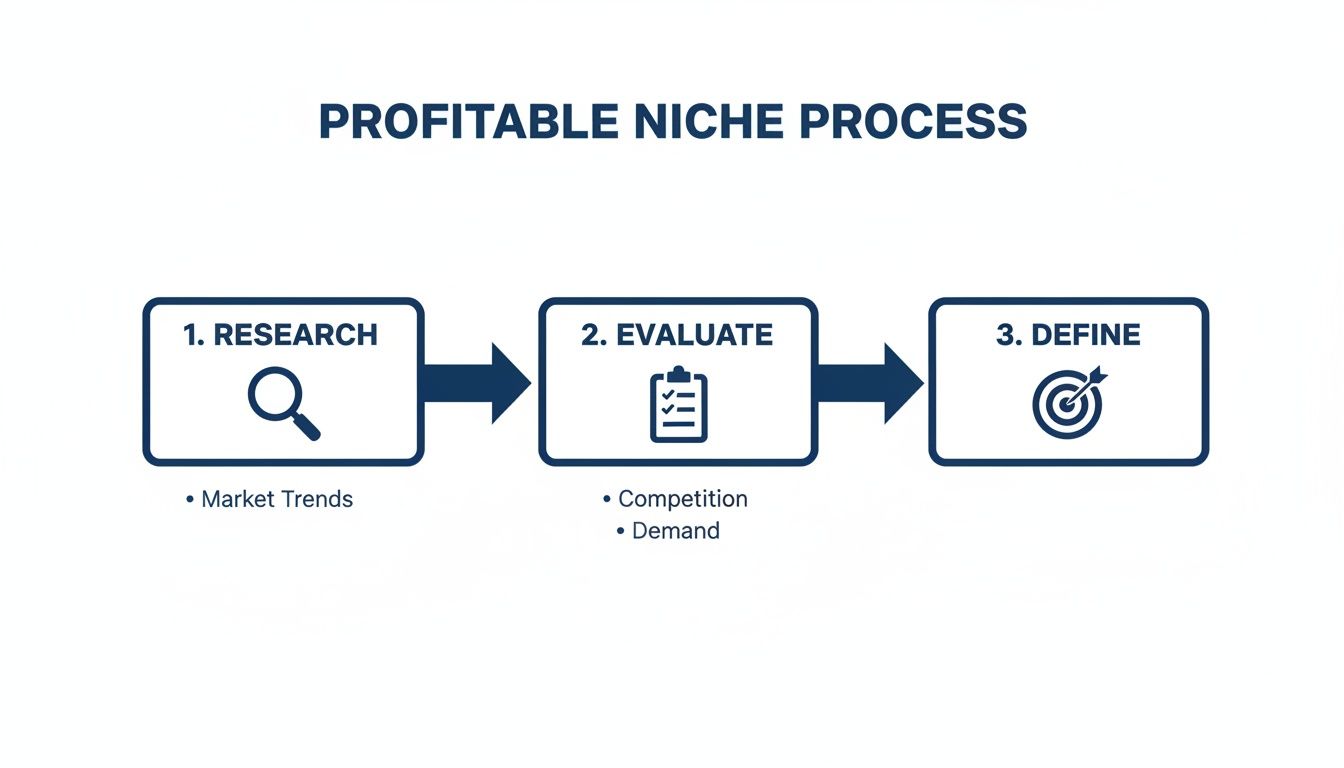
This methodical approach ensures you're not just making content for the sake of it. Every video has a purpose, a plan, and a much higher chance of success.
Scripting and Voiceover: The Foundation
Your script is the absolute foundation of your video. A bland, robotic script will lead to a soulless video, and viewers will click away in seconds. While AI is a fantastic starting point for generating drafts, treat it like a writing assistant, not a ghostwriter.
Use it to hammer out the main points, pull interesting facts, and structure the narrative. Then, it's your job to go in and inject some personality, making it sound more human and conversational.
Once the script is solid, you need to give it a voice. This is where modern AI voice generators like ElevenLabs have become unbelievably good. They offer a massive range of tones, accents, and emotional inflections that sound astonishingly realistic. This is a huge money-saver compared to hiring freelance voice actors for every single video.
Pro Tip: Create a "voice persona" for your channel. Pick one or two specific AI voices and stick with them across all your videos. This builds brand recognition and makes your channel feel more cohesive and professional to your audience.
The AI Toolkit: Visuals, Editing, and More
With your script and voiceover ready, it’s time to build the visual experience. This is where you can really lean on a stack of different AI tools to create something unique and engaging.
Here’s a look at the essential AI toolkit every faceless channel creator should have.
Your Essential AI Toolkit for YouTube Automation
| Production Stage | Recommended AI Tool(s) | Key Feature |
|---|---|---|
| Scriptwriting | ChatGPT, Jasper, Copy.ai | Generates outlines, drafts, and researches topics quickly. |
| Voiceover | ElevenLabs, Murf.ai | Creates realistic, human-sounding voiceovers in minutes. |
| Image Generation | Midjourney, DALL-E 3 | Produces custom, high-quality images from text prompts. |
| Video Generation | RunwayML, Pika Labs, Luma Labs | Turns text prompts or images into unique video clips. |
| Stock Media | Storyblocks, Envato Elements | Access to millions of royalty-free video clips and music. |
Each tool handles a specific piece of the puzzle, but when you combine them, you get a powerful, semi-automated production line that can churn out high-quality videos at a fraction of the time and cost of traditional methods.
Sourcing and Generating Visuals
For a faceless channel, your visuals are everything. They have to be compelling enough to hold a viewer's attention without a human host on screen. The best workflows use a mix of different visual sources to keep things fresh.
- High-Quality Stock Footage: Libraries like Storyblocks or Envato Elements are non-negotiable. They give you millions of professional clips to illustrate almost any topic, from historical reenactments to complex financial charts.
- AI-Generated Images: Tools like Midjourney or DALL-E 3 are perfect for creating custom images that perfectly match what your script is describing. This gives you a level of creative control that stock photos just can't offer.
- AI-Generated Video: This is where things get really exciting. Platforms like RunwayML let you turn a simple text prompt into a short, dynamic video clip. You can create truly unique visuals that no other channel will have.
By blending these sources, you have an endless creative palette. A history channel, for instance, could use AI-generated portraits for historical figures, stock footage for battle scenes, and animated maps to show troop movements. For a deeper dive into the specific tools available, check out our guide on using AI for YouTube videos.
Creating Reusable Video Templates
True efficiency comes from standardization. Instead of building every single video from scratch, you need to create a set of reusable templates in your video editor or within a dedicated platform like ShortsNinja. Think of a template as a pre-built project file that contains your channel's unique DNA.
Your template should include:
- Branded Intros & Outros: A quick, professional animation with your channel's logo and name.
- Text & Title Styles: Pre-set fonts, colors, and animations for any text that appears on screen.
- Transition Effects: A consistent style for transitions between different clips.
- Background Music Placeholder: A designated spot for your preferred style of royalty-free music.
Once you have a template, your production time drops dramatically. The process becomes as simple as dropping in the new voiceover, layering in the right visual clips, and making a few minor tweaks. This is how you go from making one video a week to batching a dozen in an afternoon. This is how you truly scale.
Tuning Your Publishing and Scheduling Rhythm
Making your AI-powered videos is a huge win, but your YouTube automation channel will ultimately live or die by its consistency. True automation isn’t about scrambling to upload at the last minute. It's about building a relentless, predictable publishing machine that the YouTube algorithm learns to trust.
This is where smart batching and scheduling come in, turning your operation from a daily grind into a set-and-forget system. The idea is brilliantly simple: instead of making one video at a time, you knock out a whole month's worth of content in one or two focused sessions.
This method, known as content batching, is a superpower for faceless channels. It’s what lets you maintain a high-frequency upload schedule—which is absolutely vital for fast growth—without completely burning yourself out.
Mastering the Art of Content Batching
Batching your work smooths out the entire production line. Imagine dedicating one day entirely to scripts, the next to creating voiceovers and visuals, and a final day to putting it all together and scheduling it out. It's so much more efficient than jumping between a half-dozen different tasks every single day.
When you're batching, it's a good idea to have a quick "pre-flight" checklist for the final touches. These small details are what separate amateur content from the polished videos that keep people watching.
Your Quick-Edit Checklist:
- Captions and Subtitles: Always add accurate, easy-to-read captions. A huge number of people watch with the sound off, so this is non-negotiable for both accessibility and viewer retention.
- Royalty-Free Music: Find a background track that fits the video's mood. The right music can completely change the emotional impact.
- Sound Effects: Use subtle sound effects to punctuate key moments or transitions. It makes the viewing experience feel much more alive.
- Branding Elements: Make sure your channel logo or watermark is visible but not obnoxious. It's a small thing that builds brand recognition over time.
This systematic approach ensures every single video meets a consistent quality standard before it ever sees the light of day. You’re building a library of dependable assets, not just pumping out one-off videos.
Let Automation Handle the Uploads
Once you have a backlog of finished videos, the final piece of the puzzle is getting them scheduled. Manually uploading every day is a massive time-sink and completely defeats the purpose of automation. This is where a tool like ShortsNinja becomes your best friend, acting as your channel's automated publishing manager.
You can connect your YouTube account, upload an entire batch of videos at once, and set them to go live weeks or even months down the road. The platform takes over from there, pushing your content live at the exact dates and times you chose.
The real magic of a great scheduling tool is hitting those peak viewing times. Dive into your YouTube Analytics to figure out when your audience is most active. Scheduling your videos to drop during these windows gives them the best possible shot at getting immediate traction.
This "set it and forget it" model is the core of a true YouTube automation channel. You do the creative work in focused bursts, and the technology handles the relentless consistency needed for growth.
Why Consistency Is King for Shorts
The need for a steady publishing schedule gets amplified with short-form content. YouTube Shorts, in particular, rewards channels that constantly feed its algorithm with fresh videos. And there's a good reason this format has become such a dominant force.
YouTube Shorts now pulls in an incredible 2 billion monthly active users, putting it way ahead of its rivals. Because it's baked right into the main YouTube ecosystem, it has a massive built-in audience ready to watch. Even more impressive is its engagement: Shorts boasts an industry-leading 73% average viewer retention rate.
This data paints a pretty clear picture: a consistent, high-volume Shorts strategy is one of the fastest ways to build subscribers and funnel traffic to your longer, monetized videos. An automated scheduling system makes this kind of strategy not just possible, but sustainable.
Of course, getting the videos live is only half the battle. You also need to make sure people can find them. Dig into these actionable YouTube SEO optimization tips to ensure your titles, descriptions, and tags are pulling their weight. When you combine smart scheduling with solid SEO, you create a powerful growth engine that works for you around the clock.
Scaling Your Revenue Beyond AdSense
Relying on YouTube AdSense alone is like building your business on someone else's property. It’s a great way to get started, but the real money in YouTube automation comes from treating your channel like a proper business from day one. That means building multiple, independent income streams.
Ad revenue can be a rollercoaster, swinging wildly with seasonality and advertiser demand. To get off that ride, you need to diversify. This shifts your channel from being just a content machine to a robust media asset that earns money from several different angles.
Weaving Affiliate Marketing Into Your Scripts
For most faceless channels, affiliate marketing is the most natural next step after AdSense. The idea is simple: you recommend a product or service, and when a viewer buys through your unique link, you get a cut. The secret is making sure the products are genuinely useful to your audience—authenticity is everything.
Let's say you run a personal finance channel. Instead of just dropping a random link to a budgeting app, you could create a video called, "How I Got My Finances Organized in Under an Hour." Your AI voiceover can then walk through how that specific app was a game-changer, making the recommendation feel like a core part of the story, not a tacked-on ad.
Effective Affiliate Integration Tactics
- Solve a Problem: Frame your product recommendation as the solution to a pain point you’re discussing in the video.
- Use Pinned Comments: Drop your most important affiliate link right into a pinned comment. It’s prime real estate.
- Create a Resource Page: Use a free tool like Carrd to build a simple page listing all your recommended tools. Link to it in every video description.
This approach gives your viewers real value while building an income stream that can easily outpace AdSense, especially before you even qualify for monetization. The best part? You can start earning from your very first video.
The most successful affiliate integrations feel less like a sales pitch and more like a helpful recommendation from a trusted source. The goal is to naturally embed the product into the narrative of your video.
Creating and Selling Your Own Digital Products
The real end-game for many automated channels is moving from promoting other people's products to selling your own. This is where you'll find the highest profit margins and build a direct connection with your audience. For a faceless channel, digital products are a perfect match.
Think about what problems your audience has. If you run a history channel, maybe you could sell beautifully designed digital posters of historical timelines or a short ebook of "100 Lesser-Known Historical Facts." A productivity channel? Notion templates or a digital planner are no-brainers.
These products take some upfront work, but they can generate passive income for years. They're also infinitely scalable—it costs the same to sell one as it does to sell 1,000. You can plug them right in your videos with a simple call-to-action that sends viewers to a sales page.
Capturing High-Value Brand Sponsorships
Once your channel starts picking up steam, brands will take notice. Sponsorships are where a company pays you to feature their product or service in your videos, and they can be incredibly lucrative. For a faceless channel, the key to landing these deals is having strong engagement metrics.
Brands need to see that your audience trusts your content, even without a human face on screen. That means you need to obsess over metrics like:
- Average View Duration: This proves people are actually watching and are hooked on your content.
- Click-Through Rate (CTR) on Links: This shows your audience takes action when you recommend something.
- Comment Sentiment: A stream of positive, engaged comments signals a healthy and active community.
To really step up your game, you need to understand broader content monetization strategies and how they apply to video. Once you have a solid foundation and the numbers to back it up, you can confidently approach brands with a media kit that showcases your channel’s performance.
When you combine all these income streams, you create a powerful growth flywheel. Your optimized videos pull in new viewers, some click affiliate links, others buy your products, and the channel's overall growth attracts bigger sponsors. This diversified approach is what separates a hobby from a sustainable YouTube automation business.
For even more ideas, check out our deep dive on how to earn money on YouTube with faceless videos.
Common Questions About YouTube Automation
Jumping into YouTube automation usually sparks a few big questions. Getting those sorted out from the start saves a ton of headaches and helps you build your channel on solid ground, dodging the common traps that catch new creators. Let's get right into the stuff people always ask.
Is a YouTube Automation Channel Allowed on YouTube?
Yes, absolutely. A YouTube automation channel is perfectly fine by YouTube's rules, as long as your content is original and actually gives the viewer something of value. The word "automation" is just about creating a smarter workflow with tools and freelancers—it has nothing to do with spam bots or shady tactics.
YouTube’s main goal is to crack down on low-effort, repetitive, or spammy content. But when you’re creating unique videos using AI visuals, stock footage, and high-quality AI voices, you're in the clear. The key is that you are producing a new piece of content that people genuinely want to watch. You're trying to build an audience, not game the system.
What Is the Realistic Startup Cost for a Faceless Channel?
Your initial investment can be surprisingly lean, depending on how you approach it. You definitely don’t need a massive budget to get going, but the idea that it’s completely free is a myth.
If you go the DIY route, you might subscribe to a few different AI tools for scripts, voiceovers, and visuals. This could put you somewhere under $100 per month. The downside is that you’ll be juggling multiple platforms and trying to make them all work together.
An all-in-one platform often provides the best value. By bundling scripting, voiceovers, visuals, and scheduling into a single monthly fee, you can simplify your tech stack and potentially lower your overall costs while gaining massive efficiency.
Now, if you decide to outsource things like scriptwriting or video editing to freelancers right away, your monthly costs could easily jump to several hundred dollars. For most people just starting out, the smartest move is to handle the creative direction yourself and use a single, powerful platform to do the heavy lifting.
How Long Does It Take to Start Making Money?
This is the million-dollar question, and the honest answer is: it takes patience and relentless consistency. Sure, a video can go viral overnight, but that’s like winning the lottery. A more realistic timeframe to hit the YouTube Partner Program (YPP) requirements is usually between 6 and 12 months.
To apply for the YPP and start earning from ads, you need two things:
- 1,000 subscribers
- And either 4,000 public watch hours on long-form videos in the last year OR 10 million valid public Shorts views in the last 90 days.
How fast you grow depends on your niche, content quality, and how often you post. Channels that pump out high-quality Shorts every single day often see the quickest subscriber growth. But here's the good news: you don't have to wait for YPP to earn. You can start making money much earlier with things like affiliate marketing, sometimes from your very first videos.
Can I Run Multiple Automation Channels at Once?
You bet, and this is where the YouTube automation model truly shines. Once you’ve built a successful, documented workflow for one channel, you can clone that entire system to launch new channels in completely different niches. This is how you really scale up.
Automation platforms make it totally possible for one person to manage several channels without being completely swamped. You can batch-create videos for each channel weeks or even months ahead of time. It’s a fantastic way to diversify your income and not have all your eggs in one basket.
The proven strategy here is to get one channel right first. Document every single step of your process—from brainstorming ideas to scheduling the final video. Once that channel is running like a well-oiled machine and showing good results, you can use that exact blueprint to launch your second, third, and fourth channels with total confidence. It’s a methodical way to build a real media business.
Ready to build your own content engine? ShortsNinja provides all the AI tools you need to script, generate, and schedule videos in minutes, not hours. Start your free trial today and see how simple a YouTube automation channel can be.