
You’ve probably heard it a million times: “It’s all about the algorithm.” But what does that actually mean?
When we talk about the TikTok algorithm, we're not talking about some mysterious, unbeatable final boss. Think of it as a super-smart matchmaker. Its one and only job is to pair the right video with the right viewer, creating a content experience so personalized that you just can't look away.
Your goal isn't to "trick" it. It's to create videos that naturally give the algorithm what it's looking for: strong engagement signals like long watch times, high completion rates, and—the holy grail—rewatches. When viewers are happy, the algorithm is happy.
Understanding the For You Page Engine
Every single action you take on TikTok—every video you linger on for a split-second too long, every quick scroll past—is a piece of data. The algorithm gobbles up these signals to build an incredibly detailed profile of what you love, what you hate, and what you’re likely to watch next.
And it works. It works so well, in fact, that TikTok’s recommendation engine is responsible for a mind-boggling 85% of all video views. Compare that to Instagram, where only 57% of views come from its Explore and Reels suggestions. This is precisely why brand-new creators can blow up overnight without a single follower to their name. You can dig into more of these eye-opening TikTok statistics to see just how powerful this system is.
How the Algorithm Learns Your Tastes
So, what exactly is the algorithm watching? It’s constantly analyzing a mix of signals, from the obvious to the subtle.
It's not just about what you tap "like" on; it's about your subconscious behavior. The algorithm is smart enough to know the difference.
Here’s a breakdown of the main signal categories it pays attention to:
- User Interactions: These are the most powerful signals by far. We're talking about videos you watch all the way through, rewatch, share, comment on, and like. Just as important are the videos you skip in a heartbeat or flag as "Not Interested."
- Video Information: Think of these as context clues. The algorithm scans your captions, hashtags, and even the specific sounds and effects you use to figure out what your video is about and who might want to see it.
- Device and Account Settings: These are weaker signals but still part of the equation. Things like your preferred language, country setting, and device type help the algorithm fine-tune its recommendations.
The For You Page is a completely unique, living feed tailored to each individual. Its real magic is its ability to adapt in real-time as your interests shift, ensuring no two FYPs are ever the same.
Before we dive deeper, let’s quickly summarize the most important signals the algorithm is tracking.
Key TikTok Algorithm Signals at a Glance
This table breaks down the core metrics that TikTok's algorithm weighs most heavily when deciding whether your video is a dud or the next viral hit.
| Signal Category | Specific Metric | Why It Matters to the Algorithm |
|---|---|---|
| Viewer Retention | Watch Time & Completion Rate | Shows the video is compelling enough to hold attention. High completion is a massive green flag. |
| Repeat Viewing | Rewatches | The ultimate signal of high-value content. It tells the algorithm this video is really good. |
| Active Engagement | Likes, Comments, Shares | Direct indicators that the content is sparking a reaction and building community. |
| Content Metadata | Hashtags & Captions | Helps categorize the video and show it to users interested in those specific topics. |
| Audio & Effects | Trending Sounds & Effects | Using popular audio taps into existing trends, giving the video a built-in discovery path. |
Getting a handle on these signals is the first step. When you know what the algorithm values, you can start creating content that consistently delivers.
From Algorithm-Friendly to Audience-First
Here's the most important mindset shift you can make: stop trying to please a machine and start creating for people. The algorithm is nothing more than a reflection of what we, as humans, find interesting.
Create a video that genuinely hooks someone in the first three seconds. Tell a story that makes them feel something. Provide a tip so useful they have to save it. When you do that, you're not just making good content—you're making algorithm-friendly content by default.
This is where tools like ShortsNinja come in handy. They're built to help you produce high-retention videos at scale. By automating the tedious parts of creation, you can spend your time testing different hooks, storytelling angles, and calls to action. This creates a much faster feedback loop, helping you zero in on what your audience truly wants to see.
Throughout this guide, we'll unpack each of these ranking signals in detail, giving you a clear roadmap to getting more views.
The Watch Time Signals You Must Master
If the TikTok algorithm were a marketplace, viewer attention would be its most valuable currency. Forget vanity metrics like follower counts or even raw view numbers for a moment. The single most important question the algorithm is constantly asking is: "Can this video hold a person's attention?"
Every other signal—likes, comments, shares—is secondary to this core principle. Why? Because TikTok's entire business model is built on keeping users glued to the app for as long as possible. A video that people watch all the way through, or even multiple times, is a glaring sign of high-quality, engaging content that does exactly that.
This is the fundamental secret to cracking the TikTok algorithm for views. Your number one job is to create content that stops the scroll and keeps people watching until the very last second.
Completion Rate: The Ultimate Quality Score
Picture this: you have two videos. Video A gets 100,000 views, but most people swipe away after three seconds, giving it a dismal 20% completion rate. Video B only gets 10,000 views, but viewers are so captivated that a whopping 80% of them watch the entire thing.
Which video does the algorithm value more? Overwhelmingly, it's Video B.
While Video A technically reached more people, it sent a terrible signal: this content isn't interesting enough to hold attention. Video B, on the other hand, sent a powerful positive signal, essentially telling the algorithm, "Users who see this find it extremely valuable." In return, TikTok will reward Video B by pushing it to an even larger audience.
This isn't just theory; it's the bedrock of how modern content gets distributed. By 2026, watch time and completion rate reign supreme in TikTok's algorithm, trumping raw views—a video with 10,000 views at 80% completion is far more powerful than one with 100,000 views at 20%.
The Anatomy of a High-Retention Video
Crafting a video that people can't look away from isn't about luck; it's about structure. High-retention videos almost always follow a simple three-part formula designed to capture and hold viewer focus from beginning to end.
The Hook (Seconds 1-3): This is your one and only chance to stop a user from scrolling. It has to be immediate, intriguing, and promise some kind of value. A strong hook might be a controversial statement, a surprising visual, or a direct question that sparks instant curiosity.
The Narrative (The Middle): Once you've got their attention, you have to deliver on the hook's promise. This is the body of your video where you tell your story, share your tip, or build suspense. The key is to keep the momentum going with quick cuts, on-screen text, and a clear, logical flow.
The Payoff & Rewatch Loop (The End): The conclusion needs to provide a satisfying answer or resolution. A great payoff makes the viewer feel like their time was well spent. An elite-level ending goes one step further—it subtly encourages a rewatch, maybe with a fast-paced reveal or a detail that's easy to miss the first time around.
Key Takeaway: A powerful hook earns you a viewer's attention. A compelling narrative keeps it. A satisfying payoff makes them glad they gave it to you and might even convince them to give it again.
Beyond Watch Time: Engagement Signals That Matter
While watch time is king, other user actions act as powerful supporting signals that reinforce your video's quality score in the algorithm's eyes. Think of them as bonus points that can seriously amplify your reach.
- Shares: When a user shares your video, they're giving it a personal endorsement to their network. This is one of the strongest possible indicators of high-value content.
- Comments: Comments signal that your video sparked a real conversation. The algorithm sees this as deep engagement, especially if you reply and foster a community around your content.
- Saves: A save is a clear sign that a user found your content so useful or entertaining they want to come back to it later. This is particularly potent for educational or tutorial-style videos.
- Rewatches: This is the holy grail of engagement. A rewatch tells the algorithm your content was so good, it was worth watching all over again. This often happens with videos that are dense with information, visually stunning, or have a surprise ending.
Understanding the ideal runtime for your content can significantly impact these metrics. For a detailed breakdown, check out our guide on the best video lengths for TikTok and other platforms. By mastering these attention and engagement signals, you give the algorithm all the proof it needs to push your content far and wide.
How TikTok Distributes Your Video Step by Step
Posting a video on TikTok isn’t like shouting into the void and hoping for the best. It’s way more calculated than that. Think of it like a record label launching a new single. The TikTok algorithm for views doesn't just guess what might go viral; it runs every video through a structured, multi-phase gauntlet to test, validate, and amplify your content based on how real people react.
Your new video is like a fresh demo track. The second you hit "post," the algorithm sends it out to a small, hand-picked "test audience." This group is usually just a few hundred viewers, a mix of your followers and others who’ve already shown interest in similar content. This is your first—and most critical—audition.
During this initial test, the algorithm is watching everything. It’s a data-hungry machine tracking watch time, completion rate, likes, comments, shares—you name it. If this small group loves your "song" and plays it on repeat, that’s a massive green light. But if they skip it? Your video’s journey might be over before it even starts.
This flowchart breaks down the entire process, from that first test audience all the way to viral potential.
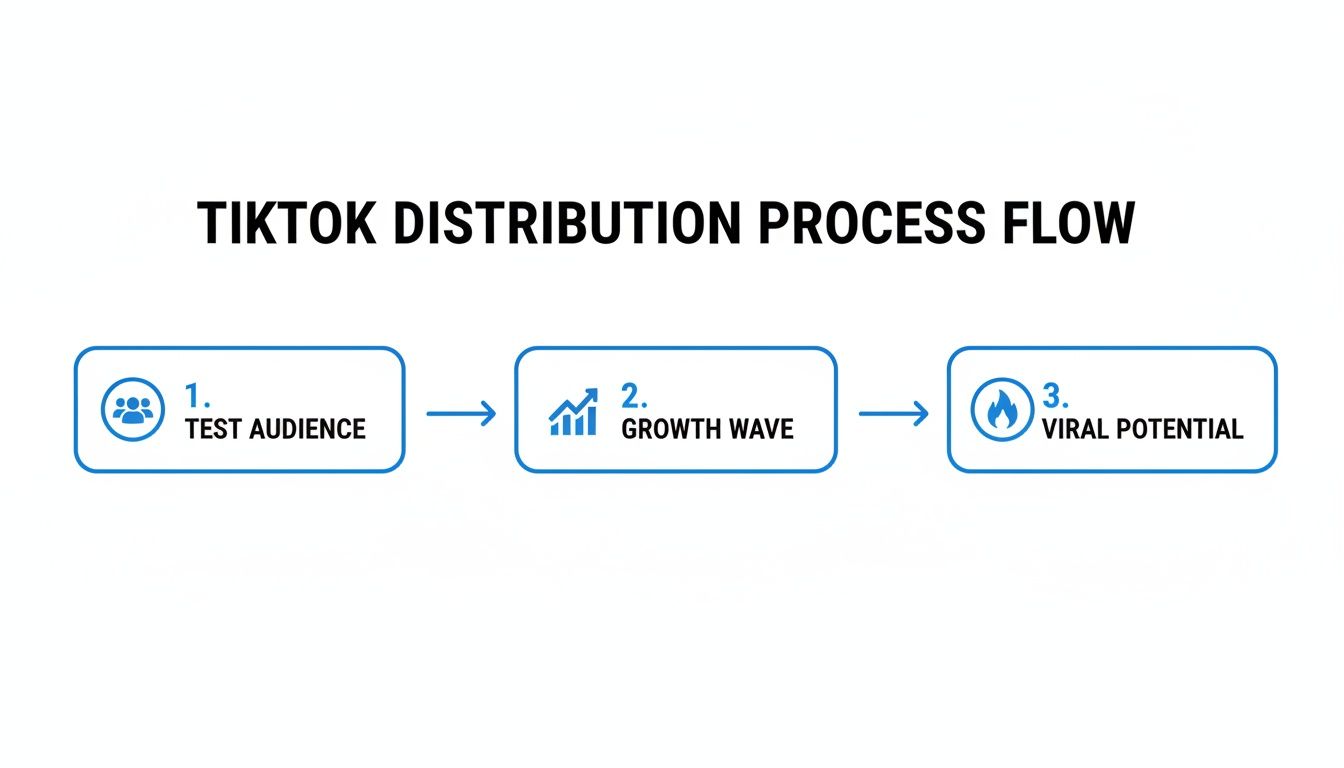
As you can see, a video’s success isn't a single lottery win. It’s a progressive journey where strong audience signals unlock the next level of exposure.
Riding the Growth Waves
So, what happens if your video aces that first test? It graduates to the next phase: the growth waves. This is where things get exciting and your content's reach can explode. The algorithm starts pushing your video to a much larger and more diverse audience, expanding beyond your immediate niche.
It’s like your song going from a tiny local radio station to a major regional network. The audience is bigger, but the test is tougher. The algorithm keeps its eye on the metrics. If the positive signals keep rolling in—high completion rates, a flood of shares—it will keep pushing your video to even bigger waves of viewers. Each new wave can be 10x or even 100x the size of the last one. This is how a video goes from a thousand views to a million, seemingly overnight.
A video's momentum is built in layers. Strong performance in a smaller audience pool earns the right to be shown to a larger one. Failing to engage a wave of viewers can stall this momentum instantly.
The Algorithmic Revival Phenomenon
One of the wildest things about TikTok's algorithm is its ability to bring old content back from the dead. Ever been scrolling your For You Page and suddenly see a video from six months ago? That’s the "algorithmic revival" in action.
This resurrection can happen for a few reasons:
- New Trend Alignment: An old video might suddenly fit perfectly with a new trend, sound, or challenge that’s blowing up.
- Audience Data Refinement: As TikTok learns more about its users, it might discover a whole new audience segment that would love your older video, giving it a second shot at fame.
- Performance Recalibration: Sometimes, a video’s first test run is a bit of a dud. The algorithm might decide to re-test it with a totally different audience weeks or months later, and this time, it just clicks.
This means a video’s life isn't over after the first 24 hours. Content that didn't take off right away can still find its people and gain massive traction long after you posted it. Getting a handle on these mechanics is crucial for long-term growth. To help manage your content strategy around these principles, you might check out tools like Tiktask, which helps organize your approach to video distribution.
Using Contextual Signals for Maximum Reach
If retention metrics are the fuel that powers your video, then contextual signals are the GPS telling the TikTok algorithm for views exactly where to send it. These signals—your hashtags, sounds, captions, and on-screen text—are the data points TikTok uses to figure out what your content is about and who needs to see it.
Think of your video as a package and the algorithm as a global delivery service. Without a clear address label (your contextual signals), that package is going to get lost or dropped off at the wrong door. Nail your signals, and you're essentially paying for express shipping straight to your perfect audience.
These elements are far from decorative; they're direct instructions. A well-chosen hashtag or trending sound is you telling TikTok, "Hey, this video belongs in this conversation, with these viewers."
Mastering Your Hashtag Strategy
Hashtags are your video's most important sorting mechanism. I see a lot of creators make one of two mistakes: they either skip them completely or they stuff their caption with dozens of random tags, hoping something sticks. A balanced, strategic approach is always more effective.
The goal is to cast a wide but targeted net. You do this by blending different types of tags to give your video multiple paths to discovery.
Broad Hashtags: These are the massive, high-volume tags like #DIY or #comedy. They'll connect you to a huge audience, but the competition is fierce.
Niche Hashtags: Think more specific, like #woodworkingprojects or #improvcomedy. The audience is smaller but way more dedicated and likely to engage.
Trending Hashtags: These are your fast-pass to relevance, tied to current challenges or viral moments. Hopping on a trend gives you an immediate visibility boost by tapping into what people are actively searching for right now.
A video about a new coffee recipe, for example, could use #coffee (broad), #icedcoffeerecipe (niche), and a relevant trending sound's hashtag to cover all its bases.
The Power of Sound and On-Screen Text
On TikTok, sound isn't just background noise—it's a discovery engine. When you use a trending sound, your video is automatically grouped with every other video using that same audio. This creates an entirely new lane for people to find your content.
Using a popular sound is like getting an invitation to a party that's already in full swing. The algorithm recognizes the sound's proven appeal and is more likely to show your video to users who have previously engaged with that audio.
And don't sleep on the value of on-screen text and SEO-friendly captions. TikTok's algorithm has gotten incredibly good at "reading" the words in your video.
Clear text that highlights your hook or key points doesn't just help with retention; it feeds searchable keywords directly to the algorithm. Your caption, now up to 4,000 characters, is prime real estate for keywords. By clearly describing your video, you make it easily discoverable via TikTok's search function, opening up another powerful stream of views long after its initial FYP push.
To put it all together, here’s a simple framework for optimizing these signals.
Content Signal Optimization Framework
This table breaks down how to handle the key secondary signals that help the TikTok algorithm categorize and distribute your content effectively.
| Signal Type | Best Practice | Example |
|---|---|---|
| Hashtags | Use a 3-5 tag mix: 1-2 broad, 2-3 niche, and 1 relevant trending tag if applicable. | A baking video might use #baking (broad), #sourdoughtips (niche), #bakingrecipe (niche), and a trending challenge tag. |
| Sounds | Prioritize sounds listed as "Trending" on the creation screen. Check the sound's page for recent viral videos. | Tapping a trending audio track that has thousands of recent videos, even if it’s just background music. |
| On-Screen Text | Add a bold, clear text hook within the first 1-2 seconds that states the video's value or core question. | "3 mistakes everyone makes when painting walls" or "This is the best coffee hack I've ever found." |
| Caption (SEO) | Write a descriptive sentence that includes keywords a user might search for. Treat it like a mini-blog post. | Instead of "My new recipe!", write "Here’s my easy 5-minute iced vanilla latte recipe that you can make at home." |
By treating these signals with the same importance as your retention metrics, you give the algorithm a complete, easy-to-read map to your ideal audience. This ensures your hard work doesn't just get seen, it gets seen by the right people.
Creating Content Series to Boost Engagement
Once you’ve got a handle on the individual signals that make the TikTok algorithm for views happy, you can start weaving them into bigger strategies. One of the most powerful moves you can make is creating a multi-part content series—a tactic that taps directly into the algorithm's hunger for sustained viewership.
A series flips a single video from a one-off moment into an ongoing conversation. Instead of just hoping someone likes your video and scrolls on, you give them a real reason to stick around. You're creating an open loop, that "what happens next?" feeling that is an absolute goldmine for boosting the metrics TikTok loves most.
Why Serialized Content Wins on TikTok
A content series isn't just a bunch of related videos; it's a strategic play for loyalty. When a viewer gets hooked on Part 1, what's their next move? They go straight to your profile to find Part 2. That one action triggers a cascade of positive signals for the algorithm.
Think about it: that profile visit is a massive vote of confidence. While they're there, they'll probably follow you so they don't miss the next part. Or better yet, they'll binge the whole series right then and there. Each of those actions—the profile visit, the follow, the rapid-fire views—screams to TikTok that your content isn't just background noise. It's valuable.
A series is designed to pull viewers off the passive For You Page and into an active exploration of your account. That shift is a huge signal that your content was compelling enough to break the endless scroll, and the algorithm will reward you for it.
The numbers don't lie. As of 2025, multi-part series on TikTok are crushing it, delivering 2.8x higher return viewer rates compared to standalone clips. And it's only getting better. Heading into 2026, series are seeing saves that are 112% higher, with a massive 80% of views coming straight from FYP recommendations. This just proves how incredibly effective they are at grabbing and holding onto an audience.
Actionable Frameworks for Your First Series
You don't need a Hollywood budget to create a series. The trick is to build your content around a central idea that can be broken down into logical, bite-sized episodes. Each part should give a little bit of resolution while teasing what’s coming next.
Here are a few battle-tested templates to get you started:
- The Tutorial Series: Break down a complex skill into easy-to-follow steps. (e.g., "30-Day Guitar Challenge – Day 1: Tuning Your Guitar").
- The Storytelling Arc: Share a personal story or a fictional narrative across multiple videos. (e.g., "How I Started My Business – Part 1: The Idea").
- The Countdown or Listicle: Create a "Top 10" list but only reveal one item per video. (e.g., "Top 5 Places to Visit in Japan – #5: Kyoto").
- The "Behind-the-Scenes" Journey: Document a cool project from start to finish. (e.g., "Building a Custom Desk – Part 1: Choosing the Wood").
For creators who want a deeper dive, our article on how to create a series on TikTok lays out the step-by-step process with more creative ideas to get you going.
This strategy is how you turn casual viewers into a dedicated community, which is the real endgame for long-term growth. Tools like ShortsNinja make this even more manageable by letting you plan, generate, and schedule an entire series in one shot. It ensures you can consistently drop the episodic content that keeps both your audience and the algorithm hooked.
Scaling Your Content Creation with AI
Knowing how the TikTok algorithm for views works is one thing. Actually feeding it what it wants, day in and day out, is a whole different beast. So many creators stall out not because they lack good ideas, but because they just don't have the time. Pumping out high-retention, perfectly optimized videos is a serious grind.
This is exactly where AI-powered tools are changing everything. Platforms like ShortsNinja were built to bridge that gap between knowing the strategy and actually doing it. They turn what used to be an hours-long slog into a task you can knock out in minutes.
But the real magic of that speed isn't just about making more videos. It’s about unlocking the ability to A/B test your ideas at a scale that was totally out of reach for most of us before.
Accelerate Your Learning with AI-Powered Testing
Let's say you want to test three different hooks for your next video. Doing that manually is a huge time sink. You have to re-edit, re-record, and re-export each version. With an AI tool, you can generate all three variations in under 10 minutes, get them live, and let the algorithm’s data show you which opener really stops the scroll.
You can apply this same rapid-fire approach to almost anything:
- Visual Styles: Quickly test different AI-generated images or video clips to see what catches your audience's eye.
- Captions and SEO: Spit out a few caption variations to discover which keywords actually pull in search traffic.
- Calls to Action: Experiment with different end screens to see which one gets more shares or saves.
This constant feedback loop is gold. Mastering engagement is the name of the game, and exploring different strategies for creating engaging TikTok videos will give you a ton of great theories to feed into your AI-driven testing process.
This screenshot shows just how simple the workflow is inside ShortsNinja—a straightforward, three-step process to get from a basic idea to a finished video.
The interface boils down scripting, finding visuals, and editing into one clean path, which is exactly what you need for fast iteration.
From Idea to Optimized Video in Minutes
The modern creator’s secret weapon is iteration. The faster you can ship an idea, see how it performs, and apply what you learned to the next video, the faster you'll zero in on what your audience craves.
By automating the grunt work—writing scripts, hunting for B-roll, adding voiceovers—you free up your brainpower for the stuff that actually matters: analyzing the data and refining your content formula.
AI automation isn't here to replace your creativity; it's here to amplify it. It acts as the engine that lets you consistently feed the TikTok algorithm with high-quality, strategically-tested content. For anyone serious about growing on the platform, learning how to scale content creation with these tools isn't just a nice-to-have anymore—it’s a massive competitive edge that saves time and gets better results.
TikTok Algorithm FAQs: Your Burning Questions Answered
Even with a solid grasp of the basics, you probably have some lingering questions about how the TikTok algorithm actually behaves in the wild. That's totally normal. Think of this section as a quick-fire round to clear up the common "what ifs" that pop up for creators.
Getting these details straight can be the difference between a video that fizzles out and one that finds its audience. Let's tackle some of the biggest points of confusion.
How Quickly Does the Algorithm Start Pushing a Video?
Almost instantly. The moment you hit "post," the algorithm gets to work, serving your video to a small, initial test group. The performance within the first 1-2 hours is absolutely critical for its future.
If that first batch of viewers sticks around and engages, you've given the algorithm a powerful positive signal. It essentially says, "Hey, people like this!" That validation is what triggers the push to a much larger audience, expanding your reach over the next few hours and sometimes even for days.
Does Deleting and Re-uploading a Video Hurt Your Account?
It’s tempting, I know. A video isn't performing, so you think, "I'll just delete it and try again." My advice? Don't do it. While TikTok hasn't put out an official statement on this, the consensus in the creator community is pretty clear: repeatedly deleting and re-uploading content can get your account flagged for spammy behavior.
Key Insight: This can throttle your account's overall reach. A better approach is to treat every underperforming video as a learning opportunity. Figure out why it didn't connect, then use that insight to make your next video even better.
Do Followers Really Matter for Getting Views?
Honestly, not as much as you'd think, especially when you compare TikTok to platforms like Instagram or YouTube. The For You Page is the great equalizer—it’s built to prioritize great content over the creator's follower count. This is exactly why a brand-new account with zero followers can still go viral overnight.
Your followers are still valuable, of course. They act as your first test audience, giving the algorithm its initial batch of data. But the FYP is where the real magic happens, and a video lands there based on its ability to grab and hold attention, period. It doesn't matter who posted it.
Ready to stop guessing and start creating algorithm-friendly content at scale? ShortsNinja uses AI to turn your ideas into high-retention videos in minutes, complete with visuals, voiceovers, and captions. Try it now and see how fast you can grow: https://shortsninja.com