
Before you even think about what to post, let's get the boring—but absolutely essential—stuff out of the way. A solid social media plan for a small business really boils down to two things: knowing what you want to achieve and who you’re talking to.
It's tempting to just jump in and start creating, but that's a fast track to burnout and disappointing results. Putting in a little bit of foundational work first ensures every post, story, and video you create has a purpose and actually connects with the right people.
Building Your Foundation for Social Success
Think of this as pouring the concrete for your house. Without a strong foundation, everything you build on top of it will be shaky. Too many small businesses skip this part, and it’s why they feel like they’re shouting into the void.
We’re going to avoid that common pitfall. Getting this right from the start means your content will be strategic, targeted, and measurable. This isn't about making more work for yourself; it's about making the work you're already doing actually count.
Define Your Business Goals First
Your social media activity needs to tie directly back to what keeps your business running. Goals like "get more followers" are pure vanity metrics—they don't pay the bills. Instead, you need concrete targets that align with real business growth.
The best way to do this is with the SMART goal framework. It forces you to get specific.
- Specific: Don't just say "increase brand awareness." A better goal is "increase mentions of our brand name on Instagram by 20%." See the difference?
- Measurable: How will you track it? For instance, "generate 25 qualified leads per month through our LinkedIn content."
- Achievable: Be honest about your resources. If you're a one-person show, aiming for ten highly polished videos a week is a recipe for disaster.
- Relevant: Does the goal actually help your business? If you run a local brick-and-mortar shop, your focus should be on geo-targeted engagement to drive foot traffic, not on getting followers in another country.
- Time-bound: Give yourself a deadline. "Increase website click-throughs from Facebook by 15% within the next quarter."
This simple exercise turns social media from a chore into a powerful business-building tool. It's a key part of what we break down in our complete guide on social media marketing strategy.
Deeply Understand Your Target Audience
Once you know what you're trying to do, you need to know who you're talking to. This is where a detailed customer persona becomes your best friend. And I'm not just talking about basic demographics like age and location.
A great customer persona feels like a profile of a real person. It details their daily challenges, what they look for online, and what motivates them to engage with a brand.
To really flesh out your persona, start asking the right questions:
- Pain Points: What problems are keeping them up at night that you can solve?
- Online Habits: Where do they hang out online? Are they scrolling TikTok during their lunch break or browsing LinkedIn after work?
- Content Preferences: Do they binge-watch quick tutorials, read deep-dive articles, or share infographics?
- Motivations: What actually drives their buying decisions? Is it all about price, or do they care more about quality, convenience, or brand values?
Let's say you own a local coffee shop. Your persona might be "Busy Professional Brenda," a 32-year-old who needs high-quality coffee and values convenience above all else. She's scrolling Instagram on her morning commute and is a sucker for beautiful latte art and promotions for mobile ordering. Now, every post you create should be made with Brenda in mind.
This level of targeting is non-negotiable today. With 96% of small businesses globally using social media for marketing, you have to be specific to cut through the noise. Getting your audience targeting right is how you stop broadcasting and start connecting.
Choosing the Right Platforms for Your Business
Okay, you’ve figured out your goals and who you’re talking to. Now for the million-dollar question: where do you actually post your content?
https://www.youtube.com/embed/DdH0YHRV7YU
This is where so many small businesses trip up. They get excited and try to be everywhere at once—Facebook, Instagram, TikTok, LinkedIn, you name it. But that’s a fast track to burnout. You end up spreading yourself too thin, and your content becomes bland and generic across the board.
The smarter move? Pick just one or two platforms where you know your ideal customers are already hanging out. It’s about meeting them where they are, not yelling into the void and hoping they find you.
Match the Platform to Your People and Your Purpose
Think of social media platforms like different rooms at a huge party. LinkedIn is the buttoned-up networking event. Instagram is the trendy art gallery opening. And TikTok? That's the chaotic, high-energy dance floor. You wouldn't wear a tuxedo to a rave, right? The same logic applies here.
If you’re a B2B consulting firm, LinkedIn is your playground. It’s the perfect spot to share deep-dive articles, celebrate client wins, and connect with other industry leaders.
But if you’re a local bakery, your people are probably scrolling through Instagram and Facebook, drooling over videos of croissants fresh out of the oven or stunning photos of custom cakes. The vibe is completely different, and your content needs to match.
This simple flowchart breaks it down. Every decision you make, especially which platform to focus on, has to connect back to your original goals and your customer persona.
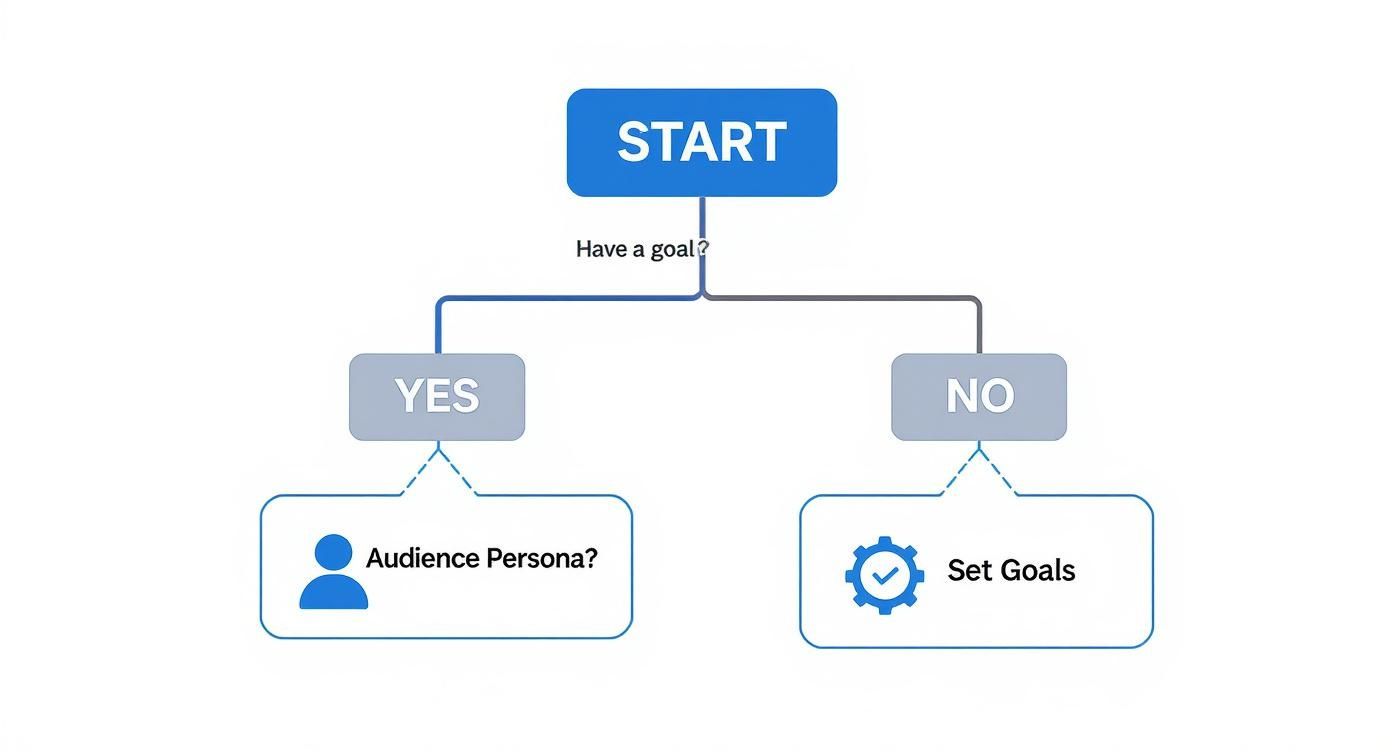
Without those two foundational pieces, you're just guessing.
Know Who Uses What (And What They Post)
Every platform has its own distinct personality, user base, and content style. You need to dig deeper than just total user numbers and see if the demographics actually line up with your ideal customer.
To make this easier, here’s a quick-glance table breaking down the top contenders for small businesses.
Platform Focus for Small Business Goals
| Platform | Primary Audience | Best For | Top Content Formats |
|---|---|---|---|
| Broad (All Ages) | Community building, local businesses, targeted ads | Video, images, events, groups, live streams | |
| Gen Z & Millennials | Visually-driven brands (fashion, food, travel, art) | Reels, Stories, carousels, high-quality photos | |
| TikTok | Gen Z & Millennials | Entertainment, trends, personality-driven content | Short-form vertical video, user-generated content |
| Professionals, B2B | Networking, lead generation, thought leadership | Articles, text posts, polls, video, case studies | |
| Primarily Women | Inspiration & planning (DIY, decor, recipes, weddings) | Infographics, tutorials, product pins, idea pins |
This table should give you a solid starting point. For instance, if you're targeting Gen Z with fun, trendy short-form video, you’re likely weighing TikTok against Instagram Reels. It pays to do your homework by understanding the nuances of platforms like TikTok and YouTube Shorts to see which one feels like a better home for your brand’s voice.
Engagement Is the Real Metric, Not Followers
A massive follower count is just a vanity metric if nobody is actually interacting with your posts. What you should be looking for is genuine engagement—likes, comments, shares, and saves.
Don't chase a presence on every new platform. Master one or two channels where your audience is most engaged before considering expansion. Quality and consistency on a few platforms will always beat sporadic, low-quality efforts on many.
Different platforms also have wildly different organic engagement rates. For creators with under 100,000 followers, TikTok is the undisputed king, with organic engagement rates hitting as high as 7.5%. That absolutely crushes Instagram’s 3.65%.
On the B2B side of things, LinkedIn is a powerhouse. Multi-image posts there see a 6.6% engagement rate, and even video posts pull in a strong 5.6%.
Choosing your platform based on where you can get the most meaningful interaction is one of the smartest moves you can make.
Nail Your Content Pillars and Build a Winning Calendar
Alright, this is where the rubber meets the road. Consistent, high-quality content is what fuels a winning social media strategy, and it all starts with your content pillars. This is the framework that ends the daily panic of, "What on earth am I going to post today?" and makes sure everything you create ties back to your brand.
Think of content pillars as the main conversation topics for your business. You'll want to land on 3-5 broad themes that your audience genuinely cares about and that are directly connected to what you do. Get these right, and creating content becomes strategic and a whole lot easier.
Defining Your Core Content Pillars
Your pillars need to live at the sweet spot where your audience's interests and your business's offerings overlap. It's not just about selling; it's about adding real value by educating, entertaining, and inspiring them. That’s how you build a community, not just a list of customers.
Let's make this real. Imagine you run a local fitness studio. Instead of just throwing random workout videos out there, you could build your strategy around these pillars:
- Workout of the Week: Short, effective routines people can do at home or in the gym. This instantly shows off your expertise and gives them something they can use right away.
- Member Success Stories: With their permission, of course! Sharing a client's journey is powerful social proof and forges a genuine emotional connection with your audience.
- Nutrition Tips: Simple, actionable advice on healthy eating that supports a fitness lifestyle. This positions you as a go-to wellness resource, not just a gym.
- Behind the Scenes: Introduce your trainers or give a sneak peek of a new class setup. This is how you humanize your brand and build that all-important trust.
Just like that, these four pillars give the studio an endless well of content ideas. Each one can be spun into dozens of posts, from Instagram Reels to Facebook Live Q&As.
Content pillars are your brand's storytelling guideposts. They ensure that every piece of content you create reinforces who you are and serves the audience you want to attract.
Put Short-Form Video at the Top of Your List
Within each of your pillars, short-form video has to be a top priority. It’s not a trend anymore—it’s the main way people connect with brands and discover new products. This format is perfect for breaking down your big pillar ideas into snackable, engaging clips.
And the numbers don't lie. Short video is the go-to format for 78% of consumers when learning about products, which lines up perfectly with the 89% of businesses already using video marketing. For small businesses, this means creating authentic, organic videos that tap into the massive social commerce movement.
So, for our fitness studio example, that looks like:
- Workout Pillar: A 30-second Reel showing a new kettlebell exercise.
- Success Story Pillar: A 60-second TikTok of a member talking about their favorite class.
- Nutrition Pillar: A quick Instagram Story Q&A where a trainer answers questions about pre-workout snacks.
Build a Simple Weekly Content Calendar
Once your pillars are set, it's time to get organized with a content calendar. This doesn't have to be some overly complicated software; a simple spreadsheet is a perfect place to start. The goal here is to plan your posts a week or two ahead to ensure you have a healthy mix of content going out.
A good calendar balances different post types to keep your audience hooked and avoid "sales fatigue." The 80/20 rule is a fantastic guideline: 80% of your content should provide value (educate, entertain, inspire), and only 20% should be directly promotional.
Here’s what a sample week could look like for our fitness studio, using their pillars:
| Day | Platform | Content Pillar | Content Type | Call to Action (CTA) |
|---|---|---|---|---|
| Mon | Workout of the Week | Reel: "3 Moves for a Stronger Core" | "Save this for your next workout!" | |
| Tue | Member Success | Text & Photo: Client testimonial | "Tag a friend who inspires you." | |
| Wed | Behind the Scenes | Story: "Meet our new trainer, Alex!" | "Ask Alex a question in the box!" | |
| Thu | TikTok | Nutrition Tips | Video: "My 3 Favorite Healthy Snacks" | "What's your go-to snack?" |
| Fri | Promotional (20%) | Event Post: "Sign up for our Yoga Workshop!" | "Link in bio to book your spot!" |
This kind of structure turns social media management from a reactive scramble into a proactive, strategic part of your business. If you want to dive deeper and save yourself hours each week, learning how to build an effective social media content calendar is the perfect next step.
Building an Efficient Content Machine

Time is the one thing every small business owner is short on. A brilliant social media plan means nothing if you don't have the hours in the day to actually pull it off. This is where smart workflows come in—they turn social media from a relentless daily grind into a manageable, high-impact system.
It's all about working smarter, not harder. Instead of scrambling for something to post every single day, you'll build a system that squeezes every drop of value out of the content you create. The result? More consistency, way less stress, and more time for you to focus on what you do best: running your business.
Master the Art of Content Repurposing
Forget the "create once, post everywhere" trap. That's a fast track to mediocre content that doesn't quite fit anywhere. The real magic is in the "create once, distribute thoughtfully" approach.
Repurposing isn't just copying and pasting. It’s about taking one core idea and smartly adapting it for different platforms and formats. Think of it like this: you roast a chicken on Sunday. On Monday, the leftovers go into sandwiches. By Tuesday, you’re using the bones to make a rich soup stock. One chicken, three completely different meals. Your content can work the same way.
Repurposing isn't about being lazy; it's about being strategic. It ensures your core messages reach the widest possible audience in the formats they prefer, multiplying the return on your initial time investment.
Let's say you filmed a five-minute customer testimonial video. Here’s how you could spin that one piece of content into gold:
- Instagram Reel: Snip out the most powerful 30-second clip, add some trending audio, and you’ve got a Reel that’s ready to fly.
- LinkedIn Post: Write a text post summarizing the customer's problem and how you solved it. Pull out a killer quote from the video to make it pop.
- Instagram Story: Design a simple, eye-catching graphic with the single most compelling line from the testimonial.
- Facebook Post: Share a slightly longer, one-minute cut of the video. End it with a question to get your audience talking in the comments.
- Email Newsletter: Embed the full five-minute video to give your subscribers a powerful dose of social proof right in their inbox.
Boom. One video, five unique pieces of content. Each one feels native to the platform it's on. That’s the foundation of a workflow that actually works.
Use Smart Automation and Scheduling
Consistency is everything on social media. It's how you stay on your audience's radar. But that doesn't mean you have to be chained to your phone, posting in real-time all day long. Automation and scheduling tools are your best friends here, helping you stay consistent without burning out.
Platforms like Buffer or Later allow you to batch-upload your posts and schedule them to go live at the perfect times. You can knock out an entire week's worth of content in just a few hours. This simple shift frees you from the tyranny of the daily post. For a deeper dive, our guide on how to schedule social media posts has everything you need to get started.
Embrace the Power of Batching
Content batching is a game-changer. It’s the simple act of grouping similar tasks together and doing them all in one focused session. Instead of constantly switching gears between planning, shooting, writing, and scheduling, you dedicate specific blocks of time to each task. The focus is intense, and the efficiency is undeniable.
Here’s what a batching workflow could look like:
- Planning (1 Hour): On Monday morning, you sit down with your content calendar. You brainstorm and finalize every post idea for the week.
- Creating (2-3 Hours): Monday afternoon is all about creation. You film all your videos, design your graphics, and write every caption in one go.
- Scheduling (1 Hour): Tuesday morning, you take all that finished content and plug it into your scheduling tool for the entire week.
And just like that, you've handled your social media for the next seven days in just a few focused hours. This frees up your mental energy and lets you spend the rest of the week actually engaging with your community and, you know, running your business.
Measuring Performance and Optimizing Your Strategy

If you're creating content without measuring what it does, you're basically driving with your eyes closed. Sure, you're moving, but who knows if you're even on the right road? A data-driven approach is what separates random posting from a predictable engine for growth, making sure every ounce of effort you put in actually pays off.
And don't worry, this isn't about getting tangled up in complex spreadsheets. It's about zeroing in on the few key numbers that tell you the real story of what’s working.
Moving Beyond Vanity Metrics
It's tempting to get a rush from a post getting tons of likes or watching your follower count climb. But those are what we call vanity metrics. They feel great, but they often don't mean much for your actual business goals. A post can rack up hundreds of likes and still not lead to a single website visit or sale.
A smart small business social media strategy is all about action-oriented KPIs. These are the numbers that directly connect your social media activity to your bottom line.
- Click-Through Rate (CTR): This tells you how many people who saw your post cared enough to actually click your link. It’s a fantastic measure of how compelling your content and call-to-action really are.
- Conversion Rate: This is the big one. It tracks the percentage of people who take the desired action after clicking—like signing up for your email list, downloading a freebie, or making a purchase.
- Cost Per Click (CPC): If you're putting money into ads, this metric is your best friend. It shows exactly what you’re paying for each click, helping you see if your ads are efficient and hitting the right audience.
Focusing on these metrics gives you a much clearer picture of what's driving real results. You stop just being on social media and start profiting from it.
Using Built-In Analytics Tools
The good news? You don't need to shell out for expensive software to get started. Every major social platform comes with its own set of powerful, free analytics tools that are packed with valuable information.
For example, Instagram Insights will show you which Reels got the most reach, how many profile visits a specific post drove, and even the demographics of your most engaged followers. Facebook's Meta Business Suite offers similar data, letting you see which posts are earning the most clicks or comments.
Your analytics dashboard is the most honest focus group you'll ever have. It tells you exactly what your audience responds to, not what you think they want to see.
Just set aside a little time each week to poke around in these reports. You'll start noticing patterns pretty quickly. Maybe your behind-the-scenes videos consistently get more saves and shares than your polished product shots. That’s not just interesting—it's a direct command telling you exactly what to create next.
Creating a Simple Monthly Review Framework
To keep this from feeling overwhelming, just create a simple monthly review for yourself. At the end of each month, sit down with your numbers and ask a few key questions. This isn’t about judging your performance; it’s about learning and getting better.
Here’s what your monthly check-in should cover:
- Which content pillar performed best? Look at your main themes. Did your "How-To" tutorials send more traffic to your site than your "Customer Spotlight" posts? This is how you know where to double down.
- What was our top-performing post and why? Find your single best post for the month and dissect it. Was it a video? A carousel? A question? Figure out the magic formula so you can try to replicate it.
- What time of day drove the most engagement? Most platforms will literally show you a chart of when your audience is most active. Use that data to tweak your posting schedule for maximum impact.
- How did our link clicks and conversions change? Are more people taking the actions you want them to take? If not, maybe it's time to test out some new calls to action or look at the landing page you're sending them to.
This cycle of creating, measuring, and optimizing is the secret sauce to a social media presence that actually works. It keeps your strategy fresh, aligned with your audience, and consistently delivering results that help your small business grow.
Frequently Asked Questions
Jumping into social media often feels like learning a new language, filled with unspoken rules about best practices, budgets, and which trends are actually worth your time. Let's cut through the noise with some straight answers to the questions I hear most from small business owners.
How Often Should I Be Posting?
The golden rule here is consistency over frequency. Seriously. It’s far better to publish three high-quality, engaging posts every single week than it is to post twice a day for a week and then vanish for the next two. Burnout is a real danger, so set a pace you can actually maintain.
A great starting point is 3-5 times a week on your main platform. This keeps you on your audience's radar without completely taking over your life. Once you get into a groove, your analytics will tell you what’s working, and you can adjust from there based on engagement and what you can realistically handle.
The goal is to build a sustainable habit, not to win a short-term sprint. An audience that knows when to expect content from you is an audience that is more likely to engage.
Do I Really Have to Make Videos?
In a word, yes—but don’t let that scare you. Short-form video (think Reels and TikToks) is the undisputed king of engagement right now. People have shown time and again they'd rather watch a quick video to learn about a product than read a long post.
And here's the best part: authenticity almost always beats high-production value. You don’t need a fancy film crew; your smartphone is more than enough to get started.
- Go behind the scenes: Show off your workspace, introduce your team, or give a sneak peek at how your product comes to life.
- Do a quick demo: Highlight one single feature or a cool way to use your product in under 30 seconds.
- Answer a customer question: Grab your phone and record a quick, personal answer to a question you get all the time.
These simple videos make your brand feel human and relatable, which is the foundation of building a real community online.
How Much Should I Spend on Ads?
You don’t need a huge ad budget to make an impact. In fact, starting small is the smartest way to go. Kick things off with a small, experimental budget—something like $5 to $10 per day on a platform like Facebook or Instagram where you know your audience hangs out.
Use that initial budget to "boost" your best-performing organic posts. It’s a low-risk method to get your proven content in front of a bigger, more targeted audience. This strategy lets you:
- Test what works: See which content, images, and messages get the most clicks and comments.
- Gather valuable data: Learn who is actually responding to your ads.
- Optimize before you scale: Use what you've learned to refine your strategy before you even think about increasing your ad spend.
Where Can I Find More Answers?
Building a solid social media presence is a process of continuous learning. Platforms change, new trends pop up, and you're going to run into new challenges along the way. For more insights into the hurdles you'll inevitably face, you might find some answers in these common social media FAQs. Staying informed will help you make decisions with confidence and adapt as your business grows.
Ready to create high-quality short videos without the headache? ShortsNinja uses AI to turn your ideas into engaging faceless content for TikTok, YouTube, and Instagram in minutes. Stop spending hours editing and start growing your channels on autopilot. Try ShortsNinja today and see how easy content creation can be!