
Welcome to the ultimate launchpad for your next short film. In a saturated media landscape, a compelling idea isn't just a starting point; it's the entire foundation. A well-crafted prompt can be the difference between a forgotten project and a festival-winning masterpiece. This guide moves beyond generic suggestions like "a mysterious box arrives." Instead, we're providing structured, actionable prompts for short films, complete with cinematic frameworks and practical tips.
This collection is designed to be your creative toolkit. You will discover how to turn specific constraints into cinematic strengths, build compelling narratives without dialogue, and structure a story that captivates from the first frame to the last. We'll explore powerful concepts including:
- Single-location storytelling
- Reverse chronology narratives
- Found footage and POV perspectives
- Experimental and non-linear structures
Whether you're a seasoned director battling creative block or a first-time filmmaker looking for a solid blueprint, these prompts are designed to challenge you and streamline your pre-production. Each entry includes specific implementation details, example loglines, and even suggestions for adapting the ideas for modern tools like AI video generators. Forget the blank page. Your next great film idea starts right here, with a prompt that sparks genuine creativity and provides a clear path from concept to final cut. Let's dive into the frameworks that will help you create a film that truly resonates with your audience.
1. One Location, Multiple Stories
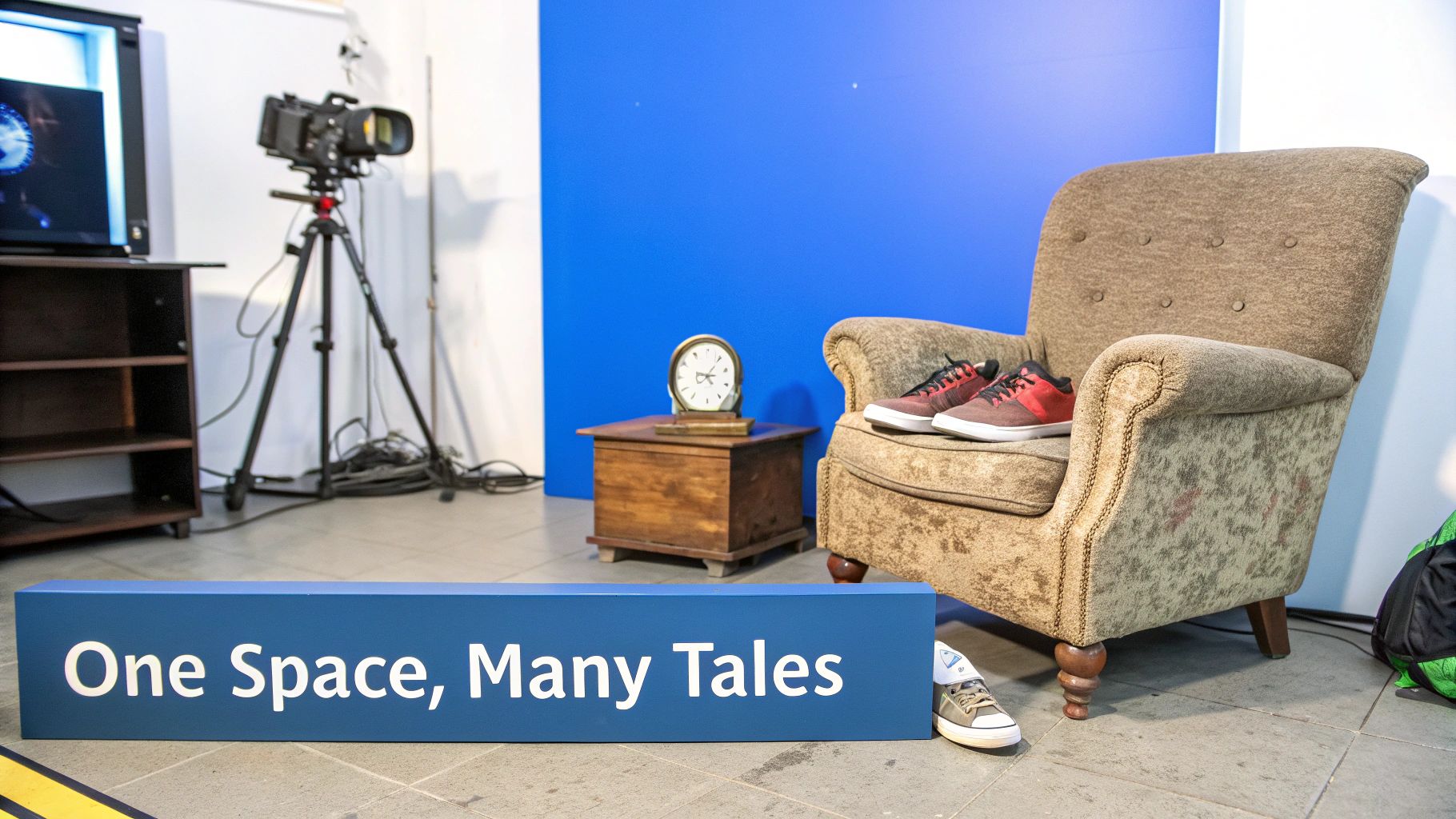
This powerful creative constraint challenges you to tell a compelling story within a single, unchanging setting. Instead of relying on varied scenery, the "One Location, Multiple Stories" prompt forces you to explore the depth of a single space, using it as a character in its own right. The narrative can unfold through interconnected vignettes, parallel timelines, or the layered perspectives of different characters all experiencing the same environment.
This approach is one of the most effective prompts for short films for filmmakers working with limited budgets, as it minimizes the complexities of company moves, location scouting, and set dressing. It shifts the focus from spectacle to substance, demanding sharp writing, nuanced performances, and inventive cinematography to keep the audience engaged.
Why This Prompt Works
A single location acts as a narrative pressure cooker. By confining the action, you naturally heighten tension and force characters to confront each other and their circumstances directly. Think of the intense jury room in 12 Angry Men or the claustrophobic vertical prison in The Platform. The environment shapes the conflict, revealing character through interaction with the limited space available.
Actionable Tips for Implementation
- Design a Dynamic Set: Your location needs depth. Include windows, doors, and distinct zones (a kitchen, a desk, a seating area) that allow for varied shot composition and character movement.
- Manipulate Time and Light: Show the passage of time through changing light. A sunbeam moving across the floor or the shift from daylight to artificial light can completely alter the mood.
- Leverage Sound Design: Use off-screen sounds to expand the world. The sound of city traffic, a neighbor's argument, or an approaching storm can add layers of context and tension without ever showing the source.
- Strategic Camera Work: Use camera angles and movement to reveal new information. A slow push-in can build suspense, while a high-angle shot can create a sense of vulnerability or observation.
This prompt is also perfect for serialized content. You could use the same location as a recurring setting for an episodic story, a format that performs exceptionally well on platforms like TikTok. Check out our guide on how to create a compelling series for social media for more ideas on this approach.
2. No Dialogue Challenge
This classic filmmaking exercise strips away spoken words, forcing you to communicate a complete narrative using only visual language. The "No Dialogue Challenge" is a pure test of cinematic skill, where every element-from an actor's subtle glance to the color of a prop-must carry narrative weight. It compels filmmakers to master the art of "show, don't tell," relying on action, expression, sound design, and music to evoke emotion and drive the plot forward.
Embracing this constraint is one of the most powerful prompts for short films for honing your storytelling instincts. By removing the crutch of dialogue, you learn to build scenes that are universally understood, transcending language barriers. It forces a return to the visual roots of cinema, making you a more thoughtful and deliberate director.
Why This Prompt Works
Without dialogue, the audience becomes a more active participant, piecing together the story from visual and auditory clues. This active engagement creates a deeper, more immersive experience. The silence amplifies the impact of every sound and image, making a simple gesture or a sudden musical cue incredibly powerful. Think of the emotional weight conveyed in Pixar's Bao or the silent-era masterpieces of Charlie Chaplin; their stories resonate because they communicate through the universal language of human emotion and action.
Actionable Tips for Implementation
- Storyboard Meticulously: Plan every shot. Your storyboard is your script, defining the visual flow, character actions, and emotional beats without relying on words.
- Focus on the Eyes: The eyes are the most expressive part of the human face. Direct your actors to convey thoughts and feelings through their gaze, blinks, and brow movements.
- Use Props as Symbols: Every object can tell a story. A wilting flower, a ticking clock, or a dropped photograph can signify themes like decay, urgency, or loss.
- Invest in Sound and Music: Your soundscape becomes a primary character. A carefully chosen score can set the entire mood, while specific sound effects (a creaking door, a distant siren) can provide crucial context and build tension.
- Emphasize Physicality: Direct your actors to use clear, motivated body language. The way a character walks, slumps their shoulders, or clenches their fist should reveal their internal state.
3. Reverse Chronology Storytelling
This narrative technique flips traditional storytelling on its head by presenting events in reverse order. You begin with the conclusion, a dramatic or enigmatic final moment, and then meticulously work backward to reveal the causes, motivations, and sequence of events that led to it. The audience knows the destination from the start; the mystery lies in understanding the journey.
This non-linear structure is one of the more ambitious prompts for short films, demanding careful planning and precision. Instead of building suspense toward an unknown outcome, it generates a unique form of tension and dramatic irony. The audience is constantly re-evaluating what they know as each new scene adds a layer of preceding context. This transforms the viewing experience from "what will happen?" to "why did this happen?"
Why This Prompt Works
Reverse chronology forces an active viewing experience. The audience becomes a detective, piecing together clues to solve the puzzle of the narrative. It’s an incredibly effective way to explore themes of fate, causality, and the weight of past decisions. By showing the tragic end first, as in Gaspar Noé’s Irréversible, the story emphasizes the inevitability of the outcome and shifts focus to the human moments that preceded it. Christopher Nolan's Memento uses this structure to immerse the audience in the protagonist's disoriented state of mind.
Actionable Tips for Implementation
- Start with a Powerful Ending: The first scene you show must be captivating. It needs to be visually striking and emotionally charged to hook the audience and make them invest in understanding its origin.
- Plant Reverse Clues: Scatter subtle visual or auditory hints throughout the story that only make sense in retrospect. An object in one scene might be explained by an event in a later scene (which occurred earlier in time).
- Maintain Character Consistency: A character's emotional state in one scene must be a logical result of what happened in the "next" scene (the one that came before it chronologically). This requires meticulous character tracking.
- Use Clear Temporal Markers: Help the audience follow the timeline. Use on-screen text ("Two Hours Earlier"), shifts in lighting, costume changes, or a recurring sound motif to signal a jump backward in time.
4. Found Footage / POV Camera
This filmmaking style frames the entire narrative as if it were discovered or captured by the characters themselves. The story unfolds through handheld cameras, security footage, smartphone videos, or other recording devices within the film’s world. This immersive technique shatters the fourth wall, placing the audience directly into the protagonist's visceral, first-person experience.
Found footage is one of the most compelling prompts for short films because it creates immediate intimacy and authenticity. By mimicking real-world recordings, it lowers the barrier to suspension of disbelief and can be incredibly effective for horror, thrillers, and mockumentaries. The raw, unpolished aesthetic often makes the unbelievable feel frighteningly plausible, as seen in classics like The Blair Witch Project and REC.
Why This Prompt Works
The core strength of found footage is its inherent sense of realism and urgency. The limited perspective of a single camera forces the audience to experience events as the character does, complete with shaky movements, obstructed views, and panic. This limitation becomes a narrative tool, building tension by what it doesn't show. The "why is this being filmed?" question adds a layer of mystery and motivation that can drive the plot forward.
Actionable Tips for Implementation
- Justify the Camera: Establish a strong, logical reason for the character to be filming continuously. Are they a journalist, a vlogger, a ghost hunter, or simply documenting a strange event? This justification is crucial for believability.
- Embrace Imperfection: Authenticity comes from flaws. Incorporate realistic technical glitches, battery-dying warnings, moments of fumbling, and out-of-focus shots to enhance the realism. Avoid making it look too polished or professionally shot.
- Vary the Source: In a modern context, you aren't limited to a single camcorder. Mix footage from different sources like a smartphone, a laptop webcam, a security camera, and a body cam to create a more dynamic and contemporary feel, as seen in Searching.
- Sound is Your Co-Star: Since the visuals are often chaotic or limited, sound design becomes paramount. Use off-screen noises, panicked breathing, distorted audio, and sudden silences to create suspense and tell the story beyond the frame.
5. Constraint-Based Filmmaking (Format Limits)
This approach turns limitations into creative fuel by imposing strict technical or thematic rules on your production. Instead of being stifling, these boundaries challenge you to solve problems in novel ways, forcing you out of your comfort zone and into a space of pure innovation. The prompt could be a time limit (like a 60-second film), a technical rule (only natural light), or a narrative constraint (no dialogue).
Constraint-based filmmaking is one of the most effective prompts for short films for sharpening your skills as a director, writer, and cinematographer. It strips away the excess and demands that you focus on the core elements of storytelling. By working within a rigid framework, you often discover creative solutions you would have never considered otherwise, leading to a more distinct and memorable final product.
Why This Prompt Works
Constraints force you to be deliberate with every choice. When you can only use a single camera angle, every bit of set dressing and actor blocking becomes critical. When you have only 60 seconds, every shot must be packed with meaning. This method, popularized by movements like Dogme 95 and events like the 48-Hour Film Project, proves that limitations can amplify creativity rather than restrict it.
Actionable Tips for Implementation
- Choose Stories That Fit: Don't try to cram a complex epic into a one-minute format. Select a concept that naturally thrives within the given constraints, such as a single, powerful moment or a quick, witty interaction.
- Plan Meticulously: The more constraints you have, the more important pre-production becomes. Storyboard every shot, rehearse extensively, and plan your lighting and sound design to the last detail before you ever press record.
- Use Constraints as a Springboard: Don't view the rules as a cage; see them as a creative challenge. If you can't use dialogue, how can you tell your story visually? If you only have one location, how can you make it feel dynamic?
- Focus on the Core Narrative: Above all, the story is king. Ensure your creative execution serves the narrative, not the other way around. The goal is to make the audience forget the constraints and become immersed in the world you've built.
This prompt is especially relevant for social media, where platform-specific time limits are a built-in constraint. To master this, it's crucial to understand what works best for each format. Explore our guide to find the best video lengths for TikTok, YouTube, and Instagram and turn those limits into your creative advantage.
6. Character Study / Monologue Format
This prompt strips away complex plot mechanics to focus entirely on the interior world of a single character. Instead of driving the narrative with external events, the story unfolds through a monologue, an intimate confession, or a series of revealing moments. The film becomes a psychological portrait, exploring a character's deepest fears, desires, memories, and contradictions.
This approach is one of the most powerful prompts for short films for showcasing an actor's range and a writer's command of voice. It’s an exercise in depth over breadth, demanding a script that is both poetic and revealing, paired with a performance that can captivate an audience with minimal action. Think of the raw vulnerability in the Oscar-winning short Stutterer or the masterful confessions in Fleabag.
Why This Prompt Works
Focusing on a single character creates an immediate and intense connection with the audience. By letting viewers into someone's private thoughts, you build empathy and curiosity. The limited scope forces you to make every word and every glance count, resulting in a dense, emotionally charged narrative. It's a pure form of storytelling where a compelling character is the entire plot.
Actionable Tips for Implementation
- Choose a Compelling Subject: The character must have a strong, unique voice and a compelling internal conflict. A person at a crossroads, confessing a secret, or grappling with a memory works well.
- Balance Words and Visuals: Don't just show a talking head. Use the environment, lighting, and objects to visually echo the character's internal state. A messy room might reflect a chaotic mind, while a single, stark light can create a feeling of interrogation.
- Use Close-Ups Masterfully: Micro-expressions are your best friend. A slight quiver of the lip or a flicker in the eyes can convey more than a full page of dialogue. Frame your actor to capture these subtle emotional shifts.
- Create a Narrative Arc: Even a monologue needs a beginning, middle, and end. The character should be in a different emotional or psychological place by the end than they were at the start.
This prompt is an excellent starting point for new filmmakers looking to hone their storytelling skills. To build a strong foundation, dive into our guide on script writing for beginners to learn how to craft a character voice that can carry an entire film.
7. Twist/Unreliable Narrator Structure
This classic narrative device challenges you to construct a story where the audience's understanding is deliberately manipulated, leading to a powerful revelation that reframes everything they have seen. By using an unreliable narrator, withholding crucial context, or presenting false information, you guide viewers down one path only to reveal the true picture in the final moments. The goal is to create a shocking and satisfying twist that makes the story worth rewatching.
This framework is one of the most memorable prompts for short films because it hinges on clever storytelling rather than a large budget. The impact comes from the intellectual and emotional surprise, a testament to a well-crafted script. It forces a filmmaker to be meticulous with details, knowing that the audience will scrutinize every frame after the big reveal, as seen in iconic films like The Usual Suspects and The Sixth Sense.
Why This Prompt Works
A narrative twist creates an active viewing experience, turning the audience into detectives trying to piece together the truth. When the reveal lands, it provides a jolt of cognitive dissonance followed by the satisfaction of a puzzle being solved. This structure inherently builds suspense and mystery. The unreliability can be rooted in a character's psychology (Shutter Island), deliberate deception (Gone Girl), or a fundamental misunderstanding of their reality.
Actionable Tips for Implementation
- Plant Fair Clues: A great twist feels earned, not random. Sprinkle subtle hints, visual cues, or double-meaning dialogue throughout the film. These "breadcrumbs" reward observant viewers and make a second viewing even more rewarding.
- Motivate the Unreliability: The narrator's unreliability should stem from their character. Are they delusional, a pathological liar, traumatized, or simply misinformed? The "why" behind the deception makes the twist more compelling.
- Test Your Reveal: Before locking your edit, show a rough cut to a fresh audience who knows nothing about the story. Their reaction will tell you if the twist is too obvious or too confusing.
- Craft a Dual-Meaning Story: The narrative must be engaging on its own terms before the twist is revealed. The final revelation should enhance the story, not be the only thing that makes it interesting. For prompts focusing on narrative complexity and distinct aesthetics, delving into the classic Film Noir style can offer rich inspiration for your short film's plot twists and character development.
8. Experimental / Non-Linear Narrative
This advanced prompt invites you to break free from the traditional three-act structure and explore storytelling through fragmented, abstract, or poetic formats. Instead of a clear beginning, middle, and end, a non-linear narrative prioritizes mood, theme, and sensory experience. The story can be told through disjointed timelines, symbolic imagery, or an associative logic that values emotional impact over plot clarity.
By abandoning conventional structure, you can create a film that feels more like a dream, a memory, or a piece of visual poetry. This is one of the most creatively liberating prompts for short films, ideal for filmmakers who want to explore complex internal states or philosophical ideas. It shifts the focus from "what happens next?" to "what does this feel like?"
Why This Prompt Works
Experimental narratives can evoke powerful emotions and ideas that are difficult to express through traditional storytelling. By deconstructing time and logic, you can tap directly into the subconscious, creating a deeply personal and resonant experience for the viewer. Think of the surreal dream logic in Maya Deren's Meshes of the Afternoon or the unnerving atmosphere of David Lynch's Eraserhead. The disorientation is the point.
Actionable Tips for Implementation
- Establish an Internal Logic: Your film doesn't need to be random. Create a set of rules, even if they are abstract. Perhaps the narrative is structured around a recurring color, a specific sound, or a character's emotional arc rather than events.
- Use Motifs and Repetition: Anchor the viewer with recurring visual or sonic motifs. Repeating a specific image, sound, or line of dialogue can create a sense of cohesion and thematic depth amidst the fragmentation.
- Prioritize Sensory Experience: Focus on creating a powerful audiovisual experience. Use evocative cinematography, a meticulously crafted soundscape, and a distinct editing rhythm to guide the audience's emotional journey.
- Embrace Ambiguity: Don't feel the need to explain everything. Intentional ambiguity invites the audience to become active participants, interpreting the film's meaning based on their own experiences and perspectives.
8-Point Short-Film Prompt Comparison
| Approach | 🔄 Implementation Complexity | ⚡ Resource Requirements | 📊 Expected Outcomes | 💡 Ideal Use Cases | ⭐ Key Advantages |
|---|---|---|---|---|---|
| One Location, Multiple Stories | Medium — careful blocking, cinematography & editing | Low — single set reduces location costs; moderate design needs | Layered perspectives, strong visual focus; high mise-en-scène payoff | Intimate dramas, chamber pieces, low-budget shorts | Efficient logistics; concentrated character depth |
| No Dialogue Challenge | High — precise visual planning, actor physicality required | Low–Medium — saves on dialogue recording but needs rehearsals and sound design | Universal emotional clarity; broad international accessibility | Silent shorts, visual storytelling showcases, festival entries | Strengthens visual language; timeless emotional impact |
| Reverse Chronology Storytelling | High — complex editing, strict continuity | Medium — standard production but heavy post-production demands | High engagement and surprise; cognitive payoff for audiences | Mysteries, thrillers, films exploring causality | Memorable structure; reveals motivations creatively |
| Found Footage / POV Camera | Medium — must maintain consistent POV and rationale for camera | Low — minimal gear often acceptable; authentic imperfections welcome | Strong immersion and tension; immediate authenticity | Horror, thrillers, social-media style pieces, viral formats | High immersion, cost-effective, contemporary resonance |
| Constraint-Based Filmmaking (Format Limits) | Variable — depends on specific constraint; planning-critical | Low — often designed for limited resources and quick turnarounds | Focused, tightly-edited results; encourages innovation | 48-hour/one-minute contests, training, festival challenges | Sparks creativity; accessible for varied skill levels |
| Character Study / Monologue Format | Medium — performance- and direction-intensive | Low — minimal locations and crew; actor-dependent | Deep emotional resonance; strong festival/award potential | Actor showcases, intimate psychological dramas | Highlights acting craft; intimate audience connection |
| Twist / Unreliable Narrator Structure | High — precise information control and clue placement | Medium — normal shoot resources; heavy writing and testing | High rewatchability and discussion; risk if twist feels unearned | Psychological thrillers, twist-driven shorts aiming for buzz | Creates surprise and strong audience engagement |
| Experimental / Non-Linear Narrative | High — conceptual cohesion and craft-heavy execution | Variable — can be low-budget or resource-heavy depending on techniques | Strong artistic impact; appeals to festivals and art audiences | Art films, installations, festival circuit, gallery exhibitions | Maximum creative freedom; distinctive artistic voice |
From Prompt to Production: Your Next Steps
You've just explored a creative arsenal filled with eight distinct and powerful prompts for short films. From the claustrophobic tension of a single location to the silent poetry of a no-dialogue narrative, each prompt serves as more than just an idea; it's a structural key designed to unlock compelling storytelling. We've deconstructed how constraints like found footage or reverse chronology aren't limitations but catalysts for innovation, forcing you to think creatively and engage your audience in new and unexpected ways.
The journey, however, doesn't end with a chosen prompt. The most brilliant concept remains just that, a concept, until you begin the work of transforming it into a living, breathing piece of media. This is where the modern creator has a distinct advantage. The path from script to screen is no longer exclusively paved with expensive equipment, large crews, and logistical nightmares.
Turning Concepts into High-Quality Content
The true takeaway from this guide is the understanding that a strong narrative framework is the foundation of any successful short film. Whether you're crafting a complex character study or a mind-bending experimental piece, the principles of setup, conflict, and resolution remain paramount. Your chosen prompt provides the blueprint, but bringing that structure to life requires a new set of tools.
This is where the paradigm shifts from traditional production to agile, AI-powered creation. Imagine selecting the 'No Dialogue Challenge'. Instead of struggling with complex cinematography to convey emotion, you can now generate a sequence of visually stunning, mood-perfect shots that tell your story with cinematic precision. Or, take the 'Character Study / Monologue' prompt; you can write a powerful script and immediately hear it performed by a professional-grade AI voice, iterating on tone and delivery in seconds, not hours.
Key Insight: A great prompt provides the "what" and "how" of your story. Modern creative tools provide the "now," enabling you to bypass traditional barriers and bring your vision to life with unprecedented speed and quality.
Actionable Steps to Start Your Film Today
The gap between a great idea and a finished product has never been smaller. To bridge it effectively, you need a clear plan of action. Here are your immediate next steps:
- Select Your Prompt: Revisit the list and choose the one prompt that genuinely excites you the most. Passion is a powerful fuel for the creative process. Don't overthink it; go with your gut instinct.
- Outline Your Core Beats: Using the examples provided, break your idea down into a simple three-act structure: a beginning (setup), a middle (confrontation), and an end (resolution). What is the central conflict or question? How does it resolve?
- Write a "Micro-Script": Don't aim for a perfect screenplay on your first try. Write a short, functional script that details the key actions, visuals, and any necessary dialogue or voiceover. Focus on clarity and momentum.
- Leverage Modern Technology: As you move from conceptualizing prompts to actual production, exploring innovative resources like AI tools for content creators can streamline your workflow and spark new ideas. These platforms can assist with everything from scriptwriting and storyboarding to asset generation, making the production process more accessible than ever.
By following these steps, you transform an abstract prompt into a tangible project plan. The most important thing is to start moving. Every great film began as a simple idea, and yours is ready to take that first step.
Ready to turn one of these powerful prompts for short films into a stunning visual reality? ShortsNinja is the AI-powered video creation platform designed to bring your narrative ideas to life in minutes. Stop waiting for the perfect conditions and start creating today with powerful AI visuals, voiceovers, and an intuitive workflow. Try ShortsNinja and make your first short film now!