

Are you feeling stuck on a content treadmill? The non-stop demand for fresh, high-quality stuff can be a real grind. The secret to scaling up your content creation isn't just making more content. It's about building a systematic, repeatable 'content engine' that uses smart workflows, templates, and a bit of automation to multiply your output without letting quality slide.
Moving From Content Treadmill To Content Engine

So many marketing teams are stuck in reaction mode, constantly chasing algorithm updates and just trying to keep their heads above water. This is the "content treadmill"—a reactive cycle that leads to burnout and wildly inconsistent results. The focus is always on the very next piece of content, not on building a sustainable system that actually drives long-term growth.
The root of the problem? Old-school, one-off production methods just don't cut it when you need to churn out a high volume of quality content day in and day out. You sink hours into a single video or blog post, only to wake up the next day and start from scratch. That model is inefficient and, let's be honest, impossible to scale.
The Power of a Content Engine
Switching to a "content engine" model completely changes the game. Instead of seeing every video or post as a separate task, you start treating the entire process like an interconnected system. The goal is to build efficient, repeatable workflows that give you predictable, high-quality results every single time. It turns a chaotic, stressful process into a strategic asset that fuels real business growth.
So, what does that actually look like in practice? It's about:
- Systematizing Creativity: Creating standardized templates for your scripts, visuals, and captions to keep everything on-brand and consistent.
- Adopting Batch Production: Grouping similar tasks together. Think scripting ten videos at once instead of one by one—it’s a massive time-saver.
- Integrating Smart Tools: Using AI and automation to handle the repetitive grunt work, freeing up your team to focus on bigger-picture strategy.
- Focusing on Repurposing: Designing content from the very beginning so it can be easily sliced, diced, and adapted for different platforms.
By building a content engine, you’re not just making more stuff. You’re creating an operational framework that lets your brand’s voice be heard consistently and effectively everywhere, building trust and authority with your audience along the way.
This guide is your practical playbook for making that shift. We're going to skip the fluffy theories and get right into the specific systems, tools, and workflows you can put into action today. You'll learn how to set clear goals, build processes you can count on, and bring in automation to amplify your efforts. The whole point is to help you step off that treadmill for good and build a powerful engine that drives your content strategy forward, turning content creation from a chore into a core driver of your success.
Laying the Groundwork for Scalable Content
Scaling content production isn't about just hitting "record" more often. To do it right, you need a repeatable framework—a solid blueprint that keeps your quality high and your brand voice consistent, even as you ramp up volume.
Think of it like building a house. You don’t just start nailing boards together. You need a detailed plan first. Your content foundation is that plan. Skip it, and you'll end up with a chaotic mess that doesn’t connect with anyone or drive real results.
Define Goals That Actually Matter
First things first: get clear on why you're creating content. Scaling for the sake of it is a quick way to burn through your budget. Forget vanity metrics like likes and shares for a moment and connect your content directly to business outcomes.
Ask yourself these questions:
- What business goal are we supporting? Is it lead generation? Product sign-ups? Customer retention?
- Who are we really talking to? Get specific with your ideal customer personas. Every piece of content should hit on their exact pain points and interests.
- What's the next step for them? Every video or post needs a clear call-to-action that tells your audience what to do next.
This simple shift changes your focus from "getting more views" to hitting tangible targets, like increasing qualified leads by 15% or boosting webinar registrations by 25%.
Your goals are your North Star. They tell you what topics to cover, which formats to use, and where to post, making sure every ounce of effort pushes your business forward.
Lock in Your Production Workflows
Once you know your destination, it's time to map out the journey. Standardized, repeatable workflows are the assembly line for your content engine. They kill the guesswork and smooth out the process from idea to publish. This is the secret sauce to scaling content creation without losing your mind.
Map out every stage of the content lifecycle. A simple flowchart can be a game-changer for your team.
A typical workflow might look like this:
- Ideation: A structured way to brainstorm and vet topic ideas.
- Scripting/Writing: The creative part, guided by smart templates.
- Visual Asset Creation: Sourcing images, clips, and graphics.
- Review & Approval: A clear feedback loop that prevents bottlenecks.
- Scheduling & Publishing: The final step to get your content out the door.
Documenting this ensures everyone—from your in-house creator to a brand-new freelancer—knows their role and can execute flawlessly.
Create Versatile Content Templates
Templates are your secret weapon for maintaining quality at scale. They give you a pre-built structure for different content formats, slashing creation time while keeping everything on-brand.
And I'm not just talking about visual templates. Create structured outlines for everything. For a short-form video on TikTok or YouTube Shorts, a script template could be as simple as this:
- Hook (0-3 seconds): A bold claim or question that stops the scroll.
- Problem (4-7 seconds): Quickly state the pain point.
- Solution (8-12 seconds): Deliver your key tip or fix.
- Call-to-Action (13-15 seconds): Tell them what to do (e.g., "Follow for more tips").
By templatizing your most-used formats, you take the friction out of creating. Your team can focus on the message instead of reinventing the wheel every single time. It's a massive efficiency win.
The numbers back this up. AI is becoming a huge part of this process, with 50% of bloggers already using it and 83.2% of marketers planning to use AI tools in 2024. This isn't just a trend; it's a strategic move. Content marketing already costs 62% less than traditional methods and generates 6x more leads. Check out more insights from Reboot Online's latest research to see where things are headed.
Build a Centralized Brand Kit
Finally, pull it all together with a centralized brand kit. This is your single source of truth for your brand's look and feel. It’s an accessible home for all your essential assets, ensuring every piece of content feels like it came from the same team, no matter who created it.
Your brand kit must include:
- Logos and Variations: All approved logo files for every possible use.
- Color Palette: Your primary and secondary brand colors with their HEX codes.
- Typography: The specific fonts you use and guidelines for headings versus body text.
- Tone of Voice Guidelines: Clear examples of your brand’s personality, word choice, and overall style.
With these pillars in place—clear goals, standardized workflows, versatile templates, and a central brand kit—you’re not just making content anymore. You're running a scalable content engine built for consistency, efficiency, and real, sustainable growth.
Mastering Production Workflows For Maximum Efficiency
Once your foundational strategy is locked in, it’s time to build the machinery that will actually pump out the content. This is where the magic happens. Efficient production workflows are what separate the amateurs from the pros, turning a good plan into a high-volume reality.
Forget the old "artisanal" approach where every video is a unique, one-off project. To scale, you have to think like a factory, not an artist. Building repeatable systems eliminates the daily grind of decision-making and frees up your brain for the creative stuff that actually matters. This is the heart of scaling your content creation.
The flowchart below breaks down how these pieces fit together. It all starts with your goals and flows right through to your brand kit, creating a solid base for everything you produce.
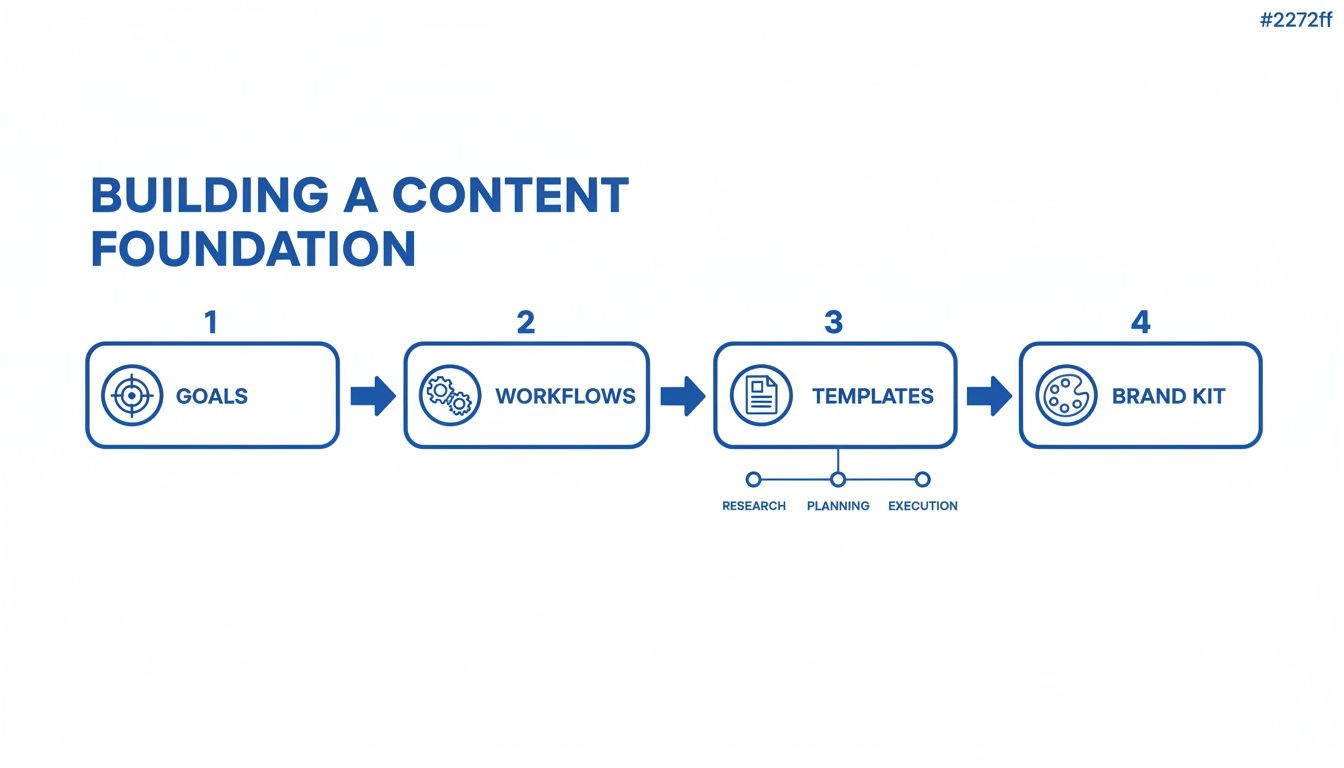
As you can see, each step logically builds on the last, creating a stable system that makes consistent output feel almost effortless.
Embrace Content Batching
One of the single most powerful things you can do for your productivity is content batching. This just means grouping similar tasks together and knocking them out in dedicated time blocks. So, instead of jumping between scripting, filming, and editing for a single video, you do all your scripting at once, then all your filming, and so on.
Here’s what that looks like in the real world:
- Monday Morning (Scripting): Block out two hours to do nothing but write scripts. The goal? Finish 10 complete video scripts for the next two weeks.
- Monday Afternoon (Visuals): Spend the afternoon sourcing or creating all the visuals needed for those 10 scripts. By 5 PM, all the raw materials are ready to go.
- Tuesday Morning (Filming/Recording): Get all your filming or voiceover work done in one shot. This keeps your energy, lighting, and sound consistent across a dozen videos.
This approach is a game-changer because it eliminates context switching—the ultimate productivity killer. Every time you shift gears, your brain has to catch up, wasting time and mental fuel. Batching keeps you in the zone, letting you produce better work, faster. To take this even further, you can explore what is workflow automation and how it can supercharge these processes.
Go Beyond Visual Templates
Templates are an absolute lifesaver for keeping your brand consistent, but don't stop at just visuals. To really get your workflow humming, you need to create templates for every repetitive part of the process.
Think about building out structured templates for things like:
- Scripts: Have a few core outlines ready for your main content pillars. Maybe one for a "How-To," another for "Myth Busting," and one for "Trend Commentary." Each template should have clear placeholders for your hook, the core message, and your call-to-action.
- Captions and Descriptions: Don't write these from scratch every time. Create a few go-to formulas. A great template might include a hook sentence, three bullet points, a hashtag block, and a clear CTA.
- Email Announcements: If you use email to push out your new content, have a pre-written template ready. Just drop in the new video details, and you're good to go.
Templates don't kill creativity—they create a framework for it. By taking care of the boring structural stuff, they free you up to focus 100% on nailing your message.
Your Content Calendar Is Your Command Center
A well-kept content calendar is the single source of truth for your entire operation. It's not just a schedule; it's a strategic command center that keeps everyone on the same page and prevents those last-minute "what are we posting today?!" panics.
At a minimum, your calendar should track this info for every single piece of content:
- Topic and Title: What's the video about?
- Format: Is it a YouTube Short, an Instagram Reel, or a TikTok?
- Status: Where is it in the pipeline? (e.g., "Scripting," "In Review," "Scheduled").
- Publish Date: When does it go live?
- Key Metrics: Leave a spot to circle back and record performance data later.
This bird's-eye view helps you plan content themes, spot bottlenecks before they become disasters, and maintain a consistent publishing rhythm. The next logical step is to connect your calendar to a scheduling tool. Learning how to automate social media posts is the final piece of the puzzle, turning your well-oiled plan into hands-off execution.
How to Use AI To Amplify Your Content Output
This is where your content engine really kicks into high gear. Artificial intelligence isn't some far-off concept anymore; it's a practical, powerful partner that can seriously boost your output without watering down the quality. The trick is to look past the hype and find specific, real-world tools that solve your biggest production headaches.
Let's be clear: the goal isn't to replace human creativity. It's to automate the tedious, repetitive junk that drains your team's energy and slows you down. When you hand off the grunt work to AI, you free up your people to focus on strategy, unique insights, and the big ideas that actually make your brand stand out.
From Hours to Minutes: A Practical Example
Think about the typical slog of creating one short-form video. You've got brainstorming, scripting, finding visuals, recording a voiceover, and editing. That whole process can easily eat up a few hours for a single 30-second clip.
Now, let’s look at it with AI in the mix. Using a platform like ShortsNinja, this entire headache is boiled down to a simple, three-step process that takes about five minutes:
- Input Your Idea: Just drop in a simple text prompt or a keyword.
- Refine the Script: AI spits out a script, and you give it a quick once-over for tone and accuracy.
- Generate and Publish: The platform builds the entire video—complete with AI-generated visuals, a realistic voiceover, and background music—and even schedules it for you.
This isn't just a tiny improvement; it's a massive leap in efficiency. It’s how a small team can pump out a high volume of quality content every single day, which is a must if you want to master how to scale content creation.
The real power of AI in content production is its ability to collapse time. It takes the most time-consuming parts of the process and executes them in seconds, giving you back hours of your day.
Specific AI Use Cases for Your Workflow
You don't have to go all-in on AI overnight. Just plug it into specific parts of your current workflow to see immediate benefits. The tech is already changing how industries operate. If you're curious how it's shaking up other creative fields, this piece on AI's role in revolutionizing fashion content creation offers a great perspective.
Here are some of the most impactful ways to use AI right now:
- Content Ideation: AI tools can scan trending topics and what your competitors are doing to generate dozens of on-brand ideas in minutes. No more "what should we post today?" meetings.
- Scriptwriting: Use AI to whip up first drafts from a simple outline. This gives you a solid base to work from, which you can then polish with your unique brand voice.
- Visual Generation: Create entire videos from text prompts. These platforms can generate custom images and video clips that match your script, so you can finally stop endlessly scrolling through stock footage sites.
- Voiceovers: Get realistic, human-sounding voiceovers in dozens of languages. This is a game-changer for reaching a global audience without the crazy high cost of hiring voice actors.
The numbers back this up. Marketers who do everything manually report spending up to 3 hours on a single long-form article. But those using AI? They slash that time to under 1 hour—a 67% reduction. It's no surprise that AI is already used for 58% of blog publications and 55% of social media posts.
Manual Vs AI-Powered Content Workflow Comparison
The efficiency gains become painfully obvious when you put the two workflows side-by-side. An AI-powered approach doesn't just speed things up; it completely changes the model by automating the most labor-intensive steps. For more tactical examples, check out our deep dive into AI social media content creation.
Take a look at how the time investment breaks down. The table below shows just how much time and effort you save when you switch from a manual process to an AI-powered platform like ShortsNinja.
| Task | Manual Workflow (Time per Video) | AI-Powered Workflow (Time per Video) |
|---|---|---|
| Ideation & Scripting | 30 – 60 minutes | 2 minutes |
| Visual Sourcing | 30 – 45 minutes | 1 minute (Automated) |
| Voiceover Recording | 15 – 30 minutes | 1 minute (Automated) |
| Editing & Assembly | 45 – 90 minutes | 1 minute |
| Total Time | 2 – 4 hours | ~5 minutes |
As you can see, the difference is staggering. Adopting AI tools isn't just about moving faster. You're fundamentally changing the economics of content production, making it possible to hit a scale that was once totally out of reach for most teams.
Optimizing Distribution And Measuring What Matters

Look, cranking out a high volume of quality content is a huge win, but it's only half the battle. If your videos aren't seen, all that work might as well have never happened. This is where the real magic of a scaled content engine comes into play: smart distribution to get maximum eyeballs and sharp measurement to see what's actually working.
A scaled operation doesn't just make more stuff. It makes every single piece work harder. That means ditching the old "publish and pray" approach for good and getting strategic about how your content reaches the right people.
Smart Repurposing Across Platforms
You can't just blast the same video everywhere and expect it to work. Each platform has its own vibe, its own audience, and its own unspoken rules. Smart repurposing is all about tweaking your core content to feel native on each channel.
Take one AI-generated YouTube Short. With a few small changes, it can get a second, third, and fourth life:
- For TikTok: Re-edit it with a trending sound or stitch it with another creator’s video to jump on a current conversation.
- For Instagram Reels: Add a poll or question sticker directly into the video to get people tapping and engaging right in the app.
- For LinkedIn: Pair the video with a thoughtful text post. Share a personal story or a professional takeaway that gives it context for a business audience.
This approach shows you understand each platform, making your content feel like a natural part of the feed, not just another ad. For a deeper dive, check out our full guide on content distribution strategies.
The key is to adapt, not just copy-paste. A small tweak in editing or captioning can make the difference between a video that gets ignored and one that goes viral.
Automate Your Publishing Schedule
Consistency is everything. The algorithms love it, and your audience comes to expect it. A content engine gives you the ammo to post regularly, but scheduling tools are what make it manageable without losing your mind.
Tools like Buffer, Later, or the scheduler built right into ShortsNinja let you plan out your content calendar weeks or even months ahead. This takes the daily pressure off and ensures you never miss a beat. Better yet, these tools often provide data on the best times to post for your audience, so you're publishing when they're most likely to be scrolling.
Focus On Metrics That Drive Growth
When you're swimming in data, it’s easy to get distracted by vanity metrics like follower count. The real secret is to zero in on the numbers that signal a real connection with your audience and, ultimately, an impact on your business.
I always tell my team to focus on metrics that answer three simple questions:
- Are people paying attention? (Engagement)
- Watch Time & Completion Rate: What percentage of your video do people actually watch? A high completion rate is a massive signal to the algorithm that your content is worth pushing.
- Saves & Shares: These are gold. A save means someone found your content so useful they want to come back to it. A share means they thought it was good enough to stake their own reputation on it.
- Are we reaching new people? (Reach & Discovery)
- Impressions from non-followers: This shows you how well you're breaking out of your existing audience bubble.
- Profile Visits: Did the video make someone curious enough to check you out? That's the first step to earning a new follower.
- Is this driving business results? (Conversion)
- Click-Through Rate (CTR) on links: Are people taking the action you want them to take, like visiting your site?
- Leads or Sign-ups: Can you directly trace new leads or customers back to specific videos?
Tracking these data points lets you see what’s resonating and what’s a dud. You can then confidently double down on the winners and ditch the formats that aren't pulling their weight.
This feedback loop—create, distribute, measure, refine—is what makes a content engine truly sustainable. It’s not just about making more content; it’s about consistently making more of what works.
Answering the Tough Questions on Scaling Content
Even with the best playbook, scaling up your content production is going to bring up some tough questions. This is where the rubber meets the road. Let's dig into the most common hurdles I see teams and solo creators face when they start to really ramp things up.
Getting these answers right can be the difference between a small speed bump and a full-blown roadblock.
How Do We Keep Our Brand Voice With More People Creating Content?
This is easily the #1 fear for most teams, and for good reason. The moment you bring in freelancers, an agency, or even new hires, keeping that unique brand personality consistent feels like a huge challenge.
The secret isn't more oversight—it's better upfront work.
Your centralized brand style guide is your single source of truth. But it can't just be a PDF with your logo and hex codes. Think of it as a living, breathing resource that defines your brand’s voice, tone, and personality with specific, real-world examples.
Here’s what a truly useful style guide includes:
- "This, Not That" Examples: Don't just describe your voice; show it in action. For example, "We say 'Here’s how to fix it,' not 'This guide will provide a solution for.'" Concrete examples leave no room for interpretation.
- Core Messaging Pillars: What are the big ideas your brand constantly circles back to? Outline them clearly.
- Audience Empathy Map: Give your creators a window into the mind of your audience. What are their biggest frustrations? Their goals? This helps them write to someone, not just for a brand.
A solid review process and regular feedback are non-negotiable, especially at the start. You'll likely be more hands-on with edits initially, but as creators get the hang of it, they'll internalize the brand voice and the whole process gets a lot smoother.
Where Should We Draw the Line Between AI and a Real Person?
With all the hype around AI, it's easy to wonder where to draw the line. Which tasks can you hand off to an algorithm, and which ones absolutely need that human touch?
My rule of thumb is simple: use AI for the grunt work. Let it handle the repetitive, time-consuming tasks so your team can focus on what they do best—strategy and creativity.
Think of AI as the world's most efficient intern. It’s brilliant at doing research, churning out first drafts, and sorting through data. But it still needs an experienced human to provide final creative direction, add unique insights, and give it strategic purpose.
Here’s a practical way to split the work:
- Let AI handle: Brainstorming a ton of initial ideas, turning a simple outline into a first-draft script, generating visuals from detailed prompts, and analyzing performance data.
- Keep humans for: Polishing the final script, weaving in personal stories or unique industry takes, ensuring the content feels on-brand, and actually engaging with your community in the comments.
This approach gives you the speed of automation without losing the authenticity that actually builds a connection with your audience.
How Can a Small Team Actually Scale Content Without Burning Out?
Look, scaling content isn't just a game for big corporations with bottomless budgets. Small teams and even solopreneurs can be incredibly efficient and punch way above their weight—if they have the right systems.
For a small operation, your workflow is everything. It's all about leaning hard on templates, batching, and smart automation.
A single person can realistically crank out an entire week’s worth of short-form videos in just a few dedicated hours. How? By batching tasks. You set aside one block of time for scripting, another for generating all your visuals with an AI tool, and a final block for scheduling everything out.
This stops the constant, draining context-switching and lets you get into a state of deep focus. The goal isn't to work more; it's to make the hours you do work count for a whole lot more.
Ready to stop the content grind and start building a true content engine? With ShortsNinja, you can turn a single idea into a polished, ready-to-publish short video in just five minutes. Our AI-powered platform automates everything from scripting to visual generation, so you can focus on strategy while your channels grow on autopilot. Try it now and see how easy it is to scale your video content. Get started with ShortsNinja today!