
Welcome to your playbook for blowing up on YouTube. The formula that’s working right now is surprisingly straightforward: you create a constant stream of high-discoverability Shorts that feed into your deeper, value-packed long-form videos. Then, you optimize everything for the algorithm and promote it like your channel depends on it—because it does.
This isn't about hoping for slow, steady gains. It’s a framework for engineering rapid growth.
Building Your Foundation for Rapid YouTube Growth

This guide lays out a proven system for moving from a rough idea to a full-blown promotion machine. Success on YouTube rarely happens by accident; it's built. The channels that skyrocket operate like lean startups—they create a "minimum viable product" (their video), launch it into the world, and then obsessively iterate based on what the data tells them.
We're going to break down the essential pillars that fuel this kind of explosive growth. You'll learn how to create a powerful engine where your Shorts and long-form content work together, feeding each other. This data-driven mindset is what separates channels that take off from those that just… exist. It's about figuring out what your viewers want, sometimes even before they do.
To give you a bird's-eye view of what we're covering, here are the core strategies this guide is built on.
Core Pillars of Fast Channel Growth
| Growth Pillar | Key Action | Why It Matters |
|---|---|---|
| Content Strategy | Combine Shorts and long-form videos. | Shorts act as a top-of-funnel discovery tool, while long-form videos build community and watch time. |
| Algorithm Optimization | Master hooks, thumbnails, titles, and SEO. | These are direct signals to the algorithm that your content is valuable and worth showing to more people. |
| Data-Driven Iteration | Analyze what works and double down. | Your analytics are a direct line to your audience. Ignoring them is like flying blind. |
| Strategic Promotion | Repurpose and cross-promote content everywhere. | Don't just publish and pray. Actively push your content on other platforms to drive traffic back to YouTube. |
Think of this table as your cheat sheet. Each pillar is a critical piece of the puzzle for achieving sustainable, rapid growth.
Setting Your Growth Trajectory
Before you even think about hitting record, you need to adopt a strategic mindset. That starts with setting ambitious but grounded goals for your first 30, 60, and 90 days. This is your mission briefing—it defines what success looks like at each stage and keeps you focused on what matters. To really put fuel on the fire, understanding effective YouTube promotion strategies from the get-go is a game-changer.
This plan is all about removing the guesswork by setting clear, tangible objectives:
- Days 1-30: Your only mission is to validate your niche and get into a consistent publishing rhythm. That's it.
- Days 31-60: Now you have some data. It's time to dig into your analytics and start refining your video formats and topics based on what people are actually watching.
- Days 61-90: You've found some early winners. Double down on what's working and start scaling up your production and promotion efforts.
The opportunity for creators right now is just massive. YouTube's global audience is projected to hit 2.85 billion monthly active users by 2025. That's more than a third of everyone on the internet. This isn't just a number; it’s an ocean of potential viewers waiting to discover your channel.
Key Takeaway: Rapid growth isn't about a single viral hit. It's about building a repeatable system that consistently attracts viewers, converts them into subscribers, and tells the YouTube algorithm that your channel deserves to be pushed. Your 90-day plan is the blueprint for that system.
Creating Content That Captures Attention

The secret to a fast-growing YouTube channel isn’t some hidden algorithm hack or a bottomless ad budget. It's much simpler: create content that’s impossible to ignore. Your job is to engineer videos—both long-form and Shorts—that grab a viewer's attention in the first few seconds and hold it tight.
This is about more than just making "good" videos. It's about crafting content that respects your viewer's time and delivers on its promise instantly. The YouTube algorithm is a direct reflection of viewer behavior, and it aggressively rewards content that keeps people watching.
Engineering the Perfect Hook
You have a tiny window—often just the first 0-15 seconds—to convince someone your video is worth watching. The best way to do this is to start with a bold statement, a burning question, or a quick preview of the most exciting moment. You have to script your intro meticulously to stop the scroll.
Think about a DIY channel. Instead of opening with, "Hi everyone, today we're going to build a bookshelf," you could flash a shot of the stunning finished product and say, "You can build this entire custom library for under $100, and I’m about to show you how." The second option promises a clear, desirable outcome and creates an instant need to see the process.
Here are a few hook templates you can steal:
- The Problem/Agitation Hook: "Are you tired of [common problem]? What if I told you there's a simple fix that takes less than five minutes?" This hits a pain point and promises a quick win.
- The Bold Statement Hook: "[Controversial or surprising statement]. It sounds crazy, but in this video, I'm going to prove it." This sparks immediate curiosity and makes people want to see if you can back it up.
- The Sneak Peek Hook: Start with a 3-5 second clip of the most visually exciting part of your video before the title card even appears. This shows the viewer exactly what they stand to gain by sticking around.
Structuring Videos for Maximum Retention
Once you've hooked someone, the real work begins: keeping them there. Audience retention is arguably the most powerful signal you can send to the YouTube algorithm. High retention tells YouTube that viewers find your video valuable, which prompts the platform to push it out to a wider audience.
The key is to maintain momentum. Cut out long, rambling intros or any section where the energy dips. A good rule of thumb is to introduce a new visual or auditory element every 30-60 seconds to reset the viewer's attention.
Expert Insight: Think of your video's structure like a series of mini-chapters. Each one should deliver a specific piece of value and transition smoothly into the next, keeping the viewer engaged and preventing them from clicking away.
A solid structure for a long-form video might look like this:
- The Hook (0-15s): A powerful opening that promises a specific outcome.
- Quick Value (15s-1min): Deliver on a small part of that promise right away to build trust.
- Core Content (Segmented): Break down your main topic into clear, digestible chunks, each with its own visual flair.
- Call to Action (Last 30s): Encourage viewers to subscribe, comment, or watch another video.
This approach works for any type of content, from tutorials to vlogs. Keep refreshing the screen with B-roll, animated text, graphics, or even simple zoom-ins to make the viewing experience dynamic. For more ideas on applying these principles, check out our guide on the 10 best practices for short-form video content.
The Psychology of a Click-Worthy Thumbnail
Your thumbnail is your video's billboard. Paired with your title, it's the single most important factor determining your click-through rate (CTR). A high CTR signals to YouTube that your content is appealing, and the algorithm will show it to more people. Simple as that.
Effective thumbnail design is a science. It's about telling a story and sparking curiosity in a single glance. Use bright, contrasting colors to pop in a crowded feed. And don't underestimate the power of human faces, especially those showing strong emotions like shock, excitement, or confusion—they are incredibly effective at drawing the eye.
Combine these visuals with minimal, large, easy-to-read text—ideally just 3-5 words—that adds context or amps up the intrigue. For example, if your video title is "I Tried the World's Spiciest Noodle," your thumbnail might be a close-up of your face in agony with the text "INSTANT REGRET" overlaid. That combination tells a compelling story before the video even starts. You have to A/B test different thumbnail styles to really nail down what resonates with your audience.
Mastering YouTube SEO and Algorithm Signals
Making a great video is just the start. If you want to grow your channel fast, people actually have to find it. This is where you learn to speak the YouTube algorithm’s language through good old-fashioned Search Engine Optimization (SEO).
It helps to think of YouTube as the world's second-biggest search engine, because that's exactly what it is. When someone types in a search, the algorithm zips through millions of videos to find the best answer. Your mission is to send crystal-clear signals that your video is the one they're looking for.
Uncovering What Viewers Are Searching For
Solid YouTube SEO starts with knowing what your audience is actively trying to find. Throwing video ideas at the wall and hoping one sticks is a fast track to burnout. You need to do some real keyword research to uncover topics with high demand and, ideally, lower competition.
Begin by brainstorming broad themes in your niche. If you run a cooking channel, that might be "easy dinner recipes" or "30-minute meals." Next, head straight to the YouTube search bar and start typing. The autocomplete feature is a goldmine—it shows you the exact phrases real people are searching for.
For a more strategic approach, you'll want to dig into the data. Plenty of tools can give you hard numbers on search volume and how competitive a keyword is. Finding the right opportunities is a game-changer, and you can explore some of the best AI tools for YouTube keyword trends to make this process much faster.
- Hunt for "long-tail" keywords. These are longer, more specific phrases like "how to make sourdough bread for beginners." They're less competitive and attract viewers who know exactly what they want.
- Spy on your competitors. Look at the top-ranking videos for your topic. What keywords are they using in their titles and descriptions? That's a ready-made blueprint of what the algorithm already likes.
- Figure out search intent. Is the user looking for a step-by-step tutorial, a product review, or just some entertainment? Your video has to match their expectation.
Crafting Titles and Descriptions That Work
Once you've locked in your target keyword, it's time to build your video's metadata around it. Your title and description are two of the most critical signals you send to the algorithm and your potential viewers.
A great title does two things: it grabs attention and includes your main keyword. It needs to spark curiosity while clearly stating the video's value. Instead of a flat title like "My Skincare Routine," try something more optimized and clickable: "My 5-Minute Skincare Routine for Glowing Skin (Dermatologist-Approved)."
Your description provides the all-important context. Don't just stuff it with a list of keywords. Write a natural, compelling summary of the video, making sure to place your most important keywords in the first couple of sentences.
Key Takeaway: A well-written description does more than inform viewers. It feeds YouTube's algorithm the context it needs to understand your video, helping it rank in search and show up as a suggested video.
The Ultimate Signal: Watch Time
Keywords get your foot in the door, but watch time is what gets you invited to the party. Watch time—the total time people spend watching your videos—is the ultimate signal that your content is engaging and valuable.
High watch time tells YouTube, "Hey, people really like this video," which makes the algorithm eager to show it to more people. This is another reason a descriptive, keyword-rich description is so important. It sets the right expectations from the start, which helps keep viewers watching longer.
In fact, data shows that detailed descriptions of around 200+ words give YouTube a much clearer picture of your content, which can seriously boost your views. You can learn more about how critical these elements are for getting views on Backlinko.com.
Boosting watch time isn't about making ridiculously long videos. It's about creating content so good that people can't bring themselves to click away.
Strategies to Boost Your Watch Time
| Strategy | How It Works | Real-World Example |
|---|---|---|
| Pattern Interrupts | Introduce a new visual or sound every 30-60 seconds to reset viewer attention. | A gaming creator cuts from gameplay to a funny meme or a quick reaction shot on their face cam. |
| Open Loops | Tease something exciting that will happen later in the video to keep viewers watching. | A travel vlogger says, "Stick around to the end to see the biggest mistake I made on this trip." |
| Strategic Playlists | Group related videos together so when one ends, another one automatically starts playing. | A fitness channel creates a "30-Day Workout Challenge" playlist, encouraging viewers to binge-watch the series. |
Your 90-Day Rapid Growth Action Plan
Ideas are great, but a plan is what gets you paid. If you're serious about growing a YouTube channel fast, you need a blueprint—a structured, step-by-step guide that tells you exactly what to do and when. This 90-day plan is built to kill the guesswork so you can put all your energy where it actually counts.
This isn't about just making videos and hoping for the best. It's a three-phase sprint designed to build real momentum. Each stage stacks on top of the last, turning your early experiments into a reliable system for growth.
Phase 1: The First 30 Days of Validation and Volume
Your mission for the first month is brutally simple: validate your niche and get into a relentless posting rhythm. Perfection is your enemy right now. This is all about shipping content, gathering data, and confirming that people actually want to watch what you’re making.
The name of the game is quantity and consistency. You need to feed the algorithm enough data so it can start figuring out who your channel is for. I recommend a high volume of Shorts—think five to seven per week—paired with one solid long-form video. This strategy uses Shorts as your discovery engine while your long-form video tests deeper engagement.
To pull this off without burning out, you have to batch-create. Dedicate one day to scripting, another to filming, and a third to editing. Treat it like a science experiment where every single video is a data point.
Key Takeaway: Your first 30 days are not about hitting a million views. They’re about building the habit of production and gathering the raw data you'll need to make smarter moves in month two.
Phase 2: Days 31-60 Are for Analysis and Refinement
After a month of creating, you now have the single most valuable asset a creator can own: data. Phase two is all about ripping into your YouTube Analytics, figuring out what’s working, and being ruthless about cutting what isn’t.
It’s time to stop guessing and start analyzing. Pull up your best-performing videos and ask the hard questions. Which Shorts actually pulled views from the feed? Which long-form video held people's attention the longest? Was there a specific topic, format, or hook that clearly outperformed the others?
Once you find a winner, you double down. Hard. If a Short about "three common-sense productivity tips" gets 10x more views than your vlogs, the market is screaming at you. Your next content batch should be laser-focused on variations of that successful theme.
This is also the perfect time to start polishing your presentation.
- Thumbnail A/B Testing: Start playing with different thumbnail styles. Slap some bold text on one, use an expressive face on another, and try a clean graphic on a third. See what moves the needle on your click-through rate.
- Title Optimization: Tweak your title formulas. Do questions work better than statements? Do numbers in the title give you a bump?
- Hook Improvement: Look at your audience retention graphs. Find the exact second people are dropping off and fix it. Re-script your first 15 seconds based on the videos that actually kept people watching.
Phase 3: Days 61-90 Focus on Scaling and Promotion
By now, you should have a solid grasp of what your audience craves and a more defined content style. Phase three is all about scaling what works and pushing your reach beyond YouTube. You've built the engine; now it’s time to pour in the gasoline.
Your production workflow should be getting smoother, which means you can either pump out more content or spend more time making each piece better. If a specific format is consistently winning, templatize it. A "Top 5 Tools for X" video, for example, can be easily replicated for different sub-topics in your niche, letting you produce proven content much faster.
This is also when you get serious about promotion. Don't just publish and pray—actively get your content in front of new eyeballs.
- Repurpose Winners: Take your best long-form video and use AI tools like Opus Clip to slice it into a dozen viral-ready clips for Shorts, TikTok, and Instagram Reels.
- Engage in Communities: Find out where your ideal viewers hang out online. That could be Reddit, specific Facebook groups, or Discord servers. Share your videos, but only when they add genuine value to the conversation. No spamming.
- Collaborate: Start reaching out to other creators in your niche who are around your size. A simple collaboration can introduce your channel to a fresh, highly relevant audience overnight.
By the end of these 90 days, you won’t just have a channel with a few videos. You'll have a data-driven content machine and a clear roadmap for what's next.
Before you jump in, here's a quick look at how the entire 90-day plan breaks down. Think of it as your cheat sheet for staying on track.
90-Day Growth Plan Snapshot
| Phase | Primary Focus | Key Tasks |
|---|---|---|
| Month 1 (Days 1-30) | Validation & Volume | – Publish 5-7 Shorts weekly – Publish 1 long-form video weekly – Batch-create all content – Establish a consistent posting schedule |
| Month 2 (Days 31-60) | Analysis & Refinement | – Deep-dive into YouTube Analytics – Identify top-performing topics/formats – A/B test thumbnails and titles – Optimize video hooks based on retention data |
| Month 3 (Days 61-90) | Scaling & Promotion | – Template winning video formats – Repurpose content for other platforms – Engage in relevant online communities – Seek out collaborations with other creators |
This table should help you visualize the progression from raw production to smart, sustainable growth. Each phase sets the stage for the next, ensuring you’re always building on what you’ve learned.
Scaling Your Workflow with AI Automation
To grow a YouTube channel fast, you need more than great ideas—you need speed and consistency. The constant pressure for new content is a surefire path to burnout, and that can kill your momentum before you even get started. This is where smart automation becomes your secret weapon, letting you multiply your output without multiplying your hours.
Working smart means handing off the repetitive, soul-crushing tasks to AI. Instead of staring at a blank page for hours, you can feed an idea to an AI scriptwriter and get back a dozen video concepts and rough drafts. This frees up your creative energy to do what really matters: refining the message and adding your unique human touch.
The goal isn't to replace your creativity, but to supercharge it. By automating the foundational stuff, you can keep up a high posting frequency—a massive signal to the YouTube algorithm—without the quality dipping. That's what keeps viewers coming back.
Building Your AI Content Machine
Modern AI tools can now handle nearly every piece of the video creation puzzle. You can go from a simple text prompt to a fully edited video in minutes, a process that used to eat up days. For anyone trying to scale, that kind of efficiency is a game-changer.
Think about the entire workflow. AI can generate a script, create a realistic voiceover in just about any language, find relevant stock footage, add captions, and even pick out background music. It’s an integrated system that lets you build a true content machine running with minimal manual input.
To really ramp up your output and slash your workflow time, exploring the latest AI video generators is a must for any creator serious about rapid growth.
A Practical AI-Powered Workflow
Let’s walk through a real-world example. Imagine you run a history channel.
- Idea to Script: Start with a simple prompt like, "Create a 60-second YouTube Short script about the most surprising facts of the Roman Empire." An AI tool can instantly spit out a punchy, hook-driven script.
- Voiceover Generation: Copy and paste that script into an AI voice generator. You can pick a style—energetic, narrative, documentary—and get a high-quality audio track in seconds.
- Visual Creation: Use an AI video editor that automatically pulls relevant stock footage and images based on keywords from your script. It'll sync the visuals to the voiceover, creating a dynamic video without you having to dig through libraries.
- Final Touches: The AI then layers on animated captions, transitions, and royalty-free music. Your role shifts from creator to director, just making small tweaks to get the final cut perfect.
This timeline shows how a structured plan, boosted by automation, can lead to explosive growth over just 90 days.
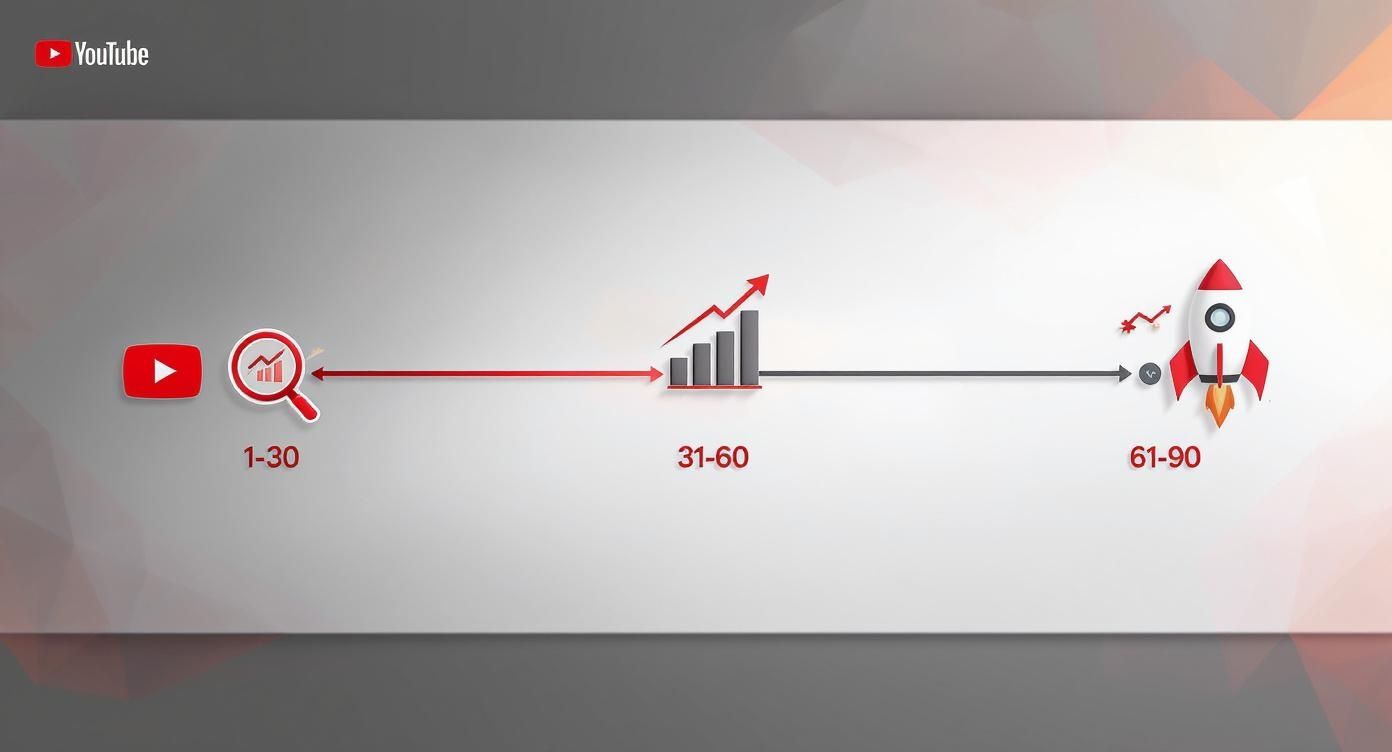
The key takeaway here is how you move from validating ideas to data-driven scaling. Automation is what makes that final stage possible.
Repurposing Content on Autopilot
One of the most powerful ways to use AI is for content repurposing. A single 10-minute long-form video has enough gold inside for a dozen or more YouTube Shorts, TikToks, and Instagram Reels. But chopping all that up manually is tedious work.
Expert Insight: AI-powered repurposing tools can analyze your long-form video, pinpoint the most engaging or "viral-worthy" moments, and automatically reformat them into vertical clips. It adds captions, reframes the shot, and turns one asset into many—multiplying your content inventory with almost zero extra effort.
This strategy creates a content ecosystem where everything works together. Your Shorts act like commercials, grabbing new eyeballs and funneling them toward your deeper, long-form videos. This synergy is a cornerstone of growing a YouTube channel fast today. For a deeper dive, check out these 5 ways to automate your video content creation to find even more efficiencies.
By bringing these automation workflows into your process, you stop being just a content creator and become a content strategist. You’re no longer stuck in the weeds of production, which frees you up to focus on the big picture: analyzing data, understanding your audience, and planning your next big hit. This is how you build a sustainable system for rapid, lasting channel growth.
Common Questions About Growing on YouTube
As you dive into growing your YouTube channel, a few key questions always seem to pop up. Getting straight answers is the fastest way to build a real strategy that works, helping you sidestep the common mistakes that trip up so many creators.
Let's clear up some of the biggest uncertainties people face when they’re trying to scale a channel from the ground up.
How Long Does Fast Growth Realistically Take
Let’s be real: “fast” is a flexible term. But with a smart, focused strategy, you can see serious results a lot quicker than you might imagine. We’ve seen channels that nail their content plan go from under 1,000 subscribers to over 10,000 in just three to six months.
Of course, that kind of timeline isn't a given. It all comes down to a few things: how competitive your niche is, the actual quality of your content, and—most importantly—how consistently you post. A channel that drops multiple high-value Shorts and one solid long-form video every single week will always smoke a channel that posts whenever they feel like it.
Should I Focus on Shorts or Long-Form Videos
For the absolute fastest growth? You need to do both. Hands down. One of the biggest mistakes creators make is thinking it’s an either/or game. It's not. They're designed to work together.
- YouTube Shorts are your secret weapon for getting discovered and pulling in new subscribers quickly. The algorithm is built to push them out to new people, making them perfect for grabbing that initial attention.
- Long-form videos are where you build a real community. This is how you rack up that crucial watch time and eventually unlock the bigger ad revenue payouts.
Think of your Shorts as trailers for your main show. Use them to hook new viewers with quick, punchy value, then point them toward your deeper long-form content. That's where you build the connection that makes them stick around.
This creates a powerful growth loop. New viewers find you through Shorts, they subscribe, and then they start watching your longer videos. This boosts your watch time and sends a massive signal to the algorithm that your whole channel is worth promoting.
What Are the Most Important Metrics to Track
When you're starting out, it's easy to get completely overwhelmed by all the data in your YouTube Studio. To keep your head straight, just focus on the handful of metrics that give you direct, actionable feedback on what’s working.
In the beginning, your dashboard should boil down to these three things:
- Click-Through Rate (CTR): This tells you if your thumbnails and titles are actually doing their job. A consistent CTR above 5% is a great sign that your packaging is on point.
- Audience Retention: Are people sticking around to watch? For your longer videos, if you can keep people watching for over 40% of the video on average, you’re holding their attention.
- Views from the Shorts Feed: This is the clearest indicator that the Shorts algorithm has picked up your content. It’s your top-of-funnel growth engine, so you want to see this number climbing.
Once your channel starts to mature, you can broaden your focus to things like total watch time and subscriber growth rate. But early on, nailing CTR, retention, and Shorts feed views is the most direct path to figuring out how to grow a YouTube channel fast.
Ready to put your content creation on autopilot? ShortsNinja uses AI to turn your ideas into dozens of high-quality short videos for YouTube, TikTok, and Instagram in minutes. Stop spending hours editing and start scaling your channel hands-free. Try ShortsNinja today and see how fast you can grow.