
It's a question I hear all the time: what makes one YouTube video explode with millions of views while another, seemingly just as good, completely flatlines? The truth is, creating a viral video isn't about luck. It's about engineering your content to trigger specific human responses and, in turn, send all the right signals to the YouTube algorithm.
Think of it less like buying a lottery ticket and more like building a well-oiled machine. You need to hook viewers fast—we're talking the first three seconds—forge a genuine emotional connection, and then make it ridiculously easy for them to share. This is what sparks that snowball effect of views and engagement that every creator dreams of.
Why Some Videos Pop Off (and Others Don't)
Forget the myth that you need a Hollywood-level budget or a celebrity cameo to go viral. The algorithm doesn't care about your production value as much as it cares about performance. A video that grips viewers and holds their attention sends a powerful message to YouTube: "Hey, people love this. Show it to more of them!"
It's a strategic process, not a random fluke. Virality is earned when your video proves its worth, convincing the algorithm to push it far beyond your initial subscriber base.
The Three Pillars of Virality
So, how do you actually engineer this? It boils down to mastering three core components. Get these right, and you'll trigger YouTube’s powerful recommendation engine.
- Audience Retention: This is your north star metric. If people click away after just a few seconds, your video is dead on arrival. High retention is the clearest signal you can send that your content delivers on the promise made by your title and thumbnail.
- Emotional Resonance: Viral content makes people feel something. It could be laughter, shock, inspiration, or pure awe. That powerful emotional hook is what makes viewers connect on a deeper level and stick around for the payoff.
- Shareability: A video truly goes viral when your viewers become your marketing team. The content has to be so compelling, relatable, or mind-blowing that people feel an almost instinctual urge to send it to a friend. That's how you create an exponential growth loop.
These three pillars don't work in isolation; they build on each other.
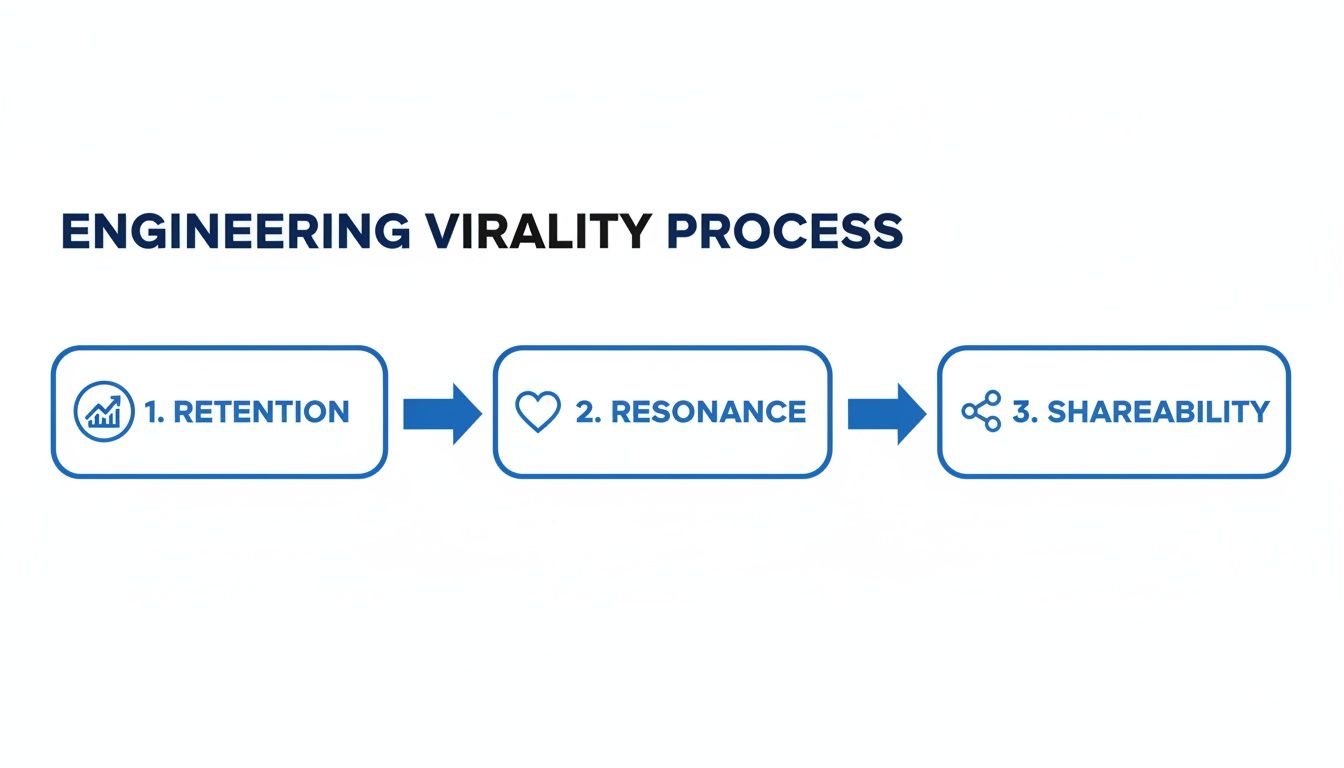
As you can see, holding attention (Retention) is the foundation. That gives you the time to create an emotional connection (Resonance), which is what ultimately drives people to hit the share button.
To give you a quick reference, here's a simple breakdown of how these pillars work together.
Key Pillars for Engineering a Viral YouTube Video
This table gives a quick overview of the essential components that drive virality, from the initial concept to the final promotional push.
| Pillar | Core Objective | Key Performance Metric |
|---|---|---|
| Retention | Keep viewers watching for as long as possible. | Average View Duration (AVD) |
| Resonance | Evoke a strong emotional response. | Likes, Comments, Engagement Rate |
| Shareability | Compel viewers to share with others. | Shares, Views from External Sources |
Mastering these three areas is non-negotiable if you want to give your video the best possible shot at going viral.
Reading the Algorithm's Signals
The moment you hit "publish," the clock starts ticking. The YouTube algorithm is a data-hungry machine, and it's watching user behavior signals like a hawk to decide if your video is a winner. Think of the first 24 hours as your video's big audition.
The initial velocity of a video—how quickly it racks up views, watch time, and engagement—is absolutely critical. A strong start tells the algorithm that your content is hitting the mark and deserves a bigger audience.
Two metrics matter more than almost anything else here: Click-Through Rate (CTR) and Average View Duration (AVD). A high CTR proves your title and thumbnail are compelling enough to earn the click. A strong AVD confirms your content is engaging enough to hold that attention.
While this guide focuses on long-form content, the core principles are universal. To dive deeper into the key numbers you should be tracking, check out this breakdown of the top 5 metrics for YouTube Shorts growth. Understanding these concepts is the foundation we'll build on from here.
Finding Ideas and Trends Worth Pursuing
A viral video is rarely a lightning-in-a-bottle moment. It's almost never a completely original idea—honestly, what is these days? The real magic happens when you find a unique angle on a topic people are already obsessing over. Your goal is to become a master trend-spotter and an expert at filling the gaps no one else sees.
Think of yourself as a digital anthropologist. Your job is to observe what people are watching, talking about, and sharing online. But before you even start digging, you have to know who you’re digging for. Nailing down who you want to reach is the first, most critical step. Spend some real time identifying your target audience. Once you genuinely understand their problems, what makes them laugh, and what they’re passionate about, finding a winning idea gets a whole lot easier.

Uncovering Trends Before They Peak
Timing is everything. Jump on a trend too early, and you're shouting into the void. Jump on it too late, and you’re just another voice in a deafeningly crowded room. The sweet spot is that "early majority" phase—the trend is picking up steam, but it hasn't been beaten to death yet.
So, where do you find these golden opportunities? Here are a few of my go-to spots:
- TikTok's Creative Center: Don't just mindlessly scroll your "For You" page. Go straight to the source. TikTok's official trend tool lets you see what hashtags, songs, and video styles are blowing up, and you can even filter by region or industry. This is where you spot the stuff that’s about to jump over to YouTube.
- Reddit's Niche Communities: Subreddits are a goldmine for raw, unfiltered human interest. Find the communities built around your niche (think r/gadgets, r/skincareaddiction, or r/DIY). Look for the questions that keep getting asked, the "before and after" posts that get tons of upvotes, or the debates that spark passionate arguments. That's your audience telling you exactly what they care about.
- YouTube's "Trending" Tab: This one feels obvious, but most people use it wrong. Don't just look at what is trending; dig into why it's trending. Is it a new challenge format? A certain type of reaction video? A specific editing style? You're looking for the pattern, not just the single video.
Serious creators are even starting to automate this. If you want a real edge, it's worth learning how to track emerging video trends with AI.
Key Takeaway: The goal isn’t to copy-paste a trend. It’s to adapt it. Always ask yourself, "How can I put my own spin on this?" or "What's the one question nobody's answering within this trend?"
Finding the Content Gap in Your Niche
Sometimes, the best idea isn't a trend at all—it's a massive blind spot your competitors have completely missed. This is called a content gap analysis, and it’s your secret weapon for creating a video that doesn't just get views but becomes the definitive resource on a topic.
Let's say you run a personal finance channel. A video on "how to save money" is DOA. It's been done a million times. But what if you noticed nobody has made a truly great video on "how to save for a house deposit while working a minimum-wage job"? That kind of specificity is where virality is born.
Here's a quick and dirty way to find these gaps:
- Map Out Key Searches: Use tools like Google Trends or just type into YouTube's search bar and see what autocomplete suggests. List out the top phrases people are looking for in your niche.
- Analyze the Winners: For each key phrase, watch the top 5-10 videos. But don't just watch—scour the comments. What questions are people still asking? What are they complaining about? That's pure gold.
- Find Your Angle: The "gap" is your opening. Maybe the top videos are boring and you can make something more engaging. Maybe they're too technical and you can simplify it. Or maybe they all miss a crucial piece of information that you can provide. This is how you create something that doesn’t just compete—it wins.
Writing Hooks and Scripts That Keep People Watching
You've got about three seconds. Maybe less.
In that tiny window, a viewer decides if your video is worth their time or if they're swiping away forever. Getting this first impression right isn't just a part of the game—it is the game. Viral videos are built on a foundation of viewer retention, and it all starts with a script that grabs them by the collar and refuses to let go.
The first line of your video, the hook, is the single most important thing you'll write. Forget those long, branded intros or a leisurely "Hey guys, welcome back." Your job is to instantly justify why they clicked. Do that by asking a provocative question, teasing a conflict, or dropping them right into the most intense moment of your story.
For example, don't say, "In this video, we're going to explore the best budget coffee makers." That's an agenda. Instead, show a shot of a terrible coffee maker and say, "This machine makes the worst coffee I've ever tasted… but this one costs less and will change your mornings forever." See the difference? One explains, the other tells a story.
Crafting a Compelling Narrative Arc
Okay, you’ve hooked them. Now what? You can't let the energy drop. A script that just wanders around is a guaranteed retention killer. The best videos, no matter the topic, follow a simple storytelling structure that builds tension and delivers a satisfying payoff.
Think of your script in three parts:
- The Setup: This is your hook and the immediate context. You're introducing the core problem or question. (e.g., "I'm going to see if it's possible to travel across Japan for just $1.")
- The Confrontation: This is the messy, interesting middle. Here, you show the journey, the struggles, and the unexpected twists. You need emotional peaks and valleys to keep people invested in the outcome.
- The Resolution: This is the payoff. You answer the question or solve the problem. A strong ending provides closure and makes the viewer feel like their time was well spent.
This framework gives your video a narrative backbone, making the viewer feel like they’re on an adventure with you, not just passively consuming facts. For a deeper dive into structuring your ideas, our guide on script writing for beginners is a fantastic starting point.
Pacing and Emotional Rhythm
Pacing is the secret sauce. A video with a flat, monotonous rhythm is boring, even if the information is solid. You need to create an emotional rhythm with highs and lows. You can pull this off by mixing up your sentence lengths, injecting moments of humor or surprise, and using "pattern interrupts"—sudden shifts in visuals, sound, or topic that snap a viewer's attention back into focus.
Look no further than the absolute dominance of short-form video. The fact that YouTube Shorts is now pulling in over 70 billion daily views is a masterclass in relentless pacing. Top creators like MacDannyGun, who exploded to 670,000 subscribers in just 5 months from Shorts, get this. The data shows channels that embrace Shorts see a 25% bump in retention because the format forces you to be brutally efficient with your story. The most viral Shorts often hit over 100% Average Percentage Viewed (APV), which means people are watching them again and again—a massive signal to the algorithm.
Pro Tip: Read your script out loud. Does it flow? Are there parts where you get bored just reading it? If so, your audience will be ten times more bored. Be ruthless and trim the fat.
AI-Powered Scripts for Faceless Content
Let's be real: churning out killer scripts day after day is a grind. It can be a huge bottleneck, especially if you're running a faceless channel or trying to scale up your production. This is where AI can be an incredible co-pilot.
Modern AI tools can help brainstorm ideas, map out your narrative, and even pump out a full first draft from a simple prompt. To get a jumpstart on your video's story, using an AI video script writer can be a massive time-saver. These tools are often trained on what works, helping you generate algorithm-friendly scripts with punchy hooks and a clear story arc.
The trick is to treat AI as a launchpad, not the final product. Always go back and inject your own voice, personality, and unique insights. That human touch is what builds a real connection with an audience. Think of it this way: AI can build the house, but you're the one who has to decorate it and make it a home. That combination of machine efficiency and human creativity is a winning formula.
Editing and Production Tricks to Boost Retention
A brilliant idea and a killer script can still fall completely flat if the final video feels slow, boring, or just plain unprofessional. The editing bay is where the real magic happens—it's where you transform raw footage into a polished, engaging experience that actually holds someone's attention.
This isn't just about trimming clips. It's about crafting a rhythm that keeps people glued to the screen. Every single cut, transition, and sound effect you choose directly impacts your audience retention.
Think of your video's pace as its heartbeat. A steady, monotonous pace will put your audience to sleep. To make a video feel dynamic and exciting, you have to master the art of the pattern interrupt. This is any technique that breaks the visual or auditory pattern, forcing the viewer's brain to snap back and re-engage.
Mastering the Art of Pacing
Fast, energetic pacing is a signature of content that performs well online. It screams confidence and respects the viewer's time by cutting the fluff and getting straight to the good stuff. No dead air allowed.
Here are a few core techniques you should bake into every single video edit:
- Strategic Jump Cuts: Don't be afraid to be ruthless. Cut out every single pause, breath, or "um." A tight jump cut that pushes the story forward is infinitely better than a slow, meandering shot that lets the viewer's mind wander.
- Purposeful B-Roll: B-roll isn't just filler footage; it's a visual explanation. When you mention a specific object, concept, or location, immediately cut to a shot of it. This provides crucial context and keeps the screen from getting stale.
- On-Screen Graphics and Text: Use animated text to hammer home key points, numbers, or takeaways. Simple graphics can illustrate complex ideas and act as powerful pattern interrupts, waking up the viewer's brain.
These elements all work together to create a seamless, fast-moving experience. The goal is to make a five-minute video feel like it flew by in two.
Viewer engagement is the ultimate currency for anyone wondering how to create a viral video on YouTube. Your editing choices are what earn you that engagement, second by second.
Elevating Your Visual Storytelling
Beyond just the speed of your cuts, the actual quality of your visuals plays a massive role in how people perceive your content. You don't need a Hollywood budget, but you absolutely need to be intentional with your production choices.
Start by varying your camera angles. Even if you're just sitting at a desk, using a second camera for a different angle (or simply punching in on your main shot during the edit) adds a professional touch and breaks up the visual monotony.
Good lighting is completely non-negotiable. A simple three-point lighting setup (key light, fill light, and backlight) can make a basic smartphone video look almost cinematic. It separates you from the background and makes everything look crisp and high-quality.
Finally, let's talk sound design. It’s often said that audio is 50% of the video experience, and it's true.
- Clean Dialogue: Make sure your voice is crystal clear and easy to understand. No one will stick around if they have to strain to hear you.
- Background Music: Add subtle music that matches the mood of your video. It fills the space and guides the viewer's emotions.
- Sound Effects (SFX): Use simple whooshes, clicks, or dings to accent your on-screen graphics and transitions. This adds a layer of polish that viewers can literally feel.
The Rise of AI in Faceless Content Creation
Creating high-quality visuals has historically been a huge barrier for many creators, especially those running faceless channels. This is where AI-powered tools are completely changing the game. Platforms like ShortsNinja can now generate stunning, high-definition video clips and images from a simple text prompt.
This technology condenses what used to be hours of searching for stock footage or creating custom graphics into mere minutes. You can script an entire video, generate every single visual element with AI, and pair it with a surprisingly realistic AI voiceover in dozens of languages.
This isn't about cutting corners; it's about democratizing production. Creators can now produce visually compelling, retention-focused content at scale, regardless of their budget or technical skill. The ability to create a viral video on YouTube is becoming less about the gear you own and more about the power of your ideas.
The data backs this up, especially in the short-form arena. Engagement is the key to going viral, and YouTube Shorts dominate with an impressive 5.91% engagement rate, beating both TikTok and Instagram Reels. With 73% viewer retention, Shorts are the undisputed king of keeping eyes on the screen, which is a massive signal to the YouTube algorithm.
As short-form content is projected to hit over 200 billion daily views in 2025, mastering this fast-paced format is critical. You can discover more insights about these YouTube statistics on Awisee. This trend proves that a well-edited, fast-paced video—whether made by a human or with AI assistance—is exactly what modern audiences are craving.
Designing Thumbnails and Titles That Get Clicks
Before anyone ever watches your video, before they hear that perfectly crafted hook, and long before the algorithm recognizes your stellar watch time, they see two things: your thumbnail and your title. This one-two punch is your video's billboard on the busiest highway in the world.
Getting this first impression right isn't just important; it's everything. A high click-through rate (CTR) is one of the most powerful signals you can send to YouTube, and it all starts here.
Think about it from the viewer's perspective. They’re aimlessly scrolling through an endless sea of content. Your thumbnail and title have less than a single second to stop their thumb dead in its tracks and scream, "This is the video you're looking for!" It's a make-or-break moment that decides whether your hard work gets seen or simply scrolled past.
The One-Second Rule of Thumbnail Design
Your thumbnail is the visual hook. I see so many creators make the classic mistake of cramming way too much information into this tiny rectangle. The goal is clarity and intrigue, not a detailed table of contents. If someone can't grasp the core idea of your video in a one-second glance, you've already lost.
Here are the principles that separate a good thumbnail from a scroll-stopping one:
- High Contrast and Bold Colors: Your thumbnail has to pop against YouTube’s interface, whether it's light mode or dark mode. Think vibrant yellows against deep blues or electric greens against a black background. Make it impossible to ignore.
- Expressive Human Faces: Our brains are wired to notice faces, especially ones showing a strong, clear emotion. A shot of someone looking shocked, overjoyed, or intensely curious is an instant curiosity magnet.
- Minimal and Strategic Text: If you absolutely must use text, keep it to three or four words max. The words should amplify the visual, not explain it. A picture of a burnt pizza with the text "My BIGGEST Mistake" works far better than "How I Failed at Making a Pizza Recipe."
- Clean and Uncluttered Composition: Focus on one clear subject. Take a look at the masters, like MrBeast. His thumbnails are almost famously simple, often featuring just one or two key elements that tell the whole story at a glance.
A great thumbnail doesn’t just show what the video is about; it makes the viewer feel what the video is about before they even click. It evokes an emotion—curiosity, excitement, or surprise—that is too strong to ignore.
Writing Titles That Spark Curiosity Without Being Clickbait
Your title is the wingman to your thumbnail; it's what seals the deal. The thumbnail grabs their attention, and the title provides the context that turns a passing glance into a committed click. A killer title communicates value and builds intrigue without resorting to cheap, dishonest tricks.
Let's be real: there's a fine line between curiosity and clickbait. Clickbait over-promises and under-delivers, which is a surefire way to kill your audience retention and tell the algorithm your video is a dud. A powerful title, on the other hand, makes an exciting promise that the video actually keeps.
It's also worth noting that your title strategy should change as your channel grows.
| Channel Size (Subscribers) | Title Strategy | Example |
|---|---|---|
| 0 – 20,000 | Be highly specific and search-focused. | "How to Build a Raised Garden Bed for Under $50" |
| 20,000 – 100,000 | Start blending specificity with intrigue. | "I Built a Garden Bed for $50 and It Changed Everything" |
| 1 million+ | Focus almost entirely on curiosity and emotion. | "My Garden's Biggest Secret" |
As your channel gets bigger, you earn the right to be less descriptive. Why? Because the algorithm—and more importantly, your audience—already have a good idea of what you're all about.
The Power of A/B Testing Your First Impression
Never, ever assume you know what your audience will respond to. The most successful creators are relentless testers. While YouTube is still rolling out its native A/B testing tool to everyone, you can still test your concepts the old-fashioned way.
Here’s a simple method I use: if a video's CTR is underperforming compared to your channel average after 24-48 hours, change the thumbnail. Upload a completely new design and watch your analytics like a hawk for the next day. Did the CTR tick up? If so, you've just found a better concept. This constant loop of testing, learning, and iterating is how you truly master the art of the click.
Promoting Your Video for Initial Momentum
So you’ve hit ‘publish.’ Don’t walk away just yet—this is where the real work begins. A video rarely goes viral in a vacuum. The YouTube algorithm is always watching, and it absolutely loves to see a burst of activity right after you upload. A smart promotion strategy is how you give your video that critical first push.
This initial momentum is a huge signal to the algorithm. When it sees people flooding in from all over the place to watch your new video, it flags it as something special, something people want to see. This is what kicks the recommendation engine into high gear, pushing your content out to a much wider audience. And that's the secret to exponential growth.

Strategic Uploads and Cross-Platform Distribution
Your first move is all about timing. Don’t just post your video the second it’s done rendering. Open up your YouTube Analytics and find the "When your viewers are on YouTube" report. Schedule your video to go live an hour or two before that peak time hits. This way, it’s fresh and waiting for your most loyal fans when they log on.
As soon as it's live, it’s go-time. The mission is to drive as much traffic as possible in the first 24-48 hours.
- Make Killer Teaser Clips: Dropping a raw link is lazy. Cut a powerful 15-30 second clip—the hook, a jaw-dropping moment, or a big reveal—and post it natively on TikTok, Instagram Reels, and YouTube Shorts. Make the call-to-action impossible to ignore: "Full video link in my bio!"
- Find Your People: Hunt down relevant subreddits or Facebook groups where your content genuinely adds value. Don’t just spam your link. Frame it as a solution to a common problem or an answer to a question people in that community are already asking.
- Activate Your Email List: If you have an email list, these are your ride-or-dies. They should be the first to know. Sending them an email the moment your video drops can give you an instant, reliable surge of views.
Treat your video launch like a mini-event. You're trying to create a concentrated blast of activity from every direction to make the algorithm sit up and take notice.
Sparking Conversation and Engagement
Promotion isn't just about getting clicks from outside of YouTube; it’s about what happens once people land on your video page. Get in the comments, especially in those first few hours. Responding to every comment effectively doubles your engagement count and starts building a real community.
Pin a comment that adds more value or asks a great question to get the ball rolling. For instance, if you just posted a tutorial, you could pin something like, "What's the one tip from this video you're going to try first? Drop it in the comments!"
This kind of hands-on engagement shows YouTube your video is more than just a piece of content—it’s a hub for a community. Every like, share, and comment fuels that initial velocity. By combining smart timing, a multi-platform promotional blitz, and active community management, you give your video its best shot at catching fire.
Common Questions About Making Viral Videos
Let's cut through the noise and tackle some of the questions that pop up all the time when you're trying to crack the viral code. Getting these fundamentals right can save you a ton of guesswork.
How Many Views Is Considered Viral?
This is the million-dollar question, isn't it? The truth is, there's no single magic number. "Viral" is all relative to your channel size and niche.
A good benchmark is when a video absolutely explodes past your subscriber count in a very short window. For a small channel just starting out, hitting 100,000 views would feel massive and could definitely be considered viral. For a creator with millions of subscribers, that number would need to be in the multi-millions to have the same impact.
How Long Does It Take for a Video to Go Viral?
You're not going to like this answer: it’s totally unpredictable.
Sometimes, a video catches fire right out of the gate. You hit publish, and within the first 24-48 hours, you've got a perfect storm of high click-through rates and amazing watch time that the algorithm just can't ignore.
But other times, it’s a “slow burn.” A video might sit quietly for weeks or even months before the algorithm suddenly decides to show it to a new audience, and then it takes off. Your best strategy isn't to hope for instant virality, but to stay consistent and give every video a fighting chance.
Ready to create stunning videos without the hassle? ShortsNinja uses AI to turn your ideas into high-quality, engaging content for TikTok, YouTube, and Instagram in just minutes. Start your free trial and automate your channel's growth today.