
If you’re diving into short-form video, the goal is simple: create consistent, valuable content that gets your specific audience to know, like, and trust you. This isn’t about chasing viral hits. It’s about building a memorable presence, one short video at a time.
But before you hit record, you need a clear strategy that outlines your goals, audience, and message.
Build Your Brand Awareness Foundation

Before you can build anything lasting, you need a solid foundation. Jumping straight into video creation without a plan is like setting sail without a map—sure, you’re moving, but you have no idea where you'll end up. This first stage is all about defining what success actually looks like and who you’re trying to reach.
This isn’t just busywork. It’s about making smart, strategic decisions that will guide every single piece of content you create. Without this clarity, your videos will feel random, and your message will get lost in the endless scroll. A well-defined strategy ensures your videos are targeted, purposeful, and effective from the get-go.
Set Meaningful Goals Beyond Views
The first step is to stop obsessing over vanity metrics. Big view counts are a nice ego boost, but they don't automatically translate to a stronger brand. Instead, focus on goals that signal genuine audience connection and brand awareness.
Your objectives need to be specific and measurable. Think about what you really want to achieve:
- Increase Brand Recall: You want your audience to think of your brand when they need a solution in your niche. A great way to track this is by looking for an increase in branded search volume.
- Capture a Larger Share of Voice: This is all about monitoring how often your brand is mentioned online compared to competitors. When this number goes up, you know you're becoming a bigger part of the industry conversation.
- Boost Audience Engagement: Go beyond likes. Track shares, comments, and saves. These actions show your content is resonating on a much deeper level.
By focusing on metrics like brand recall and share of voice, you shift from chasing fleeting attention to building lasting recognition. True awareness is when people not only see your content but remember who you are and what you stand for.
Develop Deep Audience Personas
You can't build awareness if you don't know who you're building it for. Basic demographics like age and location are a starting point, but they’re not nearly enough to create content that genuinely connects. You need to go deeper and develop rich, insightful audience personas.
Get past the surface-level data. What are their real-world problems? What's their sense of humor? Where do they hang out online, and which creators do they already follow and trust?
To get these answers, you’ll need to do some digging:
- Analyze Your Current Followers: Who’s already engaging with you? What are their interests? What other brands and creators do they follow?
- Survey Your Email List: Don't be afraid to ask direct questions about their content preferences, challenges, and social media habits.
- Explore Relevant Communities: Spend time in the trenches. Lurk in forums, subreddits, and Facebook groups where your audience gathers. Pay attention to their language, pain points, and the solutions they’re already discussing.
This research helps you build a detailed persona—let's call her "Creative Carla." Now you know she's a freelance graphic designer who struggles with time management and gets her creative fix on Pinterest and TikTok. With that insight, you can create content that speaks directly to her challenges, making your brand instantly relevant.
Before you start creating your short-form videos, nail down these foundational pillars. They'll serve as your North Star for every piece of content you produce.
Core Pillars of Your Brand Awareness Strategy
Here's a quick look at the essential elements to define before you launch your short-form video campaign.
| Pillar | Key Action | Why It Matters for Brand Awareness |
|---|---|---|
| Meaningful Goals | Define specific, measurable objectives like increased brand recall or share of voice. | Moves you beyond vanity metrics to focus on building genuine, lasting recognition. |
| Audience Personas | Go beyond demographics to understand your audience's pain points, humor, and online habits. | Allows you to create highly relevant content that resonates and builds a real connection. |
| Core Message | Pinpoint the one key idea or feeling you want your audience to associate with your brand. | Ensures consistency and helps your brand stick in the minds of viewers. |
Getting these elements right from the start prevents wasted effort and ensures your video strategy has a clear direction.
This foundational work is non-negotiable. It guarantees every video has a clear purpose and is made for a specific person. For a deeper dive into integrating these elements, check out our guide on creating a cohesive social media marketing strategy. Once your goals and audience are crystal clear, you’re ready to craft a message that will stick.
Now that you have your goals nailed down and know who you're talking to, it's time to figure out what you're actually going to say.
In the blink-and-you'll-miss-it world of short-form video, consistency is everything. If your videos feel random, people will just keep scrolling. To actually build a brand people remember, you need one big idea—your core message—and a few key topics, or content pillars, to hammer that message home again and again.
This isn't about what you sell. It's about what you stand for. Your core message is the single most important idea you want lodged in your audience's brain. It's the "why" that powers every video and the feeling you leave people with long after they've closed the app.
Pinpoint Your Core Brand Message
Before you can start brainstorming video ideas, you need to boil down your brand's entire vibe into one powerful sentence. This message needs to feel authentic, be dead simple to understand, and connect with the audience you just spent time defining. It's the common thread that ties everything together.
To get to your core message, ask yourself these questions:
- What problem do we solve better than anyone else? Get specific about your unique value.
- What feeling do we want our audience to walk away with? Inspired? Smarter? Entertained? Empowered?
- If they could only remember one thing about us, what would it be? This forces you to cut the fluff and focus on what really matters.
Let's say you're a sustainable fashion brand. A boring core message would be "we sell eco-friendly clothes." A much better one? "Style without compromise." See the difference? It's aspirational. It promises you can look good and feel good about your choices, giving you a much richer territory to play in.
Develop Your Content Pillars
With your core message locked in, the next step is to break it down into 3-5 content pillars. These are the recurring themes or topics that will become the backbone of your entire video strategy. They give your content structure and make it way easier to come up with fresh ideas that still feel connected to your main goal.
Think of your core message as the trunk of a tree and your content pillars as the main branches. Everything grows from the same source.
Content pillars are your brand's dedicated conversation starters. They give you permission to talk about the same core ideas in hundreds of different ways, which is how you build memory and recognition with an audience over time.
Let's run through a real-world example. Imagine you're a B2B SaaS company that helps freelancers manage their finances.
Core Message: "We empower freelancers to achieve financial freedom."
From that single idea, they could build out these content pillars for TikTok and YouTube Shorts:
- Freelancer Productivity Hacks: Quick tips on saving time, managing clients, and streamlining workflows. This directly supports the "empowerment" piece of their message.
- Tax & Invoicing Simplified: Breaking down complicated financial topics into snappy, 60-second videos. This tackles a huge pain point and builds immediate trust.
- Mindset & Growth Stories: Short interviews with successful freelancers who have hit their financial goals. This serves up social proof and a dose of inspiration.
- Behind the Scenes of Our Business: Showcasing the real people behind the software and the company culture. This humanizes the brand and forges a much deeper connection.
Suddenly, their content calendar practically writes itself. They're no longer just throwing random videos at the wall to see what sticks. They are methodically building an identity around their core message. Every single video, whether it's a quick tax tip or an inspiring success story, reinforces the idea that their brand is the ultimate partner for any freelancer looking for financial independence. This is how you go from just making videos to strategically building a brand.
Master Short-Form Video Production at Scale
You've got your core message and content pillars locked in. Now comes the part that trips most people up: "How in the world do I actually make all these videos?" The thought of being chained to a never-ending content treadmill is enough to cause burnout before you even start.
But here’s the thing: scaling production doesn't mean you need a Hollywood budget or a massive team.
The secret is building a repeatable, efficient workflow. When you systematize how you script, create, and edit, you can consistently pump out high-quality videos that build real brand awareness without draining every last resource. It’s all about working smarter, not harder.
The Art of the Three-Second Hook
In the fast-scrolling world of short-form video, you have literal seconds to stop someone's thumb. Your intro, or hook, is without a doubt the most critical part of your video. A weak hook guarantees even the most brilliant content will be completely ignored.
Your goal is to immediately spark curiosity, hit on a pain point, or make a bold promise. Forget vague intros like "Today, I'm going to talk about…"—that's a death sentence for your view count. Get straight to the point with something punchy.
- Problem-Agitator Hook: "You're wasting hours editing videos. Here’s how to do it in 5 minutes."
- Controversial Hook: "Everything you know about building a brand is wrong."
- Benefit-Driven Hook: "Steal my exact formula for getting 100k views on your first Reel."
These hooks just work. They instantly create a knowledge gap—the space between what the viewer knows and what they desperately want to find out. This creates an immediate need to stick around, which is the key to maximizing that all-important watch time.
Scripting for Impact, Not Perfection
Once you’ve grabbed their attention, your script needs to deliver on the hook's promise—and fast. You’re not writing a formal screenplay here. Think of it as a simple blueprint for a 30- to 60-second video. The structure should be dead simple: hook, value, and a call-to-action (CTA).
The "value" is the meat of your video. This is where you deliver on the promise you made in the hook, breaking it down in a clear, digestible way. I find that using bullet points or a numbered list in my script keeps the information tight and easy to follow. This structure also translates naturally into a more dynamic and engaging final video.
Your call-to-action should never be an afterthought; it's your chance to tell the viewer exactly what to do next. Ditch the generic "follow for more." Instead, try a specific prompt like, "Comment 'workflow' and I'll send you my template." This drives meaningful engagement, not just vanity metrics.
This diagram shows how your core idea branches out into consistent content pillars, which then become the fuel for your video creation engine.
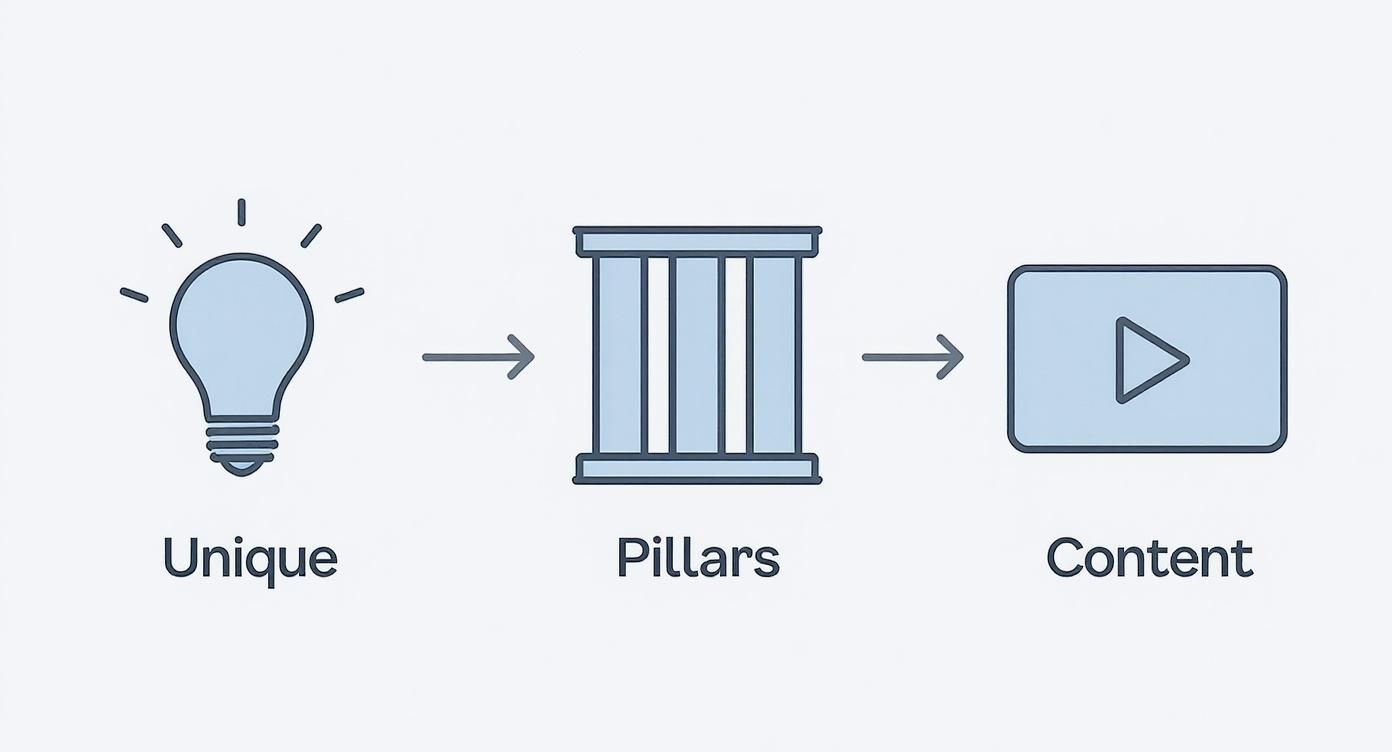
It’s a simple visual, but it perfectly illustrates how a single strong idea can spawn consistent themes. This makes it so much easier to script videos that feel connected and build that crucial brand recognition over time.
Using AI to Automate the Heavy Lifting
This is where the magic happens. This is how you truly scale. Manually creating every single asset for dozens of videos a month is completely unsustainable for most teams. Smart AI tools like ShortsNinja can automate the most soul-crushing parts of the process, freeing you up to focus on the big-picture strategy.
Instead of spending hours digging through stock footage libraries or recording voiceovers, you can turn a simple script into a finished video in minutes. A typical automated workflow looks something like this:
- Script Generation: Just feed the AI a topic or a simple idea. It can generate a full script, complete with a powerful hook and a clear CTA.
- Visual and Voiceover Creation: The tool automatically pulls relevant, high-quality visuals and pairs them with a surprisingly realistic AI voiceover in whatever language you need.
- Automated Editing: Captions, background music, and slick transitions are all added automatically. The result is a polished, professional-feeling video without you touching a single editing timeline.
This kind of automation transforms video production from a multi-hour chore into a quick, five-minute task. It’s what allows you to maintain the ruthless consistency needed to build brand awareness without ever sacrificing quality.
For a deeper dive into what makes short-form content truly click, check out these 10 best practices for short-form video content. When you combine a solid strategy with smart automation, you create a powerful engine for growth.
Amplify Your Reach With Strategic Distribution
Making a great video is a huge win, but honestly, it’s only half the battle. If your masterpiece just sits on your phone, it’s not doing you any good. Now it’s time to get that content in front of the right people with a smart, multi-platform distribution plan.
Slapping the exact same video everywhere is a classic rookie mistake. Every platform—TikTok, YouTube Shorts, and Instagram Reels—has its own vibe, algorithm, and audience. A strategic approach means tweaking your content to feel native to each channel, making sure all your hard work actually connects with people.
Tailor Your Content for Each Platform
The core message of your video can stay the same, but tiny adjustments can make a world of difference in how it performs. Blindly hitting "share to all" just ignores what makes each platform unique. It’s like telling a story to different groups of friends—you’d naturally change your tone and references for each audience.
- TikTok: This is the home of raw, trend-driven content. Jump on trending sounds and challenges. The vibe is less polished and more "in the moment," so a super-produced video can sometimes feel out of place.
- Instagram Reels: Reels viewers often lean towards more aesthetic or educational content. High-quality visuals and clear, value-packed captions tend to do really well here. It’s a great spot for tutorials, behind-the-scenes footage, and beautiful storytelling.
- YouTube Shorts: Think of Shorts as the front door to your longer-form content. It’s perfect for quick tips, highlights from bigger videos, or teasers that get people curious about your main channel. The algorithm also loves consistency and clear, concise info.
This tailored approach does more than just boost performance; it signals to both the algorithms and the users that you get the platform. You’re not just another brand dropping in content—you’re part of the community.
Optimize Your Posting and Scheduling
When you post is almost as important as what you post. To get that initial burst of engagement—which is a massive signal to the algorithms—you need to share your videos when your audience is actually online and scrolling.
Forget generic "best times to post" articles. Your audience is unique. Dive into your Instagram Insights, TikTok Analytics, and YouTube Studio to see exactly when your followers are most active. That data is gold.
Posting at peak times gives your video the best possible chance to get early traction. That initial flurry of likes, comments, and shares tells the algorithm your content is worth pushing to a wider audience, which is how you build real brand awareness.
If you're juggling multiple channels, a scheduling tool is a non-negotiable. Tools like ShortsNinja let you schedule everything in advance, so you can consistently hit those optimal time slots without being glued to your phone 24/7. This is a core part of effective content distribution strategies that helps you keep the momentum going.
Leverage Hashtags and Keywords Strategically
Hashtags aren't just for decoration; they're discovery tools that help new audiences find you. But just piling on the most popular tags won't work. You’ll be lost in a sea of millions of other videos.
A much smarter move is to use a tiered hashtag strategy:
- Broad, High-Volume Tags (1-2): These are the big ones for your industry (like
#digitalmarketing). They offer huge reach but are super competitive. - Niche-Specific Tags (3-5): Get more focused on your topic (like
#videomarketingtips). The audience is smaller but way more targeted. - Community or Branded Tags (1-2): Use tags that are unique to your brand or a community you’re in (like
#shortsninjatips).
And for YouTube Shorts, don't forget that you're on a search engine. Treat your titles and descriptions just like you would for a regular YouTube video. Weave in keywords your audience is actively searching for. This SEO approach helps your Shorts get discovered in search results long after you post them, creating a lasting source of brand discovery.
Measure What Matters and Optimize for Growth

Putting content out there is a great first step, but it's the optimization loop that really separates the stagnant channels from the ones that see explosive growth. Building brand awareness is a marathon. To win, you have to get obsessed with what’s working, what isn’t, and—most importantly—why.
This means looking past the easy, surface-level numbers. A video with a million views but zero comments or shares might have snagged a few seconds of attention, but it didn't build a connection. Real brand health shows up in the deeper metrics that prove your audience is genuinely invested.
Look Beyond the View Count
Vanity metrics feel good, but they don't tell you the whole story. To really get a handle on your impact, you need to zero in on data that reflects how your audience feels and what they do after watching. These are the numbers that tell you if your brand is actually sticking.
Here’s what you should be tracking obsessively:
- Average Watch Time: This is arguably the king of all brand awareness metrics. A high watch time signals to the algorithms that your content is valuable. More than that, it means you held someone’s attention long enough for your message to actually land.
- Shares: A share is the ultimate stamp of approval. When someone shares your video, they’re putting their own reputation on the line to vouch for your brand with their network.
- Saves: This tells you the content was so useful or inspiring that a viewer wants to return to it. It’s a huge indicator of high-value content that builds your authority in the space.
- Audience Sentiment: Get in there and read the comments. Are people asking thoughtful questions? Tagging friends? This qualitative feedback is pure gold for understanding how your content is truly being received.
A huge piece of this is knowing how to measure social media engagement the right way. It’s not just about counting likes; it's about interpreting what the numbers mean for your brand's perception and growth.
Spot Trends and Double Down on Wins
Your analytics dashboard is a treasure trove of direct feedback from your audience. Don't just give it a weekly glance; dig in and hunt for patterns. Look for the outliers—both the videos that bombed and the ones that took off like a rocket.
Did a certain hook style lead to a 20% higher watch time? Did a video using a specific format get triple the usual shares? These aren't just random occurrences. They are clear signals telling you exactly what your audience wants more of.
Once you find a winning formula, don't be shy about doubling down. This doesn't mean just reposting the same video. It means creating a whole series around that theme or applying that successful hook to a different content pillar. This is how you build a data-driven feedback loop that fuels nonstop growth.
"A healthy brand is one that customers recognize, have positive associations with, prefer over competitors, and purchase and use differentially in ways that are beneficial to the firm.”
This is what optimization is all about. Every insight you pull from your analytics should be a step toward creating content that builds those positive associations and turns casual viewers into loyal fans.
Use Simple A/B Testing to Refine Your Approach
You don't need fancy software to run effective experiments. A/B testing can be as simple as posting two similar videos with one key difference to see which one performs better. This methodical approach takes the guesswork out of the equation and lets you fine-tune every part of your content.
Here are a few simple tests you can start running today:
- Test Your Hooks: Post the same video twice, but completely change the first three seconds. Try a question in one and a controversial statement in the other. See which one grabs and holds attention longer.
- Vary Your Formats: Present the exact same information in two different styles. Maybe one is a talking-head video and the other uses slick animated text over stock footage.
- Experiment with CTAs: End one video with a question to spark comments and another with a prompt to "save this for later." Decide which action is more valuable to you and see which call-to-action drives it.
The power of a recognizable brand is undeniable: 50% of consumers are more likely to buy from brands they already know. And with 64% of consumers making a purchase after watching a branded video on social media, your content is a direct path to revenue. Ultimately, recognition builds trust—a top priority for 90% of U.S. consumers—creating a powerful cycle where awareness fuels loyalty.
Common Questions About Building Brand Awareness
Diving into short-form video to build brand awareness can feel like you're learning a new language. You’ve got a strategy mapped out, but questions are bound to pop up. Let's tackle some of the most common ones we hear from brands getting started.
Think of this as your field guide for sidestepping common mistakes. We'll give you clear, no-fluff answers to keep your video strategy pointed toward real growth and recognition.
How Long Does It Take to See Results?
This is the big one, and the honest-to-goodness answer is: it’s a marathon, not a sprint. While a single video can go viral overnight, building sustainable brand awareness is all about consistency. You're earning your audience's attention, one video at a time.
You should start seeing early signs of life within the first one to two months. Keep an eye out for these indicators:
- A steady climb in follower count.
- Better engagement (more comments, shares, and saves).
- A noticeable bump in direct traffic to your website.
But getting to a place of true market presence—where people think of you first—usually takes six to twelve months of consistent, quality video output. If you're looking for more on the bigger picture, there are some great comprehensive strategies for building brand awareness that can fill in the gaps.
What Are the Biggest Mistakes to Avoid?
Knowing what not to do is just as important as knowing what to do. So many brands stumble over the same hurdles when they first get into video. Just avoiding these will put you way ahead of the pack.
Here are the most common pitfalls we see:
- Being Too Salesy: People are on social media to be entertained or informed, not to watch a commercial. Focus on helping or entertaining first, and the sales will follow.
- Posting Randomly: The algorithms on TikTok, Reels, and Shorts thrive on consistency. If you only post when you feel like it, you’ll kill your momentum.
- Ignoring Platform Culture: What kills on TikTok might feel totally out of place on Reels. You have to tailor your content to fit the unique vibe of each platform.
- Neglecting Your Community: Not replying to comments is a massive missed opportunity. It’s your chance to build real relationships and show you're listening.
- Using Bad Audio: Viewers will forgive so-so video quality, but they will almost never forgive bad audio. Clear, crisp sound is absolutely non-negotiable.
How Do I Measure the ROI of Brand Awareness?
Connecting brand awareness efforts directly to sales can feel a bit fuzzy, but it's far from impossible. The trick is to stop trying to link every dollar of revenue to a single video. Instead, focus on tracking the leading indicators that show your brand's influence is growing.
Direct ROI for brand awareness is measured in influence, not just immediate transactions. Track the growth in branded search, share of voice, and direct traffic. These metrics show your brand is becoming a recognized authority, which is the foundation for future sales.
Over time, you'll be able to connect the dots between these brand presence metrics and your overall revenue. A rising tide of brand awareness lifts all boats—it leads to more organic traffic, easier sales conversations, and a much more loyal customer base.
Ready to stop scripting and start scaling? ShortsNinja uses AI to turn your ideas into a month's worth of high-quality, engaging videos in minutes. Automate your production and schedule your content, so you can focus on what matters most—growing your brand.