
You've probably noticed them scrolling through your feed: videos with a smooth, clear narration that feels almost too perfect. Those are AI TikTok voices, and they're the secret sauce behind the explosion of viral faceless content on TikTok, Reels, and Shorts.
What Are AI TikTok Voices and Why Are They So Popular
Think of an AI voice as your on-demand narrator—always ready, always flawless. They're the engine driving the massive trend of "faceless" channels, where creators rack up millions of views without ever showing their face. It’s a game-changer because it completely lowers the barrier to entry.
Let's be real: not everyone is comfortable on camera or has a quiet, studio-like space to record perfect audio. AI voices completely sidestep that problem, giving you a clean, professional voiceover for any video you can dream up.
The Rise of the Digital Storyteller
The real magic of these voices is their adaptability. An AI voice can be your digital storyteller, morphing into whatever persona you need to connect with your audience. Need a wise expert for a history lesson? A high-energy host for a funny clip? Or a soothing narrator for a calming story? There’s an AI voice for that.
This flexibility lets you build a consistent and scalable brand across hundreds of videos. The voice becomes a signature part of your channel, making your content instantly recognizable and building trust with your viewers over time.
At its heart, using an AI voice is about separating the creator from the creation. It allows your ideas, stories, and information to take center stage, delivered by a flawless narrator that never gets tired, makes mistakes, or has an off day.
Why This Matters for Content Creation
The impact on how content gets made is huge. AI voices have completely changed the game on the incredibly popular TikTok platform. What used to demand expensive mics, audio software, and hours of takes can now be done in just a few minutes. That efficiency is a massive advantage for anyone trying to grow an audience.
This new workflow frees you up to focus on what actually moves the needle:
- Scriptwriting: Nailing those compelling hooks and stories.
- Visuals: Finding or creating killer background footage.
- Strategy: Digging into the analytics and planning your next move.
By handing off the narration to an AI, you can pump out more content, test different ideas, and scale your channel way faster than you could before. This ability to generate quality voiceovers on the fly is a core reason so many faceless channels strike gold. For a deeper dive, check out our guide on how AI voiceovers boost TikTok engagement. Now, let's look at the tech that makes all of this possible.
How AI Voice Generation Actually Works
Ever wonder how those hyper-realistic AI voices on TikTok sound so human? It’s a fascinating process, much more like training a skilled actor than programming a clunky machine. At its core, the tech is a highly advanced form of Text-to-Speech (TTS), but it's a world away from the robotic GPS voices we all remember.
Think about it like this: a human actor learns their craft by watching thousands of hours of film, listening to different characters, and practicing countless lines. They don't just memorize words; they absorb the emotion, the rhythm, and the subtle pauses that make a performance feel real.
Modern AI TikTok voices are trained in almost the same way. These AI models are fed gigantic datasets of human speech—we're talking audiobooks, podcasts, and professional recordings containing millions of sentences spoken by actual people.
From Words to Waveforms
The AI isn’t just playing back recordings. It’s learning the fundamental patterns of human language. It analyzes how pitch rises when someone's excited, how pace slows for dramatic effect, and how a subtle shift in tone can signal sarcasm or sincerity. This all happens inside complex neural networks that can deconstruct speech into its smallest sound units (phonemes) and then rebuild them in entirely new ways.
This is what allows an AI to generate brand-new sentences it has never heard before, all while staying in character with a consistent, natural-sounding voice. It’s the difference between a puppet repeating lines and an actor delivering a nuanced performance.
If you want to go a bit deeper, understanding how AI video translator technology works offers a great parallel. Both technologies rely on similar, sophisticated principles of pattern recognition and synthesis to create their results.
The Role of Voice Providers
This is where platforms like ElevenLabs come in. They’ve absolutely perfected this training process, creating a whole library of distinct voice "actors" that creators can tap into instantly.
As you can see, the interface is incredibly simple. You just type in your text, pick a voice you like, and hit "generate." That accessibility is what has lit the fuse for the explosion of AI voices across social media.
And this tech leap is fueling some serious market growth. The AI voice generator space was valued at $3.58 billion and is on track to hit a staggering $36.43 billion by 2032, driven almost entirely by the demand for great voiceovers. You can dig into more stats about the future of voice AI from Speechmatics.
The goal of modern AI voice generation isn't just to read words aloud. It's to interpret the intent behind the words, delivering a performance that can inform, entertain, and emotionally connect with an audience, just like a human narrator would.
This ability to convey real emotion is what makes today’s AI voices so powerful for storytelling on platforms like TikTok. A creator can tweak the delivery to perfectly match the mood of their video, whether it's a tense, dramatic story or a goofy, lighthearted clip.
The whole process breaks down into a few key stages:
- Text Analysis: First, the AI reads the script to understand grammar, punctuation, and context. It spots questions, exclamations, and natural pauses.
- Acoustic Modeling: Next, it predicts the right acoustic features for that text. This involves mapping words to phonemes and figuring out the correct prosody—the rhythm, stress, and intonation of speech.
- Vocoding: Finally, a vocoder synthesizes all those acoustic features into an audible waveform, creating the audio file you actually hear.
Through these steps, a simple line of text gets transformed into a rich, human-like vocal performance, ready to grab your audience's attention.
Choosing the Best AI Voice for Your TikTok Content

Picking the right AI voice is a lot like casting the main character for your entire channel. This one decision shapes the personality of your content and can honestly make or break your connection with viewers. It’s not just about finding a voice that sounds clear; it’s about landing on one that clicks with your brand, your niche, and what your audience expects to hear.
Think of it this way: a deep, authoritative voice that's perfect for a history channel would feel completely bizarre on a lighthearted meme account. The voice is the first handshake you have with your audience. It sets the tone before they even finish reading the captions.
Aligning Voice with Your Niche
Let your content's subject matter be your north star. The voice has to feel authentic to the information you’re sharing. A mismatch between the voice and the topic is jarring, and it's a surefire way to get someone to scroll right past your video.
Consider these popular TikTok niches and the voice profiles that tend to work best:
- Educational Content: You'll want voices that sound clear, articulate, and trustworthy. A steady pace and a confident, knowledgeable tone are key to building credibility.
- Storytelling and Mysteries: Look for voices with a natural narrative quality. They need to be able to build suspense or convey emotion through subtle shifts in tone and pacing.
- Comedy and Entertainment: This is where you can use a more expressive, high-energy voice. You need a voice that can deliver a punchline with the right timing and charisma.
- Motivational and Self-Help: Go for a voice that sounds calm, reassuring, and inspirational. A smooth, even delivery helps build trust and puts listeners at ease.
When the voice fits the content, the whole experience feels seamless and professional. That's what keeps people watching.
The best AI TikTok voices don’t just read a script; they perform it. They should enhance the story you’re telling, not just narrate it. Your goal is to find a digital persona that your audience will want to listen to again and again.
Key Factors for Voice Selection
Beyond just matching your niche, a few technical and stylistic details will tell you if an AI voice is the right fit. Before you commit to one for your channel, run it through this quick checklist.
Here are the critical factors to consider:
- Clarity and Articulation: Can you understand every single word, even when the video is playing on a tiny phone speaker? The voice needs to be crisp and free of any robotic slurring or digital fuzz.
- Pacing and Rhythm: Does the voice have a natural flow? You want to avoid voices that are either completely flat or have weird, unnatural pauses that scream "I'm a robot!" The best AI voices mimic real human speech patterns.
- Emotional Range: Can the voice handle different moods? Test it with scripts that need a little excitement, seriousness, or curiosity to see if it can adapt its tone in a believable way.
- Uniqueness: Does this voice sound like everyone else's? With so many creators using AI TikTok voices, finding one that isn't overused can give your channel a distinct and more memorable identity.
If you're just starting to look around, our guide on the top 5 AI voice generators to elevate your content is a great place to find some high-quality options.
Comparing Top AI Voice Providers
Different platforms bring different strengths to the table. Some are all about hyper-realistic voices, while others offer massive libraries or deep customization tools. Your best choice really depends on what you need to create and what your budget looks like.
To give you a head start, here’s a quick comparison of some of the leading providers that TikTok creators are using right now.
Top AI Voice Providers for TikTok Creators
This table breaks down some of the leading AI voice platforms, highlighting their core features, the variety of voices they offer, and what they're best used for on social media.
| Provider | Key Features | Best For | Integration with ShortsNinja |
|---|---|---|---|
| ElevenLabs | Industry-leading realism, voice cloning, and emotional range. | Storytelling, educational content, and high-end narration. | Yes, fully integrated for seamless voiceovers. |
| Speechify | Huge library of stock voices, including celebrity options. | Quick content creation, audiobooks, and accessibility. | Yes, available for diverse voice options. |
| OpenAI | High-quality, natural-sounding voices built on their powerful models. | General-purpose content, tutorials, and informational clips. | Yes, integrated as a core voice provider. |
Ultimately, the best way to choose is to just try them out. Generate a few short clips with your top two or three candidates and give them a listen. Ask yourself: does this voice represent my brand? Would I stop scrolling to listen to this? Picking the right voice is a foundational step in building a successful faceless channel that grabs attention and holds it.
Creating Faceless Videos with AI Voices Step by Step
Alright, you’ve picked out the perfect AI voice. Now for the fun part: actually making the video. This is where your idea goes from a script to a polished, ready-to-post TikTok. The whole process is way faster than traditional video creation, which means you can finally build a consistent content machine without ever having to show your face.
Let's break down the entire workflow, from scribbling down an idea to having a finished video in your hands. This is the exact process you can repeat over and over to create professional-looking faceless content.
Step 1: Finalize Your Script
Before you touch any software, get your script locked down. A solid script is the blueprint for your entire video—it dictates the narration, the pacing, and every visual that appears on screen. Don't overthink it; for TikTok, short and punchy almost always wins.
Your main goal is to nail the first three seconds with a killer hook that stops the scroll. From there, just lay out your main points and wrap up with a clear call to action or a satisfying ending. Pro tip: Pay attention to punctuation. AI voice generators are smart enough to use commas, periods, and question marks to add natural pauses and inflection, making the narration sound much more human.
Step 2: Generate the AI Voiceover
With your script ready to go, it’s time to create the audio. This part is surprisingly simple, especially with a tool like ShortsNinja that has high-quality voice providers built right in.
- Paste Your Script: Just copy your text and drop it into the editor.
- Pick Your Voice: Select the AI voice you chose earlier. This is how you start building a recognizable sound for your channel.
- Generate and Check: Hit the generate button. In a few moments, you’ll have an MP3 of your voiceover. Give it a listen. Does the pacing feel right? Does the tone match your vibe? If something feels a bit off, try tweaking the punctuation in your script—adding a comma here or a period there can make a huge difference in the delivery.
The real magic here is how fast and repeatable this is. What used to involve finding a quiet room, setting up a microphone, and doing multiple takes is now done with a couple of clicks. Your audio quality will be crisp and consistent every single time.
Step 3: Create Your Visuals
The voiceover is the soul of your video, but the visuals are what keep people watching. For faceless videos, this means finding great stock footage, using AI-generated images, or recording your screen. Whatever you choose, it has to match your script.
The name of the game is visual pacing. You need to sync what's on screen with what's being said. If your narrator is talking about ancient Rome, you better not be showing clips of modern New York City. This connection between audio and visuals is what separates amateur content from the professional stuff. A good trick is to break your script into small sentences or phrases and find one perfect clip for each part.
If you want to go deeper on creating compelling visuals, check out our complete guide on how to create faceless videos.
Step 4: Assemble and Edit the Video
This is the final stretch where everything comes together. You'll combine your voiceover and visuals into one cohesive video. Modern editors, especially those integrated into platforms like ShortsNinja, make this part a breeze.
- Import Your Assets: Upload your AI voiceover file and all the visual clips you sourced.
- Sync Audio and Video: Drag the voiceover onto the audio timeline. Then, start arranging your video clips above it so they line up with the narration. Trim the clips so they change right as the topic shifts in the voiceover.
- Add Finishing Touches: Now’s the time to add some low-volume background music to fill the space, pop on some text or captions, and add simple transitions between clips. Captions are non-negotiable—a huge number of people watch TikToks with the sound off.
Once you’re happy with how it looks and sounds, export the video in a 9:16 aspect ratio for TikTok. By following these steps, you’re not just making one video; you’re creating a repeatable production line for high-quality content. This is the secret sauce behind every successful faceless account.
Optimizing Your AI Voiced Content for Maximum Reach
Making a great faceless video is only half the job. You still need to get people to actually watch it. Forget about secret hacks—optimizing your content for TikTok's algorithm comes down to one thing: viewer retention.
A well-produced AI voiceover is one of the best tools you have for hooking your audience from the very first second and keeping them there until the end.
Crafting an Irresistible Opening Hook
Your strategy starts with your script. The first three seconds are everything. You need an opening line so good it stops someone mid-scroll. This is where a sharp AI TikTok voice gives you an immediate advantage, delivering your hook with the perfect tone and clarity to grab attention.
Think of your hook as your video's headline. It needs to be punchy, intriguing, and promise something valuable.
Here are a few formulas that work like a charm with AI narration:
- The "You" Hook: "You've been making your coffee wrong this whole time." It's direct, personal, and makes people curious.
- The "Secret" Hook: "Here's the one history fact they never taught you in school." This promises insider info, making viewers stick around for the big reveal.
- The "Problem/Solution" Hook: "If you always feel tired in the afternoon, you need to hear this." It taps into a common pain point and offers a fix.
When you pair a tight script with a clear, energetic AI voice, you signal to the algorithm that your content is worth showing to more people. This simple flow—script, visuals, and voice—is the bedrock of every successful faceless video.
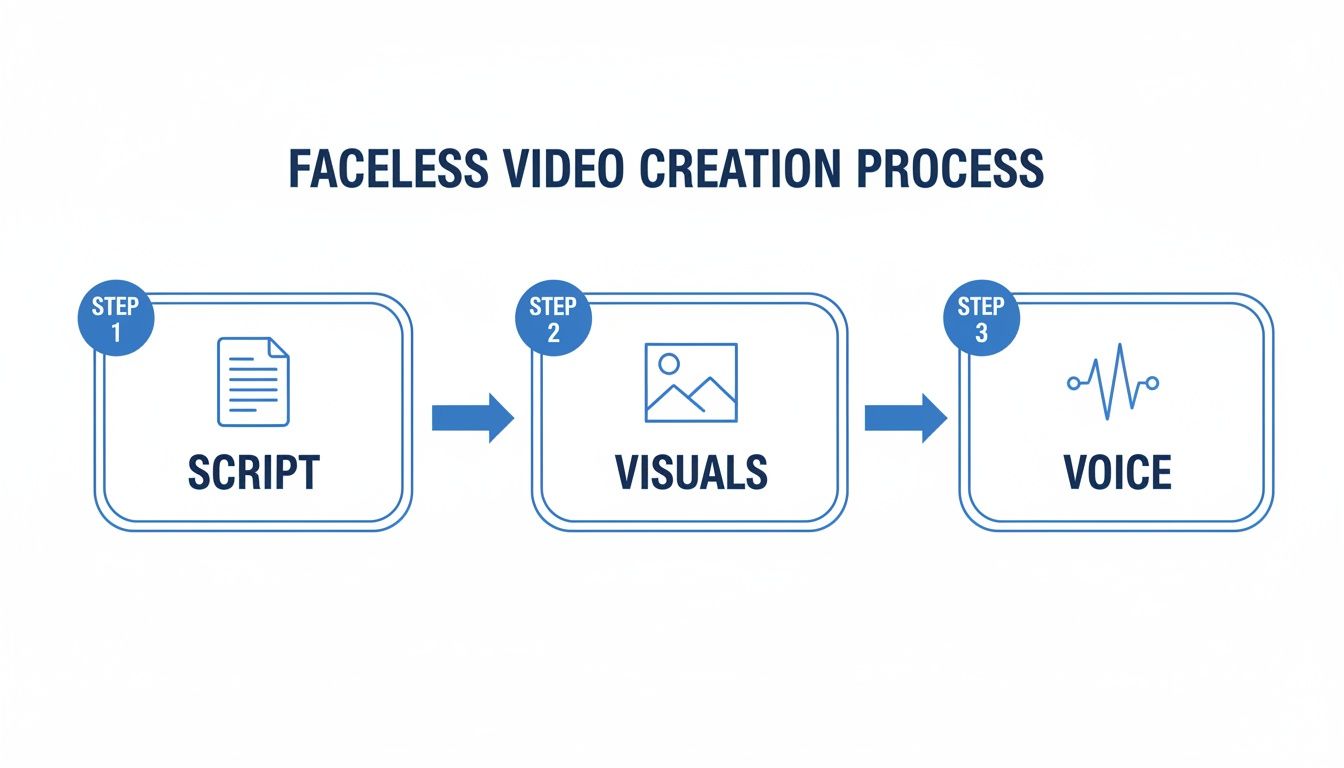
As the chart shows, a killer script is the starting point. From there, you layer on synchronized visuals and a compelling voiceover to create a polished final product.
Synchronizing Audio and Visuals for Retention
Okay, you've hooked them. Now you have to keep them. The best way to do that is by making sure your audio and visuals are perfectly in sync.
The tone of your AI voiceover has to match the vibe of your clips and music. If the voice is building suspense, the visuals need to feel mysterious and the music should be tense. It all has to work together.
This synchronization is a game-changer for viewer retention. In fact, research shows that TikTok videos using AI-powered voiceovers saw a 23% higher completion rate compared to those without. That's a jump from the platform's 58.3% average to around 71.7%. The effect is even stronger in niches like educational content (67.2% completion rate) and videos with flawless voice and music pairing (68.2%). You can dig into the full findings on video completion rates to see the data for yourself.
High completion rates are the single most important signal you can send to the TikTok algorithm. When a viewer watches your entire video, it tells the platform that your content is valuable, which leads to more impressions and a greater chance of going viral.
Best Practices for Captions and Hashtags
Finally, don't sleep on your captions and hashtags. They provide crucial context for both viewers and the algorithm, tying everything together.
- Engaging Captions: Keep it short and sweet. Ask a question to get comments flowing, summarize the video's main point, or drop a surprising fact that wasn't in the video.
- Strategic Hashtags: Don't just copy and paste trending hashtags. Use a mix of broad and niche-specific tags. Aim for 3-5 relevant hashtags that actually describe your content. So, instead of just
#history, try#ancientrome,#romanempire, and#historytok.
By nailing your hook, synchronizing your audio and visuals, and writing smart captions, you give your AI-voiced video the best possible shot at cutting through the noise and finding its audience.
Navigating the Legal and Ethical Rules of AI Voices
As you jump into using AI TikTok voices, it’s smart to know the rules of the road. This tech is incredibly powerful, but using it the right way means respecting a few legal and ethical lines. This isn't about navigating a complex legal minefield—think of it more like a simple set of guidelines for playing fair.
The whole issue really boils down to one thing: are you using a licensed, off-the-shelf AI voice, or are you cloning a real person's voice? The first option is generally safe. It’s the second one where you need to be careful.
Understanding Copyright and Consent
When you use a voice from a platform like ElevenLabs or OpenAI, you're in the clear. These companies create their voices ethically, securing the rights to the voice data they use for training. Your subscription is basically a license to use those voices in your content. For most creators, this is the safest and easiest path.
Voice cloning, on the other hand, is a whole different ballgame. A person’s voice is part of their identity. In many places, it’s protected by something called the “right of publicity.” This legal idea prevents people from using someone's name, likeness, or other recognizable traits—including their voice—for commercial purposes without permission.
The golden rule is simple: You must get explicit, informed consent before you clone or replicate a private individual’s voice. If you don't have their permission, you’re not just being unethical; you're opening yourself up to serious legal trouble.
Best Practices for Ethical AI Voice Use
Staying on the right side of these rules is pretty straightforward if you just stick to a few best practices. Follow these, and you can innovate with confidence while building trust with your audience.
Here’s what to keep in your back pocket:
- Prioritize Licensed Voices: Your best bet is to stick with the pre-made voice libraries from reputable AI providers. They’ve already done the legal homework for you.
- Always Get Permission for Cloning: If you absolutely need a custom voice clone (like your own or a collaborator's), get written consent. Make sure it clearly outlines how and where the voice will be used.
- Be Transparent with Your Audience: TikTok’s own terms require you to label AI-generated content. A simple
#AIvoicein your caption is usually all it takes to keep things transparent and build trust. - Never Impersonate: Don’t use AI to impersonate anyone, especially public figures or celebrities. It’s a fast track to legal issues and can seriously mislead your followers.
By sticking to these principles, you can use AI voices to make incredible content without worrying about crossing any legal or ethical lines.
Frequently Asked Questions About AI TikTok Voices
Even with a clear plan, it's natural to have a few questions before you jump into using AI TikTok voices. Let's tackle the big ones head-on so you can get started with confidence.
Does TikTok Penalize AI Voices?
This is probably the biggest myth out there. The short answer? No. TikTok’s algorithm doesn't ding your video just for using an AI voice.
What the algorithm really looks for is viewer engagement. Things like watch time, completion rate, likes, and comments are what truly matter. A crisp, clear AI voice can actually help with that. It delivers your script flawlessly, making your content more engaging and easier to digest, which keeps people watching longer. As long as your content is solid, an AI voice is an asset, not a problem.
Is It Legal to Use AI Celebrity Voices?
This one is a hard no. Using AI to clone the voice of a celebrity or any public figure without their direct permission is a legal and ethical disaster waiting to happen. A person’s voice is protected by what's known as "right of publicity" laws, which block people from using their identity for commercial purposes without consent.
Bottom line: Don't even think about using AI-generated celebrity voices. It can lead to serious legal trouble, from lawsuits to getting your channel shut down. Always stick to the commercially licensed voices you find on reputable platforms.
Those providers have done the legal legwork for you, so you can use their voice libraries without looking over your shoulder.
What Is the Best AI Voice Generator for TikTok?
There’s no single "best" tool for everyone—it really boils down to what you need for your specific content. Different platforms are built for different things.
Your best bet depends on what you value most:
- For pure realism: If you need a voice that’s basically indistinguishable from a human, look for a tool known for its hyper-realistic, emotional delivery.
- For a custom voice clone: If you're looking to create a unique voice clone of yourself (or someone else, with permission!), you’ll need a platform that specializes in high-quality cloning.
- For endless variety: If you want a massive library of accents, languages, and character styles to play with, go for a generator with a huge pre-made catalog.
The best way to decide is to try a few out. Run one of your own scripts through a couple of the top options. Hearing how they handle your niche and tone will quickly tell you which one is the perfect fit for your channel.
Ready to create compelling faceless content in minutes? ShortsNinja integrates top-tier AI voice generators directly into a simple, three-step workflow. Generate scripts, visuals, and voiceovers effortlessly to grow your channel on autopilot. Try it now and see how easy high-quality video creation can be. Get started at https://shortsninja.com.