
Ask any creator what the perfect YouTube video length is, and you’ll get a hundred different answers. That’s because the “ideal” length is a myth. The right duration is whatever time it takes to tell your story well, without wasting a single second.
While many creators aim for that 7-15 minute sweet spot to balance viewer engagement with monetization opportunities, the real magic happens when you stop chasing a number and start focusing on your content.
Debunking the Myth of One Perfect Video Length
New creators often hunt for a magic number that guarantees success, but the truth is, no single timestamp will make or break your channel. Instead of fixating on the clock, the best YouTubers match their video’s length to its purpose and what their audience expects to see.
Think of it like a conversation. Sometimes a quick, punchy statement is all you need to get your point across. Other times, a topic demands a much deeper, more detailed discussion. Your video length should follow that same logic, giving you just enough runway to deliver value without padding it with filler that sends your audience retention plummeting.
Understanding the Data Behind the Sweet Spot
So if there's no magic number, where did that popular 7-15 minute recommendation even come from? It’s a data-driven average that strikes a delicate balance between viewer habits and how the platform actually works.
Industry-wide analyses often put the average YouTube video length around 11.7 minutes. This figure isn't a rule; it's just a reflection of the huge mix of short clips, mid-length tutorials, and long-form documentaries on the site. If you're curious about the viewing habits that led to this, digging into YouTube user statistics can offer some great insights into why this range has become a practical target.
This "sweet spot" also happens to line up with a few key factors:
- Monetization Thresholds: Videos that are over eight minutes long are eligible for mid-roll ads, which gives creators a clear financial reason to make their content a bit longer.
- Viewer Commitment: A ten-minute video feels like a pretty manageable commitment for someone who's just exploring a new topic or channel.
- Algorithm Signals: Longer videos that manage to keep people watching generate a ton of watch time—one of the most powerful signals you can send the YouTube algorithm to say, "Hey, this content is good!"
The most effective way to think about this is to reframe the question. Stop asking, "How long should my video be?" and start asking, "How long does this specific story need to be told well?" This simple shift puts the focus back on quality and viewer satisfaction, which is where it belongs.
Quick Guide to YouTube Video Lengths by Goal
While a universal length is a myth, different formats on YouTube are built for different purposes, and their typical lengths reflect that. This table gives you a solid starting point for thinking about your own content strategy.
| Video Format | Recommended Length Range | Primary Goal |
|---|---|---|
| YouTube Shorts | 15–50 seconds | Discovery, quick engagement, audience growth |
| Standard Uploads | 7–15 minutes | Education, building authority, monetization |
| Long-Form Content | 20+ minutes | Deep dives, fostering community, expert positioning |
Ultimately, this all boils down to a simple mantra: your video should be as long as it needs to be, and not a second longer.
When you focus on delivering a tight, value-packed experience, you’re not just respecting your viewer's time—you're encouraging them to watch until the very end. And that is the strongest signal you can possibly send to the YouTube algorithm.
How Video Length Speaks to the YouTube Algorithm
To really nail down the perfect video length, you have to get inside the YouTube algorithm's head. Its number one goal is simple: viewer satisfaction. The algorithm is always on the hunt for videos that keep people watching, and watching, and watching. Video length is a huge piece of this puzzle, but it's not the whole story.
Think of your video like a meal. A 30-second Short is a quick, tasty snack—easy to consume, instantly satisfying. A 15-minute deep dive, on the other hand, is a full-course dinner. If your viewers stick around for the entire meal, it sends a massive signal to YouTube that you’ve served up something genuinely valuable. This is where watch time enters the chat.
Watch time is the total minutes and hours people have spent watching your video. It’s a way more powerful metric than just looking at view counts because it measures real engagement, not just a passing click. Naturally, a longer video has the potential to rack up more watch time from a single viewer, which the algorithm often interprets as a sign of quality.
The Power of Watch Time and Retention
But here's the catch: the algorithm doesn't reward length just for the sake of it. A boring 20-minute video that people click away from after two minutes is actually a negative signal. The metric that truly matters is audience retention—the percentage of your video people actually stick around to watch.
It’s like telling a story. If everyone is hanging on your every word until the very end, you know you’ve crushed it. But if people start pulling out their phones and wandering off halfway through, the length of your story suddenly becomes your biggest weakness.
The YouTube algorithm loves videos that hold attention. A 12-minute video with a 60% audience retention rate (averaging 7.2 minutes of watch time per viewer) is way more valuable than a 25-minute video with a 20% retention rate (averaging only 5 minutes per viewer).
This is why your goal isn't just to make longer videos. It's to create content so good that your audience wants to see it through to the end. That’s the secret to making video length work for you, not against you.
The Eight-Minute Mark and Monetization Signals
There’s another big, flashing sign that influences video length: money. YouTube lets creators place mid-roll ads—ads in the middle of a video—on anything that’s longer than eight minutes. This is a huge deal because it unlocks more ways to earn money beyond the standard ads at the beginning and end.
This creates a pretty clear incentive for creators to push their content past that eight-minute mark. While not every video needs to be that long, knowing about this financial trigger helps explain why so many successful channels live in that 8–15 minute sweet spot. It’s a strategic move that balances keeping viewers engaged with maximizing revenue.
Here’s a quick breakdown of how length shakes out:
- Under 8 Minutes: You can run pre-roll and post-roll ads. Success here is all about high retention and getting lots of shares.
- Over 8 Minutes: You become eligible for mid-roll ads, which means more revenue potential. These videos also rack up watch time much faster, sending stronger positive signals to the algorithm if people are actually watching.
At the end of the day, the algorithm rewards what works. Making a longer video is like placing a bigger bet. If it pays off with high retention, the rewards are much greater. But if the content can’t hold people’s interest, the risk of it flopping is also higher.
Of course, optimizing length is just one part of the strategy. When you upload can also make a huge difference in how the algorithm pushes your content. You can learn more about optimal upload times for YouTube videos to give your strategy another edge.
Mastering the First 60 Seconds to Earn Viewer Trust
You can script the most brilliant video in the world, but it means absolutely nothing if viewers bail before you get to the good stuff. Think of the first minute of your YouTube video less as an introduction and more as a high-stakes audition for your viewer’s attention. Nail this, and you earn the right to create longer, more detailed content.
This initial drop-off is one of the harshest realities every creator faces. If you look at your retention data, you'll almost certainly see a steep nosedive right at the beginning of your videos. That’s the modern attention span in action—viewers make snap judgments, and if you don’t immediately convince them to stick around, they're gone.
A recent study on retention benchmarks found the average viewer retention across all YouTube videos is a sobering 23.7%. Even more telling, roughly 55% of viewers are lost by the 60-second mark. That’s how fast attention vanishes when a hook is weak.
But here’s the good news: the same study found that videos that clearly presented their value within the first 15 seconds saw 18% higher retention at the one-minute mark. You can dive deeper into these numbers and check out the full 2025 retention benchmark report for more insights.
Crafting an Irresistible Hook
So, how do you beat that dreaded drop-off curve? You make a powerful, immediate promise to your viewer and start delivering on it from the very first second. Your intro isn't a slow warm-up; it should feel like the most exciting part of a movie trailer. Generic openings like, "Hey guys, in this video we're going to talk about…" are absolute retention killers.
Instead, you need to grab them with a hook so compelling they can't help but stick around.
Your video’s opening isn't just a greeting; it’s a contract with the viewer. By delivering immediate value, you earn their trust and the permission to create a longer, more impactful video. A strong start transforms your retention curve.
Here are a few proven techniques for a powerful opening:
- The Cold Open: Jump straight to the most dramatic moment or the final result. A cooking channel could flash the finished, delicious meal on screen before ever showing you the ingredients.
- The Provocative Question: Pose a question that taps into a common pain point or challenges an assumption. For a tech review, it might be, "Is this new gadget truly worth your money, or is it just clever marketing?"
- The Bold Statement: Start with a surprising or counterintuitive claim that makes people want to see if you can back it up. For example, "You've been learning this skill all wrong, and I'm about to show you why."
The Link Between a Strong Intro and Video Length
Mastering your intro has a direct impact on the ideal YouTube video length for your channel. When you consistently prove to your audience that you respect their time, they become much more willing to invest more of it in your content. A killer hook builds trust and creates momentum that carries viewers deeper into your video.
This chart shows exactly how video length, audience retention, and total watch time all connect—and why they’re such critical signals for the YouTube algorithm.
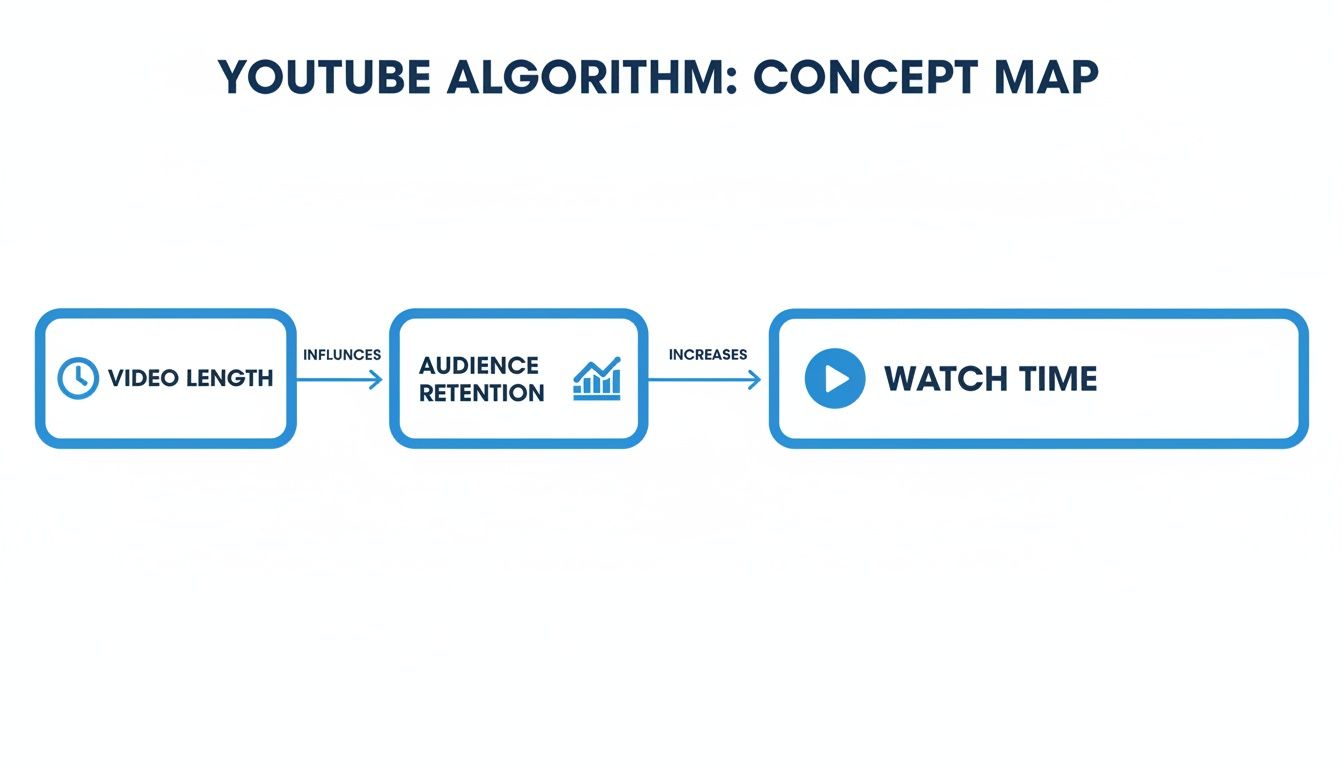
The takeaway is clear: a successful video length isn't just about the number on the clock. It's about maintaining high audience retention throughout that runtime to rack up as much watch time as possible.
Ultimately, a captivating first minute buys you the freedom to explore topics in far greater detail. If you can reliably hook viewers, you can confidently create 10, 15, or even 20-minute videos, knowing your audience is buckled in for the ride. But if you neglect the hook, even a five-minute video will feel way too long.
A Practical Breakdown of Video Length by Format

This is where the rubber meets the road. Knowing the theory behind retention and the algorithm is great, but successful channels are built by putting that knowledge into practice. Now, let’s apply those principles to the different video formats YouTube offers.
Each format has its own job to do, and your audience shows up with a different set of expectations for each one. Think of it like a toolbox—you wouldn't grab a sledgehammer to hang a picture frame. The same logic applies here. You don’t use a 45-second Short to unpack a complex topic, and you don’t stretch a simple tip into a 15-minute video.
Matching your idea to the right format is the first step in making sure it lands with maximum impact.
YouTube Shorts: The Sub-60 Second Discovery Engine
YouTube Shorts are your channel's secret weapon for discovery. These vertical, snackable videos are designed for rapid-fire consumption and are your best bet for introducing your content to a massive, new audience that might have never stumbled upon your longer videos.
The sweet spot for a YouTube Short is generally between 15 and 50 seconds. That’s just enough time to deliver a punchy, valuable nugget of information but short enough to keep people rewatching it. Those loops are a powerful signal to the Shorts algorithm that you’ve created something compelling.
Shorts are perfect for:
- Quick Hacks or Tips: A 45-second clip showing off a single, game-changing keyboard shortcut.
- Highlight Reels: A 30-second montage of the absolute best moments from a longer video.
- Behind-the-Scenes Glimpses: A 20-second look at your setup or a funny outtake.
The goal here is to tell a complete, satisfying micro-story in under a minute. Don’t fall into the trap of using cliffhangers to bait people over to your main channel. Instead, make the Short so good on its own that viewers want to see what else you’ve got.
Standard Uploads: The 7-15 Minute Sweet Spot
For most creators, this is your bread and butter. Standard, horizontal videos are where you build authority, dive deep with your audience, and generate the bulk of your watch time and revenue. There’s a reason the 7-15 minute range is so popular: it just works.
It’s long enough to explore a topic properly without asking for a huge time commitment from your viewers. More importantly, videos over eight minutes long allow you to place mid-roll ads, which can dramatically boost your monetization potential. The way you make money from different formats can get a little tricky, though. You can get the full breakdown by checking out our guide on monetization differences between Shorts and long videos.
A 12-minute video that completely solves one specific problem is the cornerstone of a healthy channel. It smashes the monetization threshold, satisfies viewer intent, and racks up serious watch time when your retention is solid.
This format is ideal for:
- In-Depth Tutorials: A 14-minute walkthrough on how to use a specific software feature.
- Product Reviews: A 10-minute deep dive into a new gadget's pros and cons.
- Educational Explainers: An 8-minute video that makes a complex scientific concept easy to understand.
Just remember, every second has to count. If you're padding a 7-minute idea just to hit that 8-minute mark for ads, your retention will tank, and you’ll end up doing more harm than good.
Long-Form Content: The 20+ Minute Deep Dive
When you need to go beyond a simple explainer and truly establish yourself as an expert, long-form content is your go-to. Videos that run for 20 minutes or longer are built to forge a deep connection with your most dedicated viewers, turning them from casual watchers into a loyal community.
These videos are a much bigger ask, so your value proposition needs to be crystal clear right from the jump. People will happily sit through a 45-minute video if they believe it’s the most comprehensive guide they can find. This is where you create your cornerstone content—the kind of stuff that becomes the definitive resource in your niche.
Long-form works brilliantly for:
- Video Podcasts and Interviews: Unscripted conversations that give topics room to breathe and evolve.
- Full Project Walkthroughs: A start-to-finish documentary showing how something is made.
- Deep-Dive Documentaries: A thorough exploration of a historical event or a complex social issue.
Making long-form work is all about your ability to hold a viewer's attention. It's a masterclass in storytelling, pacing, and visual variety. It’s never about making a long video for the sake of it; it’s about creating an immersive experience that is genuinely worth their time.
Finding Your Channel’s Sweet Spot with A/B Testing
Industry benchmarks are a great place to start, but they only tell you what works on average. The real truth about the ideal youtube video length for your channel is hiding in your audience’s behavior. To find it, you have to stop guessing and start testing.
Think of yourself as a data scientist for your channel. A/B testing is your lab, letting you run controlled experiments to see what truly connects with your viewers. It’s how you move from making assumptions to making smart, data-backed decisions that can transform your entire content strategy.
The concept is simpler than it sounds. You’ll create two videos on a similar topic but with different lengths, then compare how they perform head-to-head. This direct comparison cuts through the noise and shows you exactly how duration impacts engagement in your specific niche.
Setting Up Your A/B Test
To run a clean test, you need to isolate the variable you're testing—in this case, video length. Start by picking a topic you can deliver in both a short, punchy format and a more detailed, expanded one without compromising on quality.
For example, you could create:
- Video A (The Concise Cut): An 8-minute video that gets straight to the point, covering only the most critical information.
- Video B (The Expansive Cut): A 15-minute version of the same topic that goes deeper, adding more examples, explanations, and maybe a personal story.
It’s absolutely critical that both videos have similar thumbnails, titles, and are published around the same time. This ensures the only major difference is their length, giving you clean data to work with.
The Key Metrics to Monitor in YouTube Analytics
Once your videos are live, it’s time to jump into YouTube Analytics and see what the numbers are telling you. Don't just glance at view counts; the real story is hidden in how people engaged with each version.
Your goal isn't just to see which video got more clicks. You want to know which one held attention better and earned more trust from the viewer. Engagement data is how your audience tells you what they actually want.
Here are the three most important metrics to compare:
- Average View Duration (AVD): This is your most direct measure of engagement. Did viewers stick around longer for the short, punchy video, or did they settle in for the detailed, longer one?
- Relative Audience Retention: This graph is your best friend. Look at the retention curves side-by-side to pinpoint exactly where viewers dropped off. A high, flat curve is a sign you’ve nailed it.
- Views from Recommendations: Pay close attention to which video the algorithm decided to push more. Higher retention and watch time on one version will almost always lead to more impressions and views from YouTube's recommendation engine.
Looking at these metrics will reveal your audience’s preference. If the 8-minute video has 70% retention while the 15-minute version only hits 35%, that’s a loud and clear signal that your viewers prefer a more direct approach for that topic. But if the longer video holds a strong retention rate, it shows you have permission to go deeper.
This same data-driven mindset is crucial for other formats, too. If you’re trying to optimize your vertical video, you can learn about the top 5 metrics for YouTube Shorts growth and apply a similar testing framework.
Editing Tips to Adjust Length Without Losing Quality
Knowing your ideal video length is one thing. Actually hitting that timestamp without your quality taking a nosedive? That’s where the real skill comes in.
Whether you're trimming a video down or trying to add a bit more runtime, the golden rule is simple: every single second has to serve a purpose. Avoid the temptation to add fluff just to fill time—it's a one-way ticket to killing your audience retention. The goal is to make strategic edits that actually make the video better for the viewer.
This process often starts before you even press record. A tight, well-planned script is your best defense against a bloated, rambling video. By being ruthless with your words and cutting out redundant points in the scripting phase, you set yourself up for a lean, focused recording from the get-go.
How to Make Your Videos Shorter
When your raw footage is running long, the mission is to crank up the pace and slash anything that isn’t moving the story forward. This keeps the energy high and your audience glued to the screen.
- Use Strategic Jump Cuts: These aren't just for style. Quick jump cuts can instantly remove awkward pauses, filler words like "um" and "uh," and any moments where the energy dips. Done right, they make your video feel snappy and dynamic.
- Accelerate B-Roll Footage: Speed-ramping B-roll, like a timelapse of you setting up equipment, can condense several minutes into just a few seconds while still giving viewers all the visual context they need.
- Cut Redundant Explanations: Said it once? Trust your audience got it. Go back and remove any sentences or entire sections that just repeat information you’ve already covered.
Playing around with different video editing software options can unlock powerful tools that make these kinds of cuts feel seamless. Many modern editors are built specifically to help you nail the pacing and flow.
Key Takeaway: Shortening a video isn't about butchering your content. It's about distillation—finding the most potent, concentrated version of your message and getting rid of everything else. A shorter, tighter video almost always translates to higher audience retention.
How to Add Length That Adds Value
On the flip side, sometimes a video just feels a bit too thin to be truly helpful. The trick here is to add length by adding value, not just padding. Never, ever stretch your content just to hit that eight-minute monetization mark. Your audience will see right through it, and your retention graph will pay the price.
Instead, think about what you can add that genuinely enriches the experience for your viewer. This is your chance to deepen their understanding, build a stronger connection, and give them more of what they came for.
Here are a few ways to add meaningful length:
- Incorporate Detailed B-Roll: Show, don’t just tell. If you’re reviewing a new gadget, add some slick close-up shots of its features in action. If you’re explaining a concept, use B-roll footage to visualize what you’re talking about.
- Use On-Screen Graphics and Text: Break down complex ideas with animated text, charts, or helpful graphics. This doesn't just add a few seconds to your runtime; it boosts comprehension and keeps people visually locked in.
- Share a Relevant Personal Story: A quick, on-topic anecdote can make your content far more relatable and memorable. That little human touch can be the difference between a dry tutorial and an engaging story.
A lot of creators are now turning to AI to help with these additions. To learn more, check out our guide on AI video editing tools that can really speed up this process.
Answering Your Questions About Video Length
Alright, let's clear up some of the most common questions creators have when trying to nail down the perfect video length. Think of this as your quick-reference guide to making smarter decisions with your content strategy.
Do Longer Videos Automatically Rank Higher?
Nope, not automatically. It's a classic case of correlation not equaling causation. While a long video that keeps people glued to their screens can rack up a ton of watch time—a huge signal to YouTube—a long video that viewers click away from will actually hurt your channel.
The algorithm cares about engagement, not just how long the video is.
For example, a 15-minute video that holds viewers for eight minutes is almost always going to crush a 30-minute video that people only watch for five. Quality engagement beats raw length every time.
Should I Split a Long Topic Into a Series?
This one really depends on the topic and what your audience prefers. If you're tackling a complex subject with clear, distinct parts, breaking it into a series of 8-12 minute videos can be a brilliant move. It keeps each video focused, respects the viewer's time, and makes them want to click "next" on your playlist.
But for deep, narrative-driven content or comprehensive tutorials where context is everything, a single, definitive long-form video often works better. It positions your channel as the go-to authority on the subject because you've delivered all the value in one powerful package.
Key Takeaway: Don't split a topic just for the sake of having more videos. Split it when the content naturally divides into satisfying, standalone chapters. Each video in the series should feel complete on its own, leaving the viewer smarter than when they started.
How Does YouTube Shorts Length Affect My Channel?
YouTube Shorts have one main job: discovery. Since they have to be under 60 seconds, their purpose is to grab new eyeballs and introduce them to your brand. While the views get added to your channel's total, the watch time from Shorts currently does not count toward the 4,000 hours needed for the YouTube Partner Program.
So what's the sweet spot for a Short? Just long enough to land your punchline or deliver your core idea. The most viral Shorts are usually between 15 and 30 seconds. This length is perfect for encouraging people to watch it again (and again), which drives retention rates through the roof and signals to the Shorts algorithm that you've got something special.
Ready to streamline your short-form content creation? ShortsNinja uses AI to help you produce engaging videos for TikTok, YouTube, and Instagram in minutes. Start creating faster today at shortsninja.com.